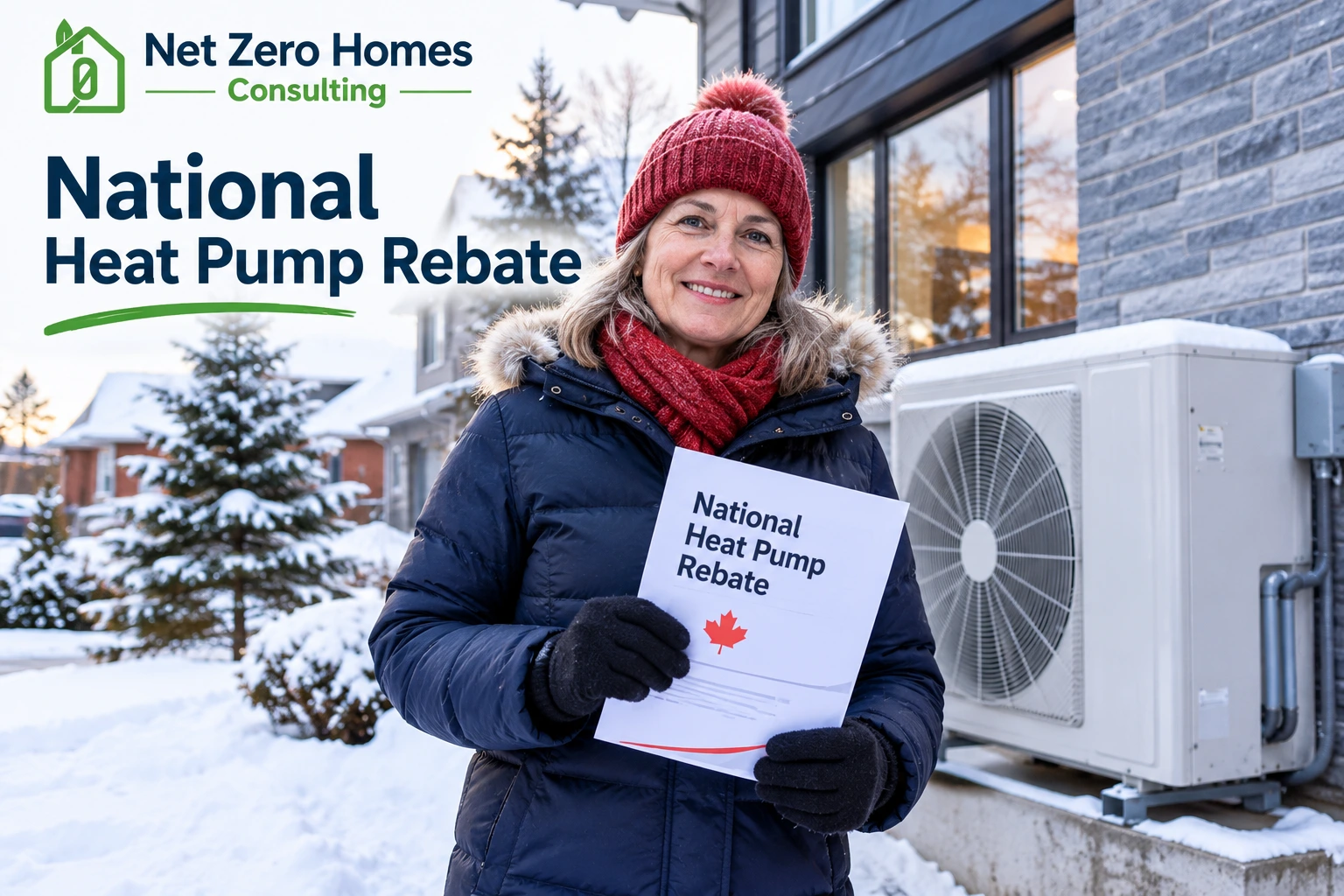
Canada’s new National Heat Pump Rebate is one of the most significant federal incentives available to homeowners looking to switch to a cold-climate heat pump. The program, part of a $2-billion investment supporting up to 820,000 households, is expected to open through an online portal in early 2027 and run until March 2034. Eligible households can receive a standard rebate of $2,000 or up to $10,000 if they meet low- to median-income thresholds, depending on installation costs.
Importantly, heat pumps installed on or after November 1, 2026 may qualify for a retroactive rebate once the portal opens, provided all eligibility rules in force on the installation date are met. No payments will be issued until the program launches and applications are approved. Program details remain subject to finalization, so always verify the latest information on official Government of Canada pages.
This guide explains how the National Heat Pump Rebate works, who qualifies for each amount, which equipment is eligible, how to verify an AHRI number, what documents to keep, and why independent home energy planning should come before any purchase decision.
What Is Canada’s New National Heat Pump Rebate?
The National Heat Pump Rebate is a federal program designed to lower the upfront cost of installing an eligible electric cold climate heat pump. It aims to help Canadian households reduce energy costs, improve comfort, and lower emissions by switching from fossil fuel or electric resistance heating systems.
Unlike some earlier programs, no pre- or post-installation energy audit is required. Approvals are targeted for rapid turnaround (within about 24 hours for eligibility confirmation in the planned process), making the program practical for both planned upgrades and emergency furnace replacements. About 80% of annual heating system replacements occur because the existing system fails unexpectedly.
The rebate supports whole home heating systems. Existing heating equipment does not need to be removed, and both planned and emergency installations can qualify. The program covers households currently heating with electricity (including electric furnaces or baseboards), natural gas, oil, propane, diesel, coal, wood or biomass, or existing heat pumps.
How Much Can You Receive?
Eligible households may qualify for:
- $2,000 if household after-tax income is above the median threshold for their province or territory and household size.
- Up to $10,000 if household after-tax income is at or below the applicable median threshold (the amount cannot exceed total eligible installation costs).
Total project costs for the higher rebate can include equipment, labour, and necessary related work such as duct modifications or electrical upgrades directly tied to the heat pump installation. Receipts must support all claimed costs.
The exact amount for the higher tier depends on income and installation costs. Funding is not guaranteed until an application is submitted and approved after the portal opens.
Who Qualifies for the $10,000 Heat Pump Rebate?
Eligibility for the higher rebate is based on after-tax household income, household size, and province or territory of residence.
How to calculate after-tax household income
Use the most recent income tax returns (referenced as 2025 returns in current guidance):
- Take line 23600 (net income).
- Subtract line 43500 (total taxes payable).
- Repeat for a spouse or common-law partner if applicable.
- Add the two results.
- Compare the total with the threshold for your province/territory and household size.
Household size includes the applicant, spouse or common law partner, and any dependents living at the primary residence address supported by household income.
Income thresholds (after-tax) include:
| Province/Territory | 1 person | 2 persons | 3 persons | 4 persons | 5+ persons |
|---|---|---|---|---|---|
| Newfoundland and Labrador | 36,434 | 76,704 | 109,064 | 136,629 | 142,622 |
| Prince Edward Island | 38,831 | 80,899 | 103,071 | 124,644 | 134,232 |
| Nova Scotia | 38,831 | 80,300 | 103,071 | 125,843 | 131,835 |
| New Brunswick | 38,352 | 78,502 | 104,270 | 127,041 | 131,835 |
| Quebec | 41,228 | 82,097 | 107,865 | 134,232 | 140,225 |
| Ontario | 46,981 | 92,884 | 119,850 | 146,217 | 158,202 |
| Manitoba | 43,146 | 85,693 | 106,667 | 125,843 | 128,240 |
| Saskatchewan | 45,543 | 92,884 | 112,659 | 134,232 | 133,034 |
| Alberta | 50,816 | 99,476 | 123,446 | 145,019 | 152,210 |
| British Columbia | 46,981 | 92,884 | 119,850 | 145,019 | 170,187 |
| Yukon | 56,090 | 115,056 | 145,019 | 170,187 | 191,760 |
| Northwest Territories | 71,431 | 135,431 | 160,599 | 186,966 | 188,165 |
| Nunavut | 82,697 | 128,240 | 128,240 | 137,828 | 146,217 |
(Values in Canadian dollars; confirm current table on Canada.ca as thresholds may be updated.)
When the portal opens, applicants seeking the higher amount will provide their Social Insurance Number for secure verification with the Canada Revenue Agency.
Basic eligibility for any rebate amount
- You own the home (does not need to be your primary residence; rental properties you own can qualify).
- You reside in Canada. Homes owned by local Indigenous governments in Indigenous communities also qualify.
- The heat pump is on the eligible product list by AHRI number as of the installation date.
- Purchased from and installed by an HVAC contractor.
- The system is capable of heating the entire home.
- No previous federal heat pump funding (e.g., Canada Greener Homes Grant or Oil to Heat Pump Affordability) at that address.
- Only one rebate per household.
Which Heat Pumps Qualify?
Eligible equipment must appear on the National Heat Pump Rebate searchable product list maintained by Natural Resources Canada. The list focuses primarily on cold-climate air-source heat pumps (ccASHP) suited to Canadian conditions, with additional pathways for certain ground-source systems.
For cold-climate air-to-air heat pumps, key performance requirements include:
- Heating Seasonal Performance Factor 2 (HSPF2), AHRI Climate Region V ≥ 6.6
- Seasonal Energy Efficiency Ratio 2 (SEER2) ≥ 15.2
- Maximum heating capacity at –15 °C (5 °F) at least 70% of rated capacity at 8.3 °C (47 °F)
- Coefficient of Performance (COP) ≥ 1.8 at –15 °C at maximum heating capacity
- Variable-capacity compressor (at least three speeds or continuously variable)
- Listed as “Live” status and available/sold in Canada.
The system must be capable of whole-home heating. Multi-split systems and certain coil-only configurations have specific listing rules. The list is updated quarterly (typically March, June, September, December). A product must be on the list as of the installation date.
What Is an AHRI Number?
The Air-Conditioning, Heating, and Refrigeration Institute (AHRI) reference number uniquely identifies a certified combination of equipment usually the outdoor unit, indoor unit (or air handler), and furnace where applicable.
A brand name or outdoor-unit model alone does not establish eligibility. The complete matched combination must appear together under the same unique AHRI number on the eligible product list. Installing mismatched components can make the system ineligible even if individual pieces appear elsewhere.
Always request the full AHRI number, outdoor model, indoor model, and any furnace or air-handler model from your contractor before purchase.
How to Check Whether Your Heat Pump Qualifies
- Ask your contractor for the complete AHRI reference number and all model numbers (outdoor, indoor, furnace/air handler if applicable).
- Visit the official searchable product list: spl-lpi.nrcan-rncan.gc.ca/en-US/product
- Enter the AHRI number.
- Confirm that the brand and exact model numbers match the combination listed.
- Verify the product was on the list as of your planned installation date.
- Confirm the system is sized for whole-home heating in your climate.
Keep screenshots or printouts of the listing for your records. The list can change; eligibility is judged by the version in effect on the installation date.
Can You Receive a Rebate for a Heat Pump Already Installed?
Yes, for systems installed on or after November 1, 2026. Installations before that date are not eligible.
During the retroactive window (November 1, 2026 until portal launch), keep all invoices, receipts, proof of payment, and installation records. Once the portal opens in early 2027, submit a complete application. Receipts must generally be submitted within six months of installation (or of eligibility confirmation for post-launch applications).
No payments are made before the program launches and an application is approved.
What Documents Should Homeowners Keep?
Create a file with:
- Itemized invoice/receipt showing your name and address, contractor company name, make/model/AHRI number of all installed equipment, number of heat pumps, and total project cost (including related ductwork or electrical work).
- Proof of payment.
- Installation date confirmation.
- Screenshots or records of the AHRI listing on the eligible product list as of installation date.
- Contractor contact information and any sizing or load-calculation documentation.
- For the higher rebate: information needed to verify after-tax household income (SIN will be required at application).
Organize these documents promptly—especially for retroactive applications.
Can You Combine Federal and Provincial Heat Pump Rebates?
The Government of Canada has indicated that the National Heat Pump Rebate can be combined with existing provincial or utility programs. Exact stacking rules, exclusions, and application processes vary by province, territory, and utility.
It is the homeowner’s responsibility to review the eligibility criteria and application steps for each program. Some programs may have different product lists, income tests, or installation date requirements. Confirm details with both the federal program and your provincial or utility provider before proceeding.
Should You Replace Your Furnace Just Because a Rebate Is Available?
A rebate reduces upfront cost, but it does not automatically make a heat pump the right choice for every home. Consider:
- Actual heating load of the home (insulation, air sealing, windows, and building envelope matter).
- Condition and remaining life of the existing furnace or system.
- Ductwork condition and design.
- Electrical service capacity (panel upgrades may be needed).
- Cold-weather performance of the specific heat pump model in your climate.
- Local electricity and gas rates (bill savings are more certain when switching from oil, propane, or electric resistance; results with natural gas vary by region and system).
- Long-term operating and maintenance costs.
- Availability of qualified installers and service technicians in your area.
Choosing equipment solely to capture a rebate can lead to an oversized or undersized system, higher long-term costs, or comfort issues. A properly sized, well-installed system matched to the home’s needs delivers better results.
Why Consult Before Choosing a Heat Pump?
Net Zero Homes Consulting is a vendor-neutral, independent home-energy planning resource. We do not sell equipment or install systems. Our role is to help homeowners understand what their home actually needs before committing to a particular solution.
Through more than 10,000 home-energy consultation visits, we have seen that the best outcomes follow a clear sequence:
ASSESS → PRIORITIZE → PLAN → UPGRADE
- Assess the home’s current energy use, heating load, envelope performance, electrical capacity, and existing equipment.
- Prioritize comfort, cost, resilience, emissions, and budget goals.
- Plan a coordinated strategy that may include insulation, air sealing, ventilation, heat-pump selection, and electrical upgrades.
- Upgrade with qualified contractors once the plan is clear.
Before you call a contractor, understand what your home actually needs. Equipment sales and installation are important services independent planning helps ensure those services align with the whole-home picture. We offer virtual consultations with a no pressure process focused on education and clear direction. We do not promise guaranteed savings; results depend on the home, climate, utility rates, equipment, and installation quality.
Homeowner Checklist for the National Heat Pump Rebate
- Confirm the complete AHRI reference number for the exact indoor + outdoor (+ furnace/air-handler) combination.
- Verify the combination appears on the official eligible product list as of the installation date.
- Obtain indoor and outdoor model numbers and confirm they match the AHRI listing.
- Ensure the system is sized for whole-home heating.
- Confirm the contractor is a qualified HVAC installer.
- Keep the itemized invoice with all required details (name, address, contractor, models, AHRI, total cost including related work).
- Retain proof of payment and installation date records.
- Calculate after-tax household income and compare with the provincial threshold if seeking the higher rebate.
- Note the six-month window for submitting receipts.
- Check provincial/utility incentives for possible stacking.
- Review current official program pages before signing any contract, as rules can be refined.
Frequently Asked Questions
1. When does the National Heat Pump Rebate open?
The online application portal is expected to open in early 2027. Sign up for official updates on Canada.ca.
2. Can I get a rebate for a heat pump installed before November 1, 2026?
No. Only installations on or after November 1, 2026 may qualify under the retroactive rules.
3. How much is the rebate?
$2,000 for eligible above-median-income households, or up to $10,000 (capped at installation cost) for low- to median-income households that meet the thresholds.
4. Do I need an energy audit?
No. Pre- and post-installation energy audits are not required.
5. What is an AHRI number and why does it matter?
It identifies the certified combination of indoor and outdoor equipment (and furnace if applicable). Only matched combinations on the eligible list qualify.
6. Can I keep my existing furnace?
Yes. The new heat pump must be capable of heating the whole home; the existing system does not need to be removed.
7. Are rental properties eligible?
Yes, if you own the property. Only one rebate is available per household.
8. Can I combine the federal rebate with provincial incentives?
The program is designed to allow combination in many cases, but rules vary. Check both programs carefully.
9. How is household income calculated?
After-tax income uses line 23600 minus line 43500 from tax returns (plus spouse/common-law partner if applicable).
10. What documents do I need?
Itemized invoice with AHRI and model numbers, proof of payment, installation date, and income verification details for the higher amount.
11. Will the rebate cover the full cost?
No. The maximum is $10,000 or the total eligible installation cost, whichever is lower, for qualifying lower-income households.
12. Are ground-source heat pumps eligible?
Certain ground-source systems can be listed under specific pathways; check the official product list.
13. What if my heat pump is not on the list after I buy it?
Eligibility is based on the list as of the installation date. Products removed later remain eligible if they were listed at installation.
14. Can a contractor apply for me?
No. Homeowners must submit their own applications (with a limited exception for Indigenous governing bodies).
15. Should I wait for the portal to open before installing?
Installations from November 1, 2026 onward can be claimed later if all rules are met. Keep thorough records. Confirm current guidance before deciding.
Before Purchasing a Heat Pump, Understand Your Home
A rebate is a helpful tool, not a substitute for good planning. The right heat pump depends on your home’s heating load, envelope performance, electrical capacity, climate, existing systems, and long-term goals.
Net Zero Homes Consulting helps homeowners assess their homes, prioritize needs, and develop a clear plan before selecting equipment or calling installers. We bring experience from more than 10,000 home-energy consultation visits and a strictly vendor-neutral approach.
ASSESS → PRIORITIZE → PLAN → UPGRADE
One Plan. One Clear Direction.
Book Your Virtual Consultation.
Questions Answered:
- How do I qualify for the National Heat Pump Rebate?
- What is the income limit for the $10,000 heat pump rebate?
- How do I check if my heat pump is eligible?
- Can I get a rebate for a heat pump installed in 2026?
- What documents do I need for the heat pump rebate?
- Do I need an energy audit for the National Heat Pump Rebate?
- Can I combine federal and provincial heat pump rebates?
- What is an AHRI number for heat pumps?
- When does the National Heat Pump Rebate open?
- How is after-tax income calculated for the rebate?