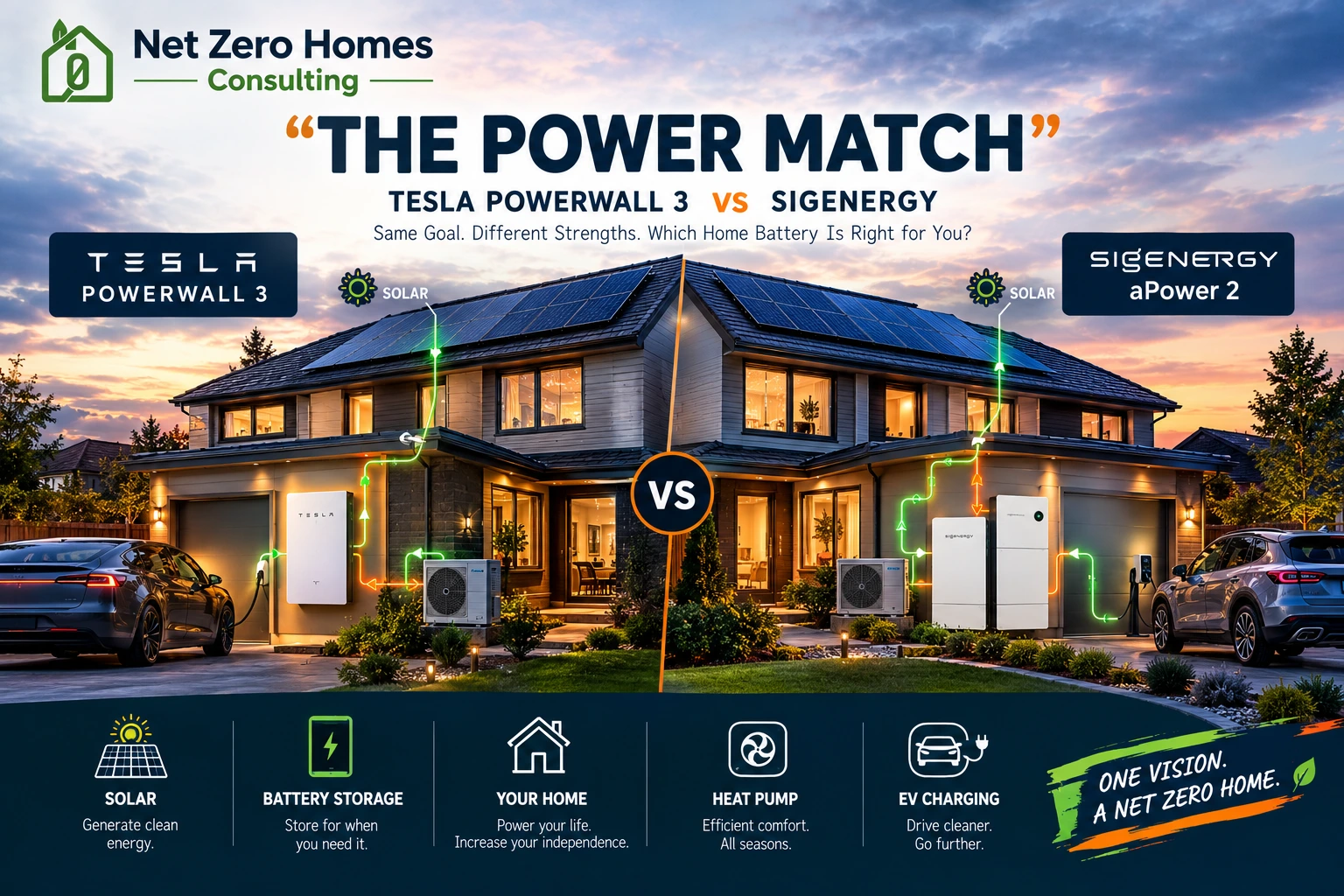
Two nearly identical suburban homes go solar in the same year. One homeowner prioritizes seamless daily energy management shifting solar surplus into evening EV charging and household loads while reducing grid purchases. The other focuses on reliable backup during winter storms and wants a system that can start high-surge motors without drama. Both look at home battery storage. Both face the same decision: Tesla Powerwall 3 or Sigenergy SigenStor.
This is not a manufacturer brochure or a “best battery” ranking. It is a head-to-head examination of two distinct energy-storage architectures available to homeowners across Canada and the United States. Net Zero Homes Consulting acts as the neutral referee. The goal is not to crown a universal winner. The goal is to help you understand which system characteristics may make more sense for your home’s electricity profile, climate, electrification plans, and priorities.
Quick Answer
Tesla Powerwall 3 and Sigenergy SigenStor are both residential energy-storage platforms with integrated solar capabilities, lithium iron phosphate (LFP) chemistry in current North American configurations, and strong backup features. Powerwall 3 is a high-power single-unit design (13.5 kWh usable, up to 11.5 kW continuous, 185 LRA motor-start). SigenStor is modular (controller configurable to 11.5 kW, battery modules of approximately 5.84 or 8.76 kWh usable, expandable to roughly 54 kWh). The better fit depends on capacity needs, power output, solar architecture, EV plans, backup strategy, scalability, software, local installer support, and future electrification not a single “winner.” Verify current model specifications and certifications with manufacturers and qualified installers.
⚔️ THE BATTLE RULES
Every system faces the same tests across 18 Battle Cards. We evaluate energy capacity, continuous power, surge capability, load displacement, solar integration, whole-home backup, heat-pump compatibility, EV integration, electrical-panel implications, chemistry and safety, cold-weather performance, scalability, software, warranty, installation, economics, North American availability and future-proofing. Specifications come from current North American manufacturer documentation. Sigenergy offers multiple configurations; comparisons note that performance scales with the chosen energy controller and battery modules. No European, Australian or Asian specs are presented as North American.
Manufacturer builds the technology. Qualified contractors design and install according to the project and local codes. An independent home-energy consultant helps the homeowner understand what the house actually needs before committing. Net Zero Homes Consultinghttp://www.net0homes.ca follows the framework ASSESS → PRIORITIZE → PLAN → UPGRADE. Battery selection belongs after understanding consumption, peak demand, solar production, HVAC loads, EV charging, panel capacity, outage expectations, utility rates, incentives, and future electrification.
⚔️ BATTLE CARD 1 — ENERGY CAPACITY
🔴 Tesla Powerwall 3 Corner
Nominal and usable capacity is listed at 13.5 kWh AC (beginning of life, standard test conditions). Additional Powerwall 3 units or Expansion units increase total stored energy. Power scalability reaches multiple units; energy scalability supports Expansion units connected to a leader unit.
🔵 Sigenergy SigenStor Corner
SigenStor is modular. US battery modules are SigenStor BAT 6.0 US (6.02 kWh total / 5.84 kWh usable) and BAT 9.0 US (9.04 kWh total / 8.76 kWh usable). One to six modules per energy controller yield total system energy from roughly 6 kWh up to 54.24 kWh depending on configuration.
🥊 Head-to-Head
Powerwall 3 starts at a fixed high-capacity unit. SigenStor lets the homeowner start smaller and add modules. Capacity alone does not determine how much of the house can run at once—that is power.
🏠 Homeowner Test
A family uses refrigerator, lights, internet, furnace blower or heat-pump fan, and evening loads. Overnight consumption may be 8–15 kWh depending on climate and habits. A single Powerwall 3 covers many nights. A two- or three-module SigenStor can match or exceed that.
⚡ Energy Test
kWh measures stored energy. Continuous kW measures how fast that energy can be delivered. High capacity with low power leaves large loads unsupported during peaks.
🔥 What This Means
Buy capacity for duration and daily cycling. Buy power for simultaneous appliances.
🧠 Net Zero Homes Referee Note
Size storage to the home’s actual overnight and outage needs after assessing solar surplus and load profile—not simply the largest advertised number.
🎯 Who Should Look Closer
Powerwall 3 may suit homeowners who want a substantial single-unit starting capacity. SigenStor may suit those who prefer modular growth or precise matching of capacity to current needs.
⚔️ BATTLE CARD 2 — CONTINUOUS POWER
🔴 Tesla Powerwall 3 Corner
Nominal continuous AC output is configurable up to 11.5 kW (120/240 V split-phase). Maximum continuous current reaches 48 A at the highest rating. Off-grid discharge can be higher under specific PV-only and temperature conditions when properly configured.
🔵 Sigenergy SigenStor Corner
The SigenStor EC SP US energy controller is field-configurable to 3.8 / 4.8 / 5.7 / 7.6 / 9.6 / 11.5 kW nominal. Backup output matches the selected rating at 240 V. Battery module continuous charge/discharge rates are 3 kW (6.0 US) or 4.6 kW (9.0 US); stacked modules increase available battery power. Peak 10-second output is higher (up to 17.1 kW on higher controller ratings).
🥊 Head-to-Head
Both can reach similar continuous power levels around 11.5 kW. Architecture differs: Powerwall 3 integrates high power in one unit; SigenStor scales power with controller selection and battery stacking.
🏠 Homeowner Test
A heat pump, induction range, and EV charger rarely run at full simultaneous demand, but evening peaks matter. Continuous power determines whether the system supports those peaks without shedding loads.
⚡ Energy Test
Capacity is the fuel tank. Power is how quickly the system can deliver energy. A large tank with a small pump cannot fill a big demand quickly.
🔥 What This Means
High continuous power supports more simultaneous loads and reduces the need for aggressive load management during outages or peak periods.
🧠 Net Zero Homes Referee Note
Match continuous power to measured or calculated peak household demand, not marketing claims.
🎯 Who Should Look Closer
Homes with heat pumps, multiple large appliances, or high simultaneous demand benefit from verifying the continuous rating of the exact configuration under consideration.
⚔️ BATTLE CARD 3 — SURGE & MOTOR STARTING
🔴 Tesla Powerwall 3 Corner
Load-start capability is rated 185 LRA (locked-rotor amps) for one second. This supports many residential motor loads including compressors and pumps.
🔵 Sigenergy SigenStor Corner
Peak output power (10 seconds) reaches higher values on larger controller ratings (documented up to 17.1 kW). Specific LRA ratings for motor starting should be verified with current manufacturer documentation and the chosen configuration, as they are not uniformly listed in the same format as Tesla’s 185 LRA figure.
🥊 Head-to-Head
Powerwall 3 publishes a clear high LRA figure useful for heat-pump and well-pump startups. SigenStor provides strong peak power that scales with configuration; confirm exact motor-start capability for the selected stack.
🏠 Homeowner Test — Canadian Winter
A cold-climate heat pump attempts to start during an outage. High inrush current can trip a battery system that has enough kWh but insufficient surge capability. Verify both continuous and surge ratings against the heat-pump nameplate LRA or MCA.
⚡ Energy Test
A battery can hold enough energy for hours yet fail to start a compressor if the inverter cannot supply the instantaneous current.
🔥 What This Means
Ask the installer to confirm motor-start capability against your specific HVAC and pump loads.
🧠 Net Zero Homes Referee Note
Surge performance is configuration- and temperature-dependent. Do not assume either system will automatically start every motor in the house.
🎯 Who Should Look Closer
Homes with heat pumps, well pumps, or large compressors should prioritize verified LRA or peak-current data.
⚔️ BATTLE CARD 4 — LOAD DISPLACEMENT
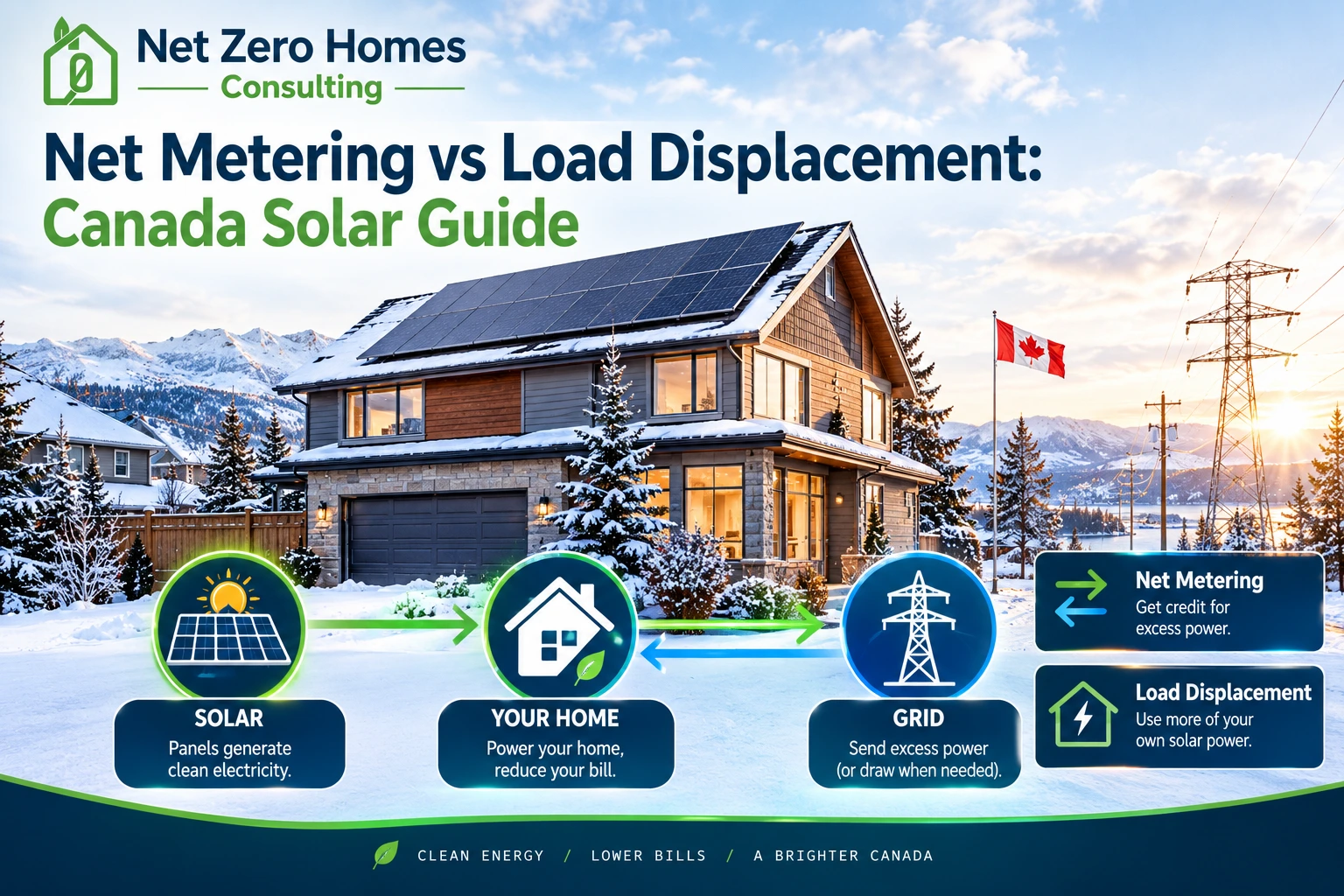
Load displacement means using solar production and battery storage to reduce the electricity drawn from the utility. The ideal daily flow is: solar serves home loads first, excess charges the battery, the battery later serves evening loads, and the grid is used only for remaining needs or export under net-metering rules.
Both systems support daily cycling for self-consumption and time-of-use (TOU) optimization where available. A pure backup battery sits idle most of the time. A daily energy-management battery works every day. Actual economics depend on utility rates, solar production, consumption profile, weather, settings, installation cost, and incentives. No system guarantees savings.
Powerwall 3 and SigenStor both enable this strategy through their energy-management software and hybrid inverter architecture. The difference lies in how easily the homeowner can set reserve levels, TOU schedules, and load priorities.
🏠 Homeowner Test
A home with good solar and moderate evening loads can shift a large portion of grid purchases into self-consumption. Homes with high EV charging or heat-pump winter demand need enough capacity and power to capture the benefit.
🧠 Net Zero Homes Referee Note
Treat the battery as a tool for load displacement and resilience, not an automatic bill reducer. Assess first.
⚔️ BATTLE CARD 5 — SOLAR INTEGRATION
🔴 Tesla Powerwall 3 Corner
Integrated hybrid inverter with six MPPTs, maximum solar STC input 20 kW, PV voltage range supporting typical residential strings. Solar can charge the battery and serve the home even during outages when properly configured.
🔵 Sigenergy SigenStor Corner
Energy controller includes four MPPTs, maximum PV power up to 23 kW on the 11.5 kW configuration. Supports DC-coupled solar and battery operation. Existing AC-coupled solar is possible with appropriate design.
🥊 Head-to-Head
Both offer strong DC-coupled hybrid architectures for new solar + battery projects. Powerwall 3 provides more MPPTs; SigenStor offers high PV oversizing ratios on larger controllers. Retrofit of existing solar requires careful evaluation of inverter compatibility and possible AC coupling or replacement.
Scenario A — Existing solar
Compatibility and whether the existing inverter remains or is replaced becomes central.
Scenario B — New solar + battery
Either integrated system can simplify design and improve efficiency.
🧠 Net Zero Homes Referee Note
The solar decision and the battery decision should be coordinated. Oversizing rules, rapid-shutdown requirements, and interconnection standards vary by jurisdiction.
⚔️ BATTLE CARD 6 — WHOLE-HOME BACKUP
Both systems support automatic transfer to backup power. Tesla uses Backup Gateway 2. Sigenergy uses LoadHub or equivalent transfer equipment for seamless transition (documented disruption times approaching 0 ms under proper conditions). Whole-home versus critical-load backup depends on panel configuration, load management, and continuous power rating. Neither system can run every possible load simultaneously on a single unit without careful design and possible shedding.
🏠 The Blackout Test
Winter storm, power out. Refrigerator, lights, Wi-Fi, furnace or heat-pump fan, sump pump, water heater, and EV all compete. Continuous power and reserve settings determine what stays online. Solar recharge during daylight extends runtime if the array is still producing.
🧠 Net Zero Homes Referee Note
Define critical loads first. Size power and capacity to those loads plus desired duration. Load management is often essential for whole-home claims.
⚔️ BATTLE CARD 7 — HEAT PUMP TEST
Cold-climate heat pumps present both continuous winter demand and high starting currents. A battery sized only for “X hours of backup” may be undersized once the heat pump cycles. Solar recharge helps on sunny winter days but is limited in prolonged cloud or deep cold. Panel capacity and service size become limiting factors as homes electrify.
Both platforms can support heat-pump homes when continuous power, surge capability, and capacity are matched to the specific equipment. Verify nameplate data and design the system around measured or calculated winter peaks.
⚔️ BATTLE CARD 8 — EV BATTLE
EV charging is one of the largest flexible loads in many homes. Level 2 charging can be scheduled to solar or battery windows. Sigenergy offers an optional integrated 25 kW bi-directional EV DC charger supporting vehicle-to-home (V2H) capabilities with compatible vehicles under manufacturer-supported conditions. Tesla supports Powershare with Cybertruck and certain configurations. Do not assume universal V2H/V2G; verify exact vehicle and hardware requirements.
🚗 The Two-EV Home Test
Solar, battery, heat pump, and two EVs. Load management, scheduling, and sufficient continuous power become decisive. Capacity alone is insufficient if the system cannot deliver power to multiple high loads.
⚔️ BATTLE CARD 9 — ELECTRICAL PANEL BATTLE
100 A, 125 A, or 200 A service; existing panel space; concurrent loads from heat pump, EV charger, induction range, battery, and solar all interact. Battery addition often triggers panel or service upgrades. Coordinate battery selection with a qualified electrician. Do not attempt electrical design as a homeowner.
⚔️ BATTLE CARD 10 — BATTERY CHEMISTRY & SAFETY
Both current North American platforms use lithium iron phosphate (LFP) chemistry, known for thermal stability relative to older chemistries. Both carry relevant UL listings (UL 9540, UL 1741 family, UL 1973 where applicable). Thermal management, enclosure ratings (outdoor-capable), and installation clearances matter. Follow manufacturer and local code requirements.
⚔️ BATTLE CARD 11 — CANADIAN WINTER TEST
Powerwall 3 operating range: –20 °C to 50 °C. SigenStor controller: –30 °C to 60 °C; battery modules: –20 °C to 55 °C. Outdoor installation is possible with both when properly mounted and ventilated. Performance and charging ability decline at temperature extremes; internal heating or management systems help but consume energy. Regional differences are real—Toronto, Ottawa, Montreal, Calgary, Edmonton, and Vancouver do not share identical winter challenges. Verify site-specific temperature management and derating.
⚔️ BATTLE CARD 12 — SCALABILITY
Powerwall 3 expands with additional full units and Expansion units (energy increases without always increasing power proportionally). SigenStor expands by stacking modules (capacity and battery power both scale) and supports parallel systems in larger designs. Future electrification (heat pump, second EV, heat-pump water heater) makes modular growth attractive for some homes.
⚔️ BATTLE CARD 13 — ENERGY MANAGEMENT SOFTWARE
Both provide mobile apps for monitoring solar, battery state of charge, energy flows, TOU settings, backup reserve, and remote diagnostics. Firmware updates improve performance over time. Evaluate the actual controls available for your utility rate structure and priorities rather than app aesthetics alone.
⚔️ BATTLE CARD 14 — WARRANTY & LONG-TERM OWNERSHIP
Both offer 10-year warranties. Tesla guarantees 70 % capacity retention at 10 years under covered applications (unlimited cycles for solar self-consumption, time-based control, and backup in the US warranty terms). Sigenergy provides 10-year coverage on battery and controller with performance guarantees typically stated as 70 % retention or throughput limits—confirm exact current terms. Warranty requires professional installation and registration. Read the full document; marketing summaries omit exclusions.
⚔️ BATTLE CARD 15 — INSTALLATION & RETROFIT
Existing solar homes may face different complexity than new solar + battery projects. Integrated hybrid designs simplify new builds. Retrofit may require gateway/transfer equipment, panel work, or inverter changes. Installer qualifications and commissioning matter for warranty and performance. A system that looks attractive on paper can change once site conditions and electrical work are known.
⚔️ BATTLE CARD 16 — COST & ECONOMICS
Do not invent pricing. Equipment cost is only one line. Installation, electrical upgrades, permits, commissioning, and incentives complete the picture. Cost ≠ value. A lower equipment price does not guarantee lower project cost. Larger capacity does not automatically improve economics. Value comes from load displacement, self-consumption, outage resilience, and alignment with future plans—evaluated against actual rates and usage. No ROI guarantee is possible.
⚔️ BATTLE CARD 17 — NORTH AMERICAN AVAILABILITY
Tesla Powerwall 3 is widely available across the United States and Canada through Tesla and certified installers, with established service and warranty processes. Sigenergy SigenStor is certified (UL/CSA) for the US market and expanding in Canada through certified distributors and installers (documented presence in Quebec, British Columbia, and growing networks). Confirm local utility interconnection approval, installer coverage, and service support for your exact location. Do not assume identical availability or support in every province or state.
⚔️ BATTLE CARD 18 — FUTURE-PROOFING
Year 1: solar. Year 3: battery. Year 5: EV. Year 7: heat pump. Year 10: second EV or heat-pump water heater. Architectural flexibility—modular capacity, high continuous power headroom, integrated EV options, and strong software—matters more than today’s exact kWh number. Neither product can be declared the future winner; both are designed for evolving homes when sized and installed thoughtfully.
.
🏠 THE THREE-HOME POWER MATCH
Home #1 — The Solar Suburban Home
2,200 sq ft, gas furnace, central AC, 8 kW solar, one EV, 200 A service, moderate outage concern. Daily load displacement and straightforward solar integration often matter most. Either platform can work; evaluate continuous power for evening peaks and expansion path if a heat pump arrives later.
Home #2 — The Fully Electrified Home
Cold-climate heat pump, heat-pump water heater, induction, EV, solar, higher annual consumption. Continuous power, surge capability, capacity for winter evenings, and load management become central. Modular growth or multi-unit power may be advantageous.
Home #3 — The Resilience Home
Rural or semi-rural, frequent outages, heat pump, well pump, sump pump, EV, solar. Backup architecture, motor-start capability, runtime duration, and solar recharge during outages dominate. Verify whole-home versus managed critical loads carefully.
Before Choosing Either Battery, Assess These 10 Things
- Annual electricity consumption
- Peak electrical demand
- Solar production and surplus
- Existing solar architecture
- HVAC system and heat-pump details
- EV charging plans
- Electrical panel and service capacity
- Critical outage loads and desired duration
- Utility rate structure and incentives
- Future electrification plans
These questions belong before selecting a battery.
🧠 REFEREE REPORT
Tesla Powerwall 3 may be worth investigating if…
You want a high continuous-power single-unit solution with strong published motor-start capability, broad North American installer coverage, and integrated six-MPPT solar for a new or retrofit hybrid system.
Sigenergy SigenStor may be worth investigating if…
You prefer modular capacity that can grow with the home, an optional high-power bi-directional EV DC charger, flexible controller power ratings, and a 5-in-1 architecture that integrates solar, storage, and EV charging under one platform.
Both require careful evaluation when…
The home has high peak loads, cold-climate heat pumps, limited panel capacity, existing solar of unknown compatibility, or ambitious future electrification. Local installer expertise and utility rules often decide practicality more than datasheet numbers.
The most important question is…
What does your home actually need the battery to do—daily load displacement, multi-day resilience, EV support, heat-pump backup, or a combination?
There is no single battery automatically right for every North American home. The correct decision depends on the home, electrical system, solar system, HVAC, EV, utility, outage requirements, budget, future plans, and installation configuration.
Why Talk to a Home Energy Consultant Before Calling a Battery Installer?
An installer may recommend the equipment they sell. That recommendation is not necessarily wrong, but it is incomplete without first understanding the whole house. Net Zero Homes Consulting helps homeowners ASSESS consumption and systems, PRIORITIZE goals, PLAN an energy strategy, and UPGRADE with the right technologies and qualified contractors. Experience across HVAC, heat pumps, solar, storage, insulation, air sealing, and energy management prevents treating the battery as an isolated purchase.
Your Battery Is Only One Piece of the Puzzle
HOME → Building Envelope → HVAC → Heat Pump → Solar → Battery → EV → Electrical System → Utility. Changing one element affects the others. A larger battery does not fix an inefficient envelope or an undersized service. Plan the system, not just the battery.
Comparison Table
| Specification | Tesla Powerwall 3 | Sigenergy SigenStor (US config example) |
|---|---|---|
| Energy capacity | 13.5 kWh nominal/usable | Modular: 5.84 or 8.76 kWh usable per module; up to ~54 kWh |
| Continuous power | Up to 11.5 kW | Controller up to 11.5 kW; battery power scales with modules |
| Peak / surge | 185 LRA | Higher 10 s peak (config-dependent); verify LRA |
| Chemistry | LFP | LFP |
| Inverter | Integrated hybrid | Integrated energy controller |
| Solar integration | 6 MPPTs, up to 20 kW | 4 MPPTs, up to 23 kW |
| Expansion | Additional units + Expansions | 1–6 modules per controller; parallel systems |
| Operating temperature | –20 °C to 50 °C | Controller –30 °C to 60 °C; battery –20 °C to 55 °C |
| Backup | Yes (Gateway 2) | Yes (LoadHub / transfer) |
| EV integration | Powershare (select vehicles) | Optional 25 kW bi-directional DC charger |
| Warranty | 10 years, 70 % retention | 10 years (confirm performance terms) |
| Certification | UL 1741, UL 9540 family, etc. | UL 1741, UL 9540, UL 1973, CSA |
| North American availability | Broad US & Canada | US certified; expanding in Canada |
FAQ
1. Is Tesla Powerwall 3 better than Sigenergy SigenStor?
No universal answer. Each has architectural strengths suited to different homes and priorities.
2. What is the difference between Powerwall 3 and SigenStor?
Powerwall 3 is a high-power integrated unit. SigenStor is modular with expandable capacity and optional integrated EV DC charging.
3. How much energy can Powerwall 3 store?
13.5 kWh usable (beginning of life).
4. How much energy can SigenStor store?
Depends on configuration—from roughly 6 kWh to over 50 kWh with multiple modules.
5. Can both systems work with solar?
Yes. Both offer hybrid inverter architectures for DC-coupled solar.
6. Can they provide whole-home backup?
Both support backup. Whether whole-home or critical-load depends on design, power rating, and load management.
7. Can a battery run a heat pump during an outage?
Possible when continuous power, surge capability, and capacity match the heat pump and other loads. Verify specific equipment.
8. Can a battery charge an EV?
Yes, within available power and energy. Some configurations support direct DC or bi-directional charging.
9. Can battery storage reduce grid electricity use?
Yes, through load displacement and self-consumption when solar and usage align. Results vary.
10. What is load displacement?
Using on-site solar and storage to minimize utility electricity purchases for household loads.
11. Which battery is better for cold climates?
Both have low-temperature operating ranges. Site-specific thermal management and design matter more than brand.
12. Can batteries be expanded later?
Yes—Powerwall 3 with additional units/Expansions; SigenStor with additional modules.
13. How long do home batteries last?
Warranties are typically 10 years with capacity retention guarantees. Useful life often extends further with gradual degradation
14. What does a home battery system cost?
Depends on equipment, installation, electrical work, and incentives. Obtain site-specific quotes.
15. Should I talk to an energy consultant before buying a battery?
Yes. Understanding the whole home first leads to better technology and design choices.
Before You Choose the Battery, Understand the Home
Understand your electricity consumption, solar production, HVAC and heat-pump loads, EV plans, electrical panel, outage requirements, and future energy strategy. Then evaluate platforms.
Net Zero Homes Consulting follows ASSESS → PRIORITIZE → PLAN → UPGRADE.
One Plan. One Clear Direction.
Two technologies. Different architectures. One homeowner decision.
ASSESS → PRIORITIZE → PLAN → UPGRADE
One Plan. One Clear Direction.