You just ordered your first electric vehicle or you’re seriously thinking about it. The excitement is real. Then a practical question hits: “Will my electrical panel handle a home EV charger?”
You’re not alone. This is one of the most common concerns for Canadian and U.S. homeowners moving to electric driving. The good news? Most modern homes with 200-amp service can support a Level 2 charger without a major upgrade. Many 100-amp homes can too especially with smart load management. The key is understanding your home’s real electrical capacity, not guessing from the size of the main breaker.
This guide walks you through everything in plain language. We’ll cover how your electrical system works, how electricians calculate loads, when a panel upgrade is truly needed, how smart technology can help you avoid or delay one, and how EV charging fits into a complete Net Zero Home plan that includes heat pumps, solar, batteries, and even Vehicle-to-Home power.
Whether you live in a suburban house, a rural property, a cottage, or a multi-EV household, the principles are the same. Let’s make sure your home is ready safely, efficiently, and ready for the future.
Home Electrical Service Explained (In Everyday Language)
Your electrical panel is the heart of your home’s power system. Electricity arrives from the utility through a service entrance (overhead or underground). It passes through a meter, then into the main breaker the big switch that can shut off everything. From there, power splits into branch circuits that feed lights, outlets, and appliances.
The main breaker rating (100A, 150A, 200A, etc.) is the maximum continuous current your service can safely deliver. Think of it like the size of a water pipe coming into your house. A bigger pipe can supply more fixtures at once without pressure dropping.
Electrical demand is how much power your home actually draws at any moment. Continuous loads (like EV charging or electric water heaters that run for three hours or more) are treated more carefully under code because they stress the system longer. Load diversity is the reality that not everything runs at full power at the same time your dryer, range, and air conditioner rarely all peak together.
This is why two identical-looking homes can need different panel sizes. One may have gas heat, a gas water heater, and modest air conditioning. The other may be all-electric with a heat pump, induction range, electric dryer, and a hot tub. The second home has higher calculated demand even if the square footage is the same.
Electricians perform load calculations (following the National Electrical Code in the U.S. or Canadian Electrical Code) to determine whether adding a new load like a Level 2 EV charger will push the total beyond the service rating. They don’t just add up every breaker; they apply demand factors that reflect real world usage. That’s why a quick glance at your panel is only the starting point.
Panel Size Comparison: What Each Service Can Realistically Handle
Here’s a practical look at common residential services in North America.
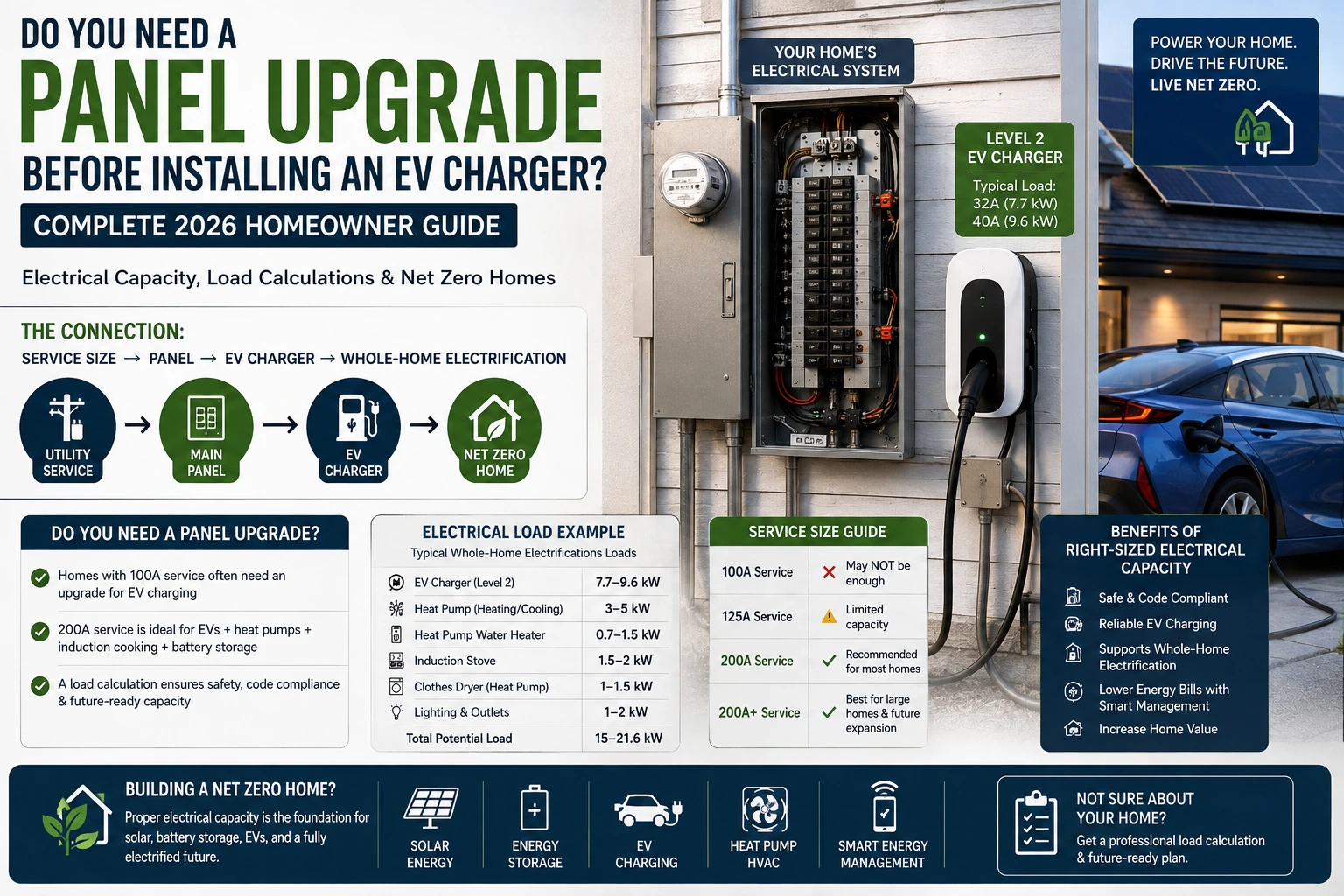
100 Amp Service Common in homes built before the mid-1990s. Works fine for many smaller homes with gas appliances. Limitations appear quickly when you add modern electric loads. A modest Level 2 charger (24–32A continuous) may fit if the load calculation supports it and gas heat/water heating keep demand low. Heat pump readiness is limited without load management or an upgrade. Solar readiness is possible but constrained. Battery readiness is limited. Future expansion potential is low without smart management or a service upgrade.
125 Amp Service A middle ground found in some renovations and mid-era homes. Better headroom than 100A. Can often support a 32–40A Level 2 charger with careful load calculation. Heat pump and modest solar readiness improve. Still limited for dual EV or heavy all electric setups.
150 Amp Service More common in 1980s–1990s homes and some upgrades. Comfortable for a single Level 2 charger in many cases. Better heat pump readiness. Solar and battery integration become more practical. Solid mid-range option for future proofing without jumping to 200A.
200 Amp Service The modern residential standard in most of Canada and the U.S. since the 1990s–2000s. Most homes in this category can support a full 48A Level 2 charger without upgrading the panel, provided the load calculation confirms capacity and breaker space exists. Excellent EV readiness, strong heat pump readiness, good solar and battery readiness, and room for future expansion (second EV, induction range, etc.). This is the sweet spot for most Net Zero Home planning.
320/400 Amp Service Found in larger custom homes, multi-family properties, or fully electrified residences. Handles multiple Level 2 chargers, heat pumps, large solar systems, whole home batteries, and high demand appliances simultaneously. Maximum future expansion potential. Often paired with smart panels or energy management systems.
Two homes with the same panel rating can still differ dramatically based on existing loads, wiring condition, available breaker slots, and local utility rules.
How Electricians Calculate Electrical Demand
Electricians follow structured methods in the NEC (primarily Article 220) or CEC (Rule 8-200 and related). For existing dwellings adding an EV charger, methods that account for existing loads are common. Continuous loads such as EV chargers are calculated at 125% for circuit sizing (the “80% rule”). A 48A continuous charger therefore needs a 60A circuit.
Nameplate ratings (the numbers on the appliance) are used, but demand factors reduce the total because not everything operates at once. EVSE (Electric Vehicle Supply Equipment) is generally added at full nameplate or a code minimum there is limited or no demand factor reduction for the charger itself in current rules.
Smart load management changes the picture. When an approved Energy Management System (EVEMS) limits the charger’s maximum draw based on real time total home load, the calculated contribution of the EV charger can be reduced. This is explicitly recognized in both NEC and CEC provisions for managed loads.
Common misconceptions:
- “My panel is full of breakers, so I need an upgrade.” (Breaker count ≠ capacity; demand factors matter.)
- “Every Level 2 charger requires 200A service.” (False—many 100A and 150A homes work with lower-amperage chargers or management.)
- “I can just add it and see.” (Unsafe and non-compliant; permits and inspections exist for a reason.)
Only a licensed electrician should perform the official calculation for permitting.
Home Appliance Load Comparison Table (Approximate Continuous or Typical Demand)
| Appliance / Device | Typical Power / Current | Notes |
|---|---|---|
| Level 1 EV Charger | 1.4–1.9 kW (12–16A @ 120V) | Slow; uses existing outlet |
| Level 2 EV Charger (32A) | ~7.7 kW (32A @ 240V continuous) | Common residential |
| Level 2 EV Charger (40–48A) | 9.6–11.5 kW | Faster; 50–60A circuit |
| Heat Pump (residential) | 3–8 kW+ (varies by size/climate) | Often with backup heat strips |
| Electric Furnace | 10–20+ kW | High continuous demand |
| Electric Water Heater | 3–5.5 kW | Continuous when heating |
| Electric Dryer | 4–6 kW | Intermittent |
| Electric Range / Oven | 8–12 kW (nameplate) | Demand factors apply |
| Induction Cooktop | 3–7 kW | Efficient but still significant |
| Hot Tub / Spa | 5–12 kW | High when heating |
| Pool Equipment | 1.5–5 kW | Varies |
| Home Battery (charge/discharge) | 5–11.5 kW continuous typical | Depends on model |
| Solar Inverter (residential) | Matches array (often 5–15 kW) | Production, not load |
| Central Air Conditioner | 3–6 kW | Seasonal |
| Electric Fireplace | 1.5–3 kW | Supplemental |
These are estimates for planning conversations. Real calculations use exact nameplates and code methods.
Level 1 vs Level 2 Charging
Level 1 uses a standard 120V outlet. It is slow (3–8 km / 2–5 miles of range per hour depending on the vehicle). Installation is simple and cheap often just a dedicated outlet. Suitable for plug-in hybrids, very low daily driving, or temporary use. Not ideal for most full battery EVs with daily commuting.
Level 2 uses 240V and delivers 25–50+ km / 15–30+ miles of range per hour. It requires a dedicated circuit (typically 30–60A). Installation is more involved but transforms home charging into a convenient overnight experience. Best for nearly all battery EV owners. Most homeowners choose Level 2 for daily driving suitability.
Cost difference is significant: Level 1 is minimal; Level 2 hardware plus install typically ranges from roughly $800–$3,000+ depending on distance, panel work, and region (before incentives).
Best Home EV Chargers 2026:
Popular options include:
- Tesla Wall Connector / Universal Wall Connector: Up to 48A, excellent Tesla integration and power sharing, strong app for Tesla owners, hardwired, competitive price, solid warranty. Best for Tesla households or mixed with Universal model.
- ChargePoint Home Flex: Adjustable up to 50A, excellent app and energy tracking, broad compatibility (J1772/NACS options), Wi-Fi, scheduling. Strong all-around choice.
- Emporia EV Charger: Up to 48A, strong value, detailed energy monitoring that pairs with Emporia home energy systems, good smart features and load awareness. Excellent budget-smart option.
- Wallbox Pulsar Plus: Up to 48A, high-quality app, load management capabilities, solar-ready features in many setups, good warranty. Great for smart homes and utility programs.
- Grizzl-E: Rugged outdoor-rated, simple and durable, lower cost (classic models less “smart”), solid for cold climates and basic needs.
- Autel MaxiCharger: Competitive power, solid features and app, good value.
- FLO Home Charger: Strong in Canadian markets, reliable, good network integration in some regions.
Look for: power output matching your needs and panel capacity, smart features (app, scheduling, load management), solar compatibility, warranty (3–5+ years), and installer support. Prices for units typically range $300–$800 before installation. Always verify current specs and local code compliance.
Smart Load Management: Often the Smarter Path
Dynamic load management (also called EVEMS or Energy Management Systems) monitors your home’s total electrical use in real time. When other high loads turn on (range, dryer, heat pump), the system automatically reduces or pauses EV charging so the main breaker never overloads. When those loads drop, charging resumes at full available power.
This approach is recognized under both NEC and CEC when properly installed and labeled. Many homeowners with 100A or 125A service (and even some loaded 200A panels) can add a Level 2 charger this way and avoid or defer a full service upgrade.
Technologies include:
- Dedicated EVEMS devices or chargers with current transformers (CTs)
- Smart panels such as SPAN Panel, Schneider Home, and systems from Sigenergy
- Smart breaker solutions and whole-home energy management platforms
These systems also support time-of-use optimization, peak shaving, and coordination with solar and batteries. They turn limited capacity into managed, safe capacity. An electrician must confirm code acceptance in your jurisdiction.
Solar + EV Charging: A Natural Pair
An average EV driven 15,000–20,000 km (9,000–12,000 miles) per year uses roughly 2,500–4,000 kWh annually, depending on efficiency and climate. A properly sized rooftop solar system can offset a large portion or all of that energy, especially with good south-facing exposure and net metering or similar programs.
Solar production is seasonal (stronger in summer). Self consumption is maximized when you charge the EV during sunny hours or use a battery to shift solar energy. Time-of-use rates reward overnight charging when solar is not producing. Many smart chargers and energy management systems prioritize solar surplus for EV charging.
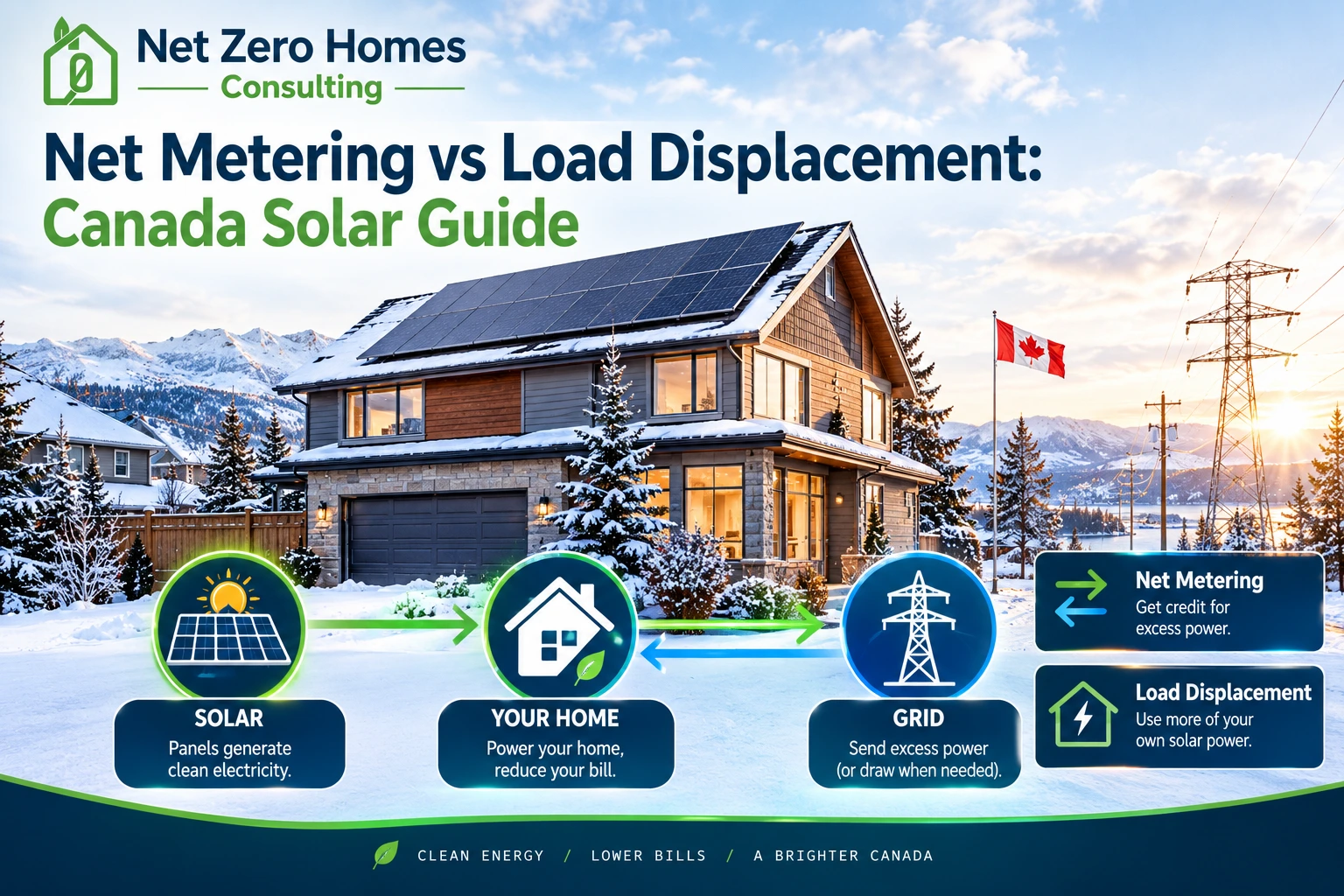
ROI improves when solar, EV charging, and eventually batteries are planned together rather than as isolated projects. Net metering rules vary by province, state, and utility check current programs.
Battery Storage Comparison & Role in Peak Demand
Home batteries provide backup during outages, enable peak shaving (using stored energy during expensive rate periods), increase solar self-consumption, and can coordinate with EV charging.
High-level 2026 comparison of leading systems:
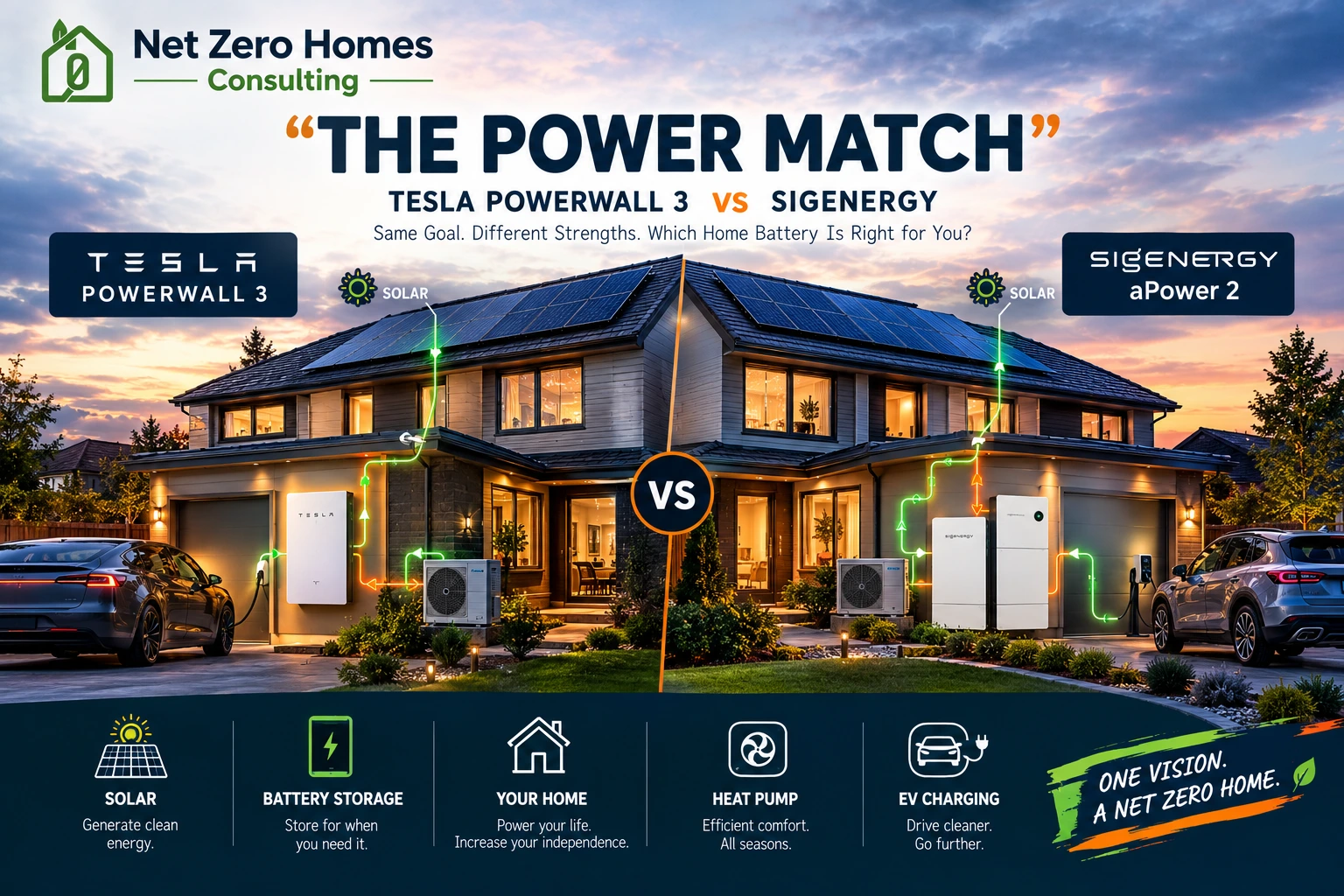
- Tesla Powerwall 3: ~13.5 kWh usable, high continuous output (~11.5 kW), integrated inverter options, excellent app, 10-year warranty, strong whole-home backup when properly configured. Great ecosystem play.
- FranklinWH aPower: Larger capacity per unit (~15 kWh), strong whole-home backup with intelligent control, good scalability, competitive warranty.
- Enphase IQ Battery: Modular (5–10 kWh units), AC coupled with microinverters, long warranty (up to 15 years), excellent for expanding existing Enphase solar.
- Sigenergy SigenStor: Modular, high integration (inverter + battery + EV charging options), AI optimization, V2H/V2X support in some configurations, scalable.
Batteries reduce peak demand on the utility service and improve resilience. They do not automatically eliminate the need for adequate electrical infrastructure the service and panel must still safely handle the simultaneous loads when the battery is charging or when grid power is present. Proper integration is essential.
Vehicle-to-Home (V2H): Turning Your EV into Backup Power
Vehicle-to-Home allows a compatible EV to send power back into your home during an outage or for peak shaving. It requires a bidirectional charger, transfer equipment, and proper interconnection.
As of 2026, commercial capability is established for:
- Ford F-150 Lightning (with Charge Station Pro and Home Integration System)
- Many GM Ultium vehicles (Silverado EV, Equinox EV, Blazer EV, Sierra EV, Lyriq, and others) with GM Energy systems
- Tesla Cybertruck (Powershare)
- Select Kia EV9 and other models in certain markets
- Emerging support on additional platforms
Many vehicles offer Vehicle-to-Load (V2L—powering devices directly from the car) without full home integration. Distinguish current supported systems from manufacturer roadmaps. Installation costs for full V2H typically add several thousand dollars beyond a standard Level 2 setup. It is a powerful resilience tool when the vehicle is home and charged.
The Net Zero Home Electrification Roadmap
A logical progression looks like this:
- Assess and modernize the electrical panel/service — Create the foundation.
- Install Level 2 EV charging (with load management if needed).
- Add a heat pump (and heat-pump water heater where suitable) for efficient heating and cooling.
- Install rooftop solar sized for home + EV loads.
- Add battery storage for self-consumption, peak shaving, and backup.
- Implement smart energy management (SPAN, Schneider, Sigenergy, or equivalent).
- Enable Vehicle-to-Home when a compatible vehicle is available.
- Achieve Net Zero through efficiency (air sealing, insulation, high-performance windows) plus clean generation and flexible loads.
Each step builds on the previous one. Planning the electrical capacity early prevents costly rework later.
Cost Analysis (Realistic North American Ranges, 2026)
Costs vary widely by region, labor rates, utility requirements, distance of wiring runs, panel condition, and whether underground service or transformer work is needed. These are planning ranges only always obtain local quotes.
- Level 2 EV charger installation (no panel upgrade): roughly $800–$3,000+ (hardware + labor + permit)
- Smart load management device/system: $200–$1,000+ depending on complexity
- Panel replacement (same amperage): $1,500–$4,000+
- 100A to 200A service upgrade: commonly $2,000–$6,000+; higher in high-cost markets or with complex utility work (sometimes $7,000–$12,000+)
- Heat pump electrical work: highly variable; often $1,000–$5,000+ depending on circuit needs and any service upgrades
- Solar integration electrical work: included in system quotes
- Home battery storage (installed): $10,000–$20,000+ for typical single-unit systems before incentives
- Permits and inspections: $50–$500+
- Utility connection/service upgrades: can add significant cost and time when required
Factors that raise costs: long conduit runs, detached garages, outdated wiring, Federal Pacific/Zinsco panels (safety replacement often recommended regardless), underground service, and strict local utility rules. Bundle work when possible. Check federal, provincial/state, and utility rebates and tax credits they change and can meaningfully reduce net cost.
Common Mistakes to Avoid
- Buying the EV first and discovering capacity issues later
- Assuming every home needs a panel upgrade
- Oversizing the service “just in case” without a proper calculation
- Ignoring future heat pump, induction, or second-EV plans
- Skipping permits and inspections
- Hiring unqualified or unlicensed installers
- Missing available rebates and incentives
- Treating EV charging as an isolated project instead of part of whole-home electrification
Actionable Homeowner Checklist
- Locate and note your main breaker rating and available breaker spaces.
- List major existing electric loads (heat, water heating, range, dryer, A/C, etc.).
- Decide on Level 1 temporary vs Level 2 permanent charging needs.
- Research smart load management options for your situation.
- Consider near-term heat pump or other electrification plans.
- Evaluate rooftop solar potential and net metering rules.
- Explore battery storage for resilience and rate optimization.
- Plan for possible second EV or V2H.
- Contact licensed electricians for load calculations and quotes; obtain required permits.
- Build toward an integrated Net Zero Home energy plan rather than isolated upgrades.
Frequently Asked Questions:
Can I install a Level 2 charger on a 100 amp panel? Sometimes yes—especially with gas appliances, a lower-amperage charger (24–32A), or approved smart load management. A proper load calculation decides.
Is 200 amp service enough for two EVs? Usually yes for sequential or managed charging. Simultaneous full-power charging of two 48A chargers is tighter and may require load sharing or higher service.
What is smart load management? Real-time systems that reduce EV charging power when total home demand approaches the service limit, preventing overloads without a panel upgrade.
Do I need a permit for an EV charger? Almost always yes for Level 2 installations. Requirements vary by municipality and province/state.
Can solar power charge my EV? Yes. Excess solar production can be directed to the EV, especially with smart charging and batteries.
Can a battery help during power outages? Yes—dedicated home batteries and compatible V2H systems provide backup power.
How much does a panel upgrade cost? Typical 100A-to-200A ranges are often $2,000–$6,000+, higher with complex utility work. Get local quotes.
Will a heat pump require a larger electrical service? It can, depending on size and existing loads. Many modern heat pumps fit on existing 200A service; all-electric homes with backup heat may need more capacity.
Is a home battery worth it? It depends on outage frequency, electricity rates, solar presence, and resilience goals. It improves self-consumption and backup but adds cost.
How do I future-proof my electrical system? Start with accurate load calculations, consider 200A (or higher if multi-EV/all-electric), leave space for expansion, and plan for solar, battery, and smart management from the beginning.
Installing an EV charger is more than adding a circuit, it is often the first major step in transforming your home’s energy system. The goal is not simply to charge a car overnight. It is to create a safe, efficient, resilient, and future-ready Net Zero Home where every upgrade works together: lower energy costs, greater comfort, reduced emissions, and preparedness for the next generation of electric transportation and home energy technology.
Book a Virtual Net Zero Homes Consultation for an independent, vendor neutral assessment of your EV charging readiness, electrical panel evaluation, load management options, solar feasibility, battery planning, heat pump integration, and complete whole-home electrification roadmap.
Your home’s electrical capacity is the foundation. Build it thoughtfully, and everything else becomes easier, safer, and more cost-effective. The transition to electric living is underway make sure your home is ready to lead it.