The Moment Many Homeowners Face
A typical Ontario homeowner starts noticing it sometime in January. The furnace is running constantly. Certain rooms feel colder than others. The energy bill arrives and it’s higher than expected again.
The house might be well built, the windows reasonably modern, and the heating system functioning perfectly. Yet the home still struggles to stay comfortable.
In many cases, the underlying issue is insulation.
When homeowners begin researching home insulation types, two options appear again and again: spray foam insulation and fiberglass insulation. Both are widely used across Canada, but they behave very differently in terms of cost, air sealing, performance, and long-term energy savings.
Understanding the spray foam vs fiberglass insulation debate can help homeowners make smarter upgrade decisions especially if the goal is to reduce energy bills and improve comfort without overspending.
This guide breaks down the key differences in a clear, practical way.
Understanding the Basics of Home Insulation
Before comparing materials, it helps to understand what insulation actually does.
Insulation slows down heat movement between the inside and outside of your home. In Canadian climates, this means:
Keeping warm air inside during winter
Preventing heat from entering during summer
Reducing workload on heating and cooling systems
Improving indoor comfort
Two factors determine insulation performance:
1. Thermal resistance (R-value)
This measures how well insulation resists heat flow.
2. Air sealing ability
Even high R-value insulation can perform poorly if air leaks allow heat to escape.
This is where spray foam and fiberglass differ significantly.
Spray Foam vs Fiberglass Insulation: Core Differences
Fiberglass Insulation
Fiberglass insulation has been the most common material used in Canadian homes for decades.
It consists of fine glass fibers formed into batts or loose-fill insulation.
Typical applications include:
Attics
Wall cavities
Basement ceilings
Floor assemblies
Advantages
Lower upfront cost
Widely available
Easy to install
Good thermal resistance
Limitations
Does not seal air leaks
Performance drops if compressed or wet
Can allow drafts through wall cavities
Fiberglass works well when combined with proper air sealing but by itself, it doesn’t stop airflow.
Spray Foam Insulation
Spray foam insulation is a chemical mixture that expands when applied. It fills cavities and hardens into a rigid insulating layer.
Two types exist:
Open-cell spray foam
Softer and lighter
Lower R-value
More affordable
Closed-cell spray foam
Dense and rigid
Higher R-value
Strong air barrier
Spray foam expands to fill cracks and gaps, which means it performs both as insulation and air sealing.
Advantages
Excellent air barrier
High R-value per inch
Reduces drafts dramatically
Helps control moisture
Limitations
Higher installation cost
Requires professional installation
Not always necessary for every space
R-Value Comparison
When comparing insulation performance, R-value often becomes the focus.
Typical ranges:
| Insulation Type | R-Value Per Inch |
|---|---|
| Fiberglass batt | R-3.0 – R-3.8 |
| Open-cell spray foam | R-3.5 – R-3.7 |
| Closed-cell spray foam | R-6.0 – R-7.0 |
Closed-cell spray foam provides the highest thermal resistance per inch.
However, air leakage often matters more than R-value alone, particularly in older Canadian homes.
A wall with fiberglass but poor air sealing may lose far more heat than a properly sealed spray foam wall with slightly lower R-value.
Cost Considerations in Canada
For many homeowners, cost is the deciding factor.
While exact prices vary by region and home design, general trends across Canada are consistent.
Fiberglass Insulation Costs
Fiberglass remains the most affordable option.
Typical installation ranges:
Attic insulation upgrades
Wall cavity insulation during renovation
Basement insulation
In most cases, fiberglass installation costs significantly less than spray foam.
This is why it remains common in new home construction.
Spray Foam Insulation Costs
Spray foam costs more because:
The material is more expensive
Specialized installation equipment is required
Certified installers must apply it
However, spray foam often reduces the need for additional air sealing measures.
In some homes, especially older ones with many air leaks, this can offset part of the higher cost.
Energy Savings and Return on Investment
Energy savings depend heavily on the condition of the home before the upgrade.
In many Ontario houses built before the 2000s, insulation and air sealing are often incomplete.
When spray foam is applied in key locations such as rim joists, attic slopes, or basement walls homeowners frequently notice:
Reduced drafts
More consistent indoor temperatures
Lower heating demand
Quieter indoor environment
Fiberglass upgrades also deliver savings, especially when attic insulation levels increase.
For example:
A homeowner in Ottawa upgrades attic insulation from R-20 to R-60 using blown fiberglass. Heating costs drop noticeably during winter.
Another homeowner in Toronto insulates basement rim joists with closed-cell spray foam. Cold floor drafts disappear almost immediately.
Both solutions can improve efficiency the key is applying them in the right places.
Common Mistakes Homeowners Make
When researching insulation comparison Canada, several misconceptions often appear.
1. Choosing Based Only on R-Value
R-value is important, but air leakage often has a bigger impact on energy loss.
Without proper air sealing, insulation cannot perform as intended.
2. Using Spray Foam Everywhere
Spray foam is powerful but expensive.
Not every part of a house requires it.
Strategic use often delivers better value.
3. Ignoring Attic Insulation
Attics are the most cost-effective insulation upgrade in many Canadian homes.
Yet homeowners sometimes focus on walls first.
4. Skipping Air Sealing
Even high-quality insulation cannot stop heat loss if air leaks remain.
Typical leakage areas include:
Attic hatches
Electrical penetrations
Rim joists
Plumbing penetrations
Recessed lighting
Step-by-Step Decision Guidance
Choosing the right insulation approach becomes easier with a structured plan.
Step 1: Identify Where Heat Is Escaping
A home energy audit or thermal scan often reveals major heat loss points.
Common locations include:
Attics
Basements
Rim joists
Older wall cavities
Step 2: Improve Air Sealing First
Before increasing insulation levels, sealing air leaks provides immediate gains.
This is where spray foam often plays an important role.
Step 3: Upgrade Attic Insulation
For many homes, adding blown fiberglass or cellulose in the attic offers one of the best ROI upgrades available.
Step 4: Use Spray Foam Strategically
High-impact areas include:
Basement rim joists
Cantilever floors
Attic roof slopes
Hard-to-seal cavities
Step 5: Combine Materials When Necessary
The best insulation systems often combine materials.
Example approach:
Spray foam for air sealing
Fiberglass for bulk insulation
This hybrid strategy is common in energy-efficient Canadian homes.
Rebates and Incentives in Ontario and Canada
Energy efficiency programs often support insulation upgrades.
Homeowners in Ontario may qualify for incentives through programs linked to:
federal efficiency initiatives
provincial energy programs
local utility energy retrofit incentives
Many programs encourage:
attic insulation improvements
whole-home efficiency improvements
Working with an energy advisor can help ensure upgrades meet program requirements.
When Spray Foam Makes Sense
Spray foam insulation tends to deliver the most value in specific scenarios.
These include:
Older homes with major air leakage
Finished basements with cold rim joists
Cathedral ceilings or attic slopes
Complex framing with many gaps
Net Zero renovation projects
In these cases, the combination of insulation and air sealing can significantly improve comfort and efficiency.
When Fiberglass May Be the Better Choice
Fiberglass insulation remains the practical choice in many situations.
It works well for:
Large attic spaces
Standard wall cavities
Budget-conscious upgrades
New home construction
When installed correctly and combined with proper air sealing, fiberglass can perform very well.
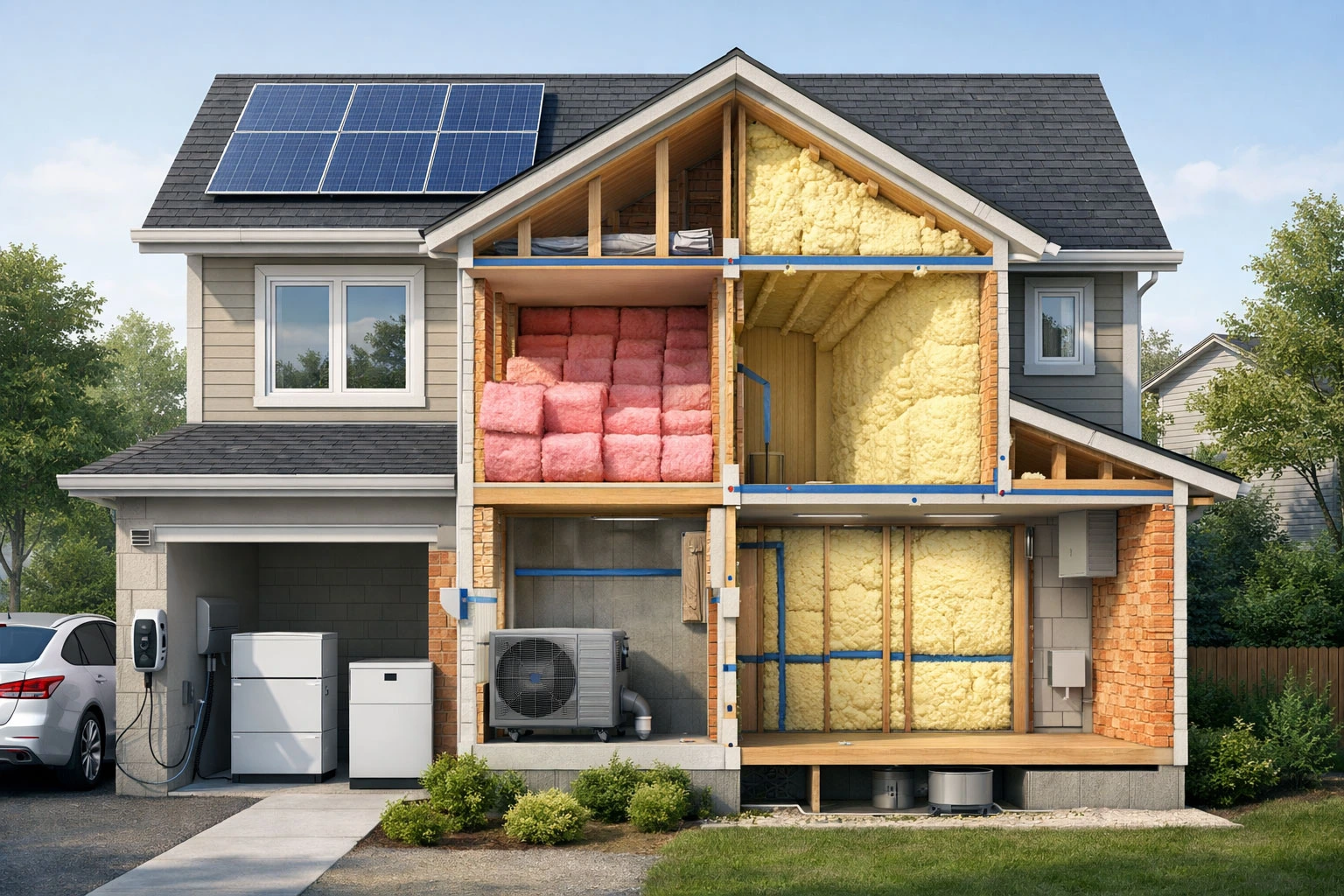
How Insulation Fits Into a Net Zero Roadmap
Insulation plays a foundational role in any long-term Net Zero home strategy.
Before adding technologies like:
the home envelope must be optimized.
Why?
Because improving insulation reduces heating demand.
Lower demand means:
smaller heating systems
lower equipment costs
higher efficiency gains
In many Net Zero homes, insulation upgrades come first followed by electrification and renewable energy.
Final Thoughts
The spray foam vs fiberglass insulation debate isn’t about choosing a universal winner.
Both materials serve important roles in Canadian homes.
Fiberglass remains a cost-effective solution for large insulation areas like attics and walls. Spray foam excels where air sealing and high performance are critical.
The best results usually come from a thoughtful combination of materials, applied strategically based on how a specific home loses energy.
For homeowners in Ontario and across Canada, improving insulation is often one of the most practical steps toward lower energy bills, better comfort, and a more future-ready home.
Book a Consultation
If you’re considering insulation upgrades but aren’t sure where to start, a professional assessment can help clarify the best path forward.
Book a consultation with Net Zero Homes Consulting to receive a customized home efficiency roadmap designed to improve comfort, reduce energy use, and prepare your home for a Net Zero future.