You wake up on a cold January morning in Canada. The house feels chilly, so the thermostat kicks on. Within minutes, the furnace blasts hot air through the vents. The room warms quickly, but shortly after, the system shuts off. Ten minutes later, it starts again.
This cycle repeats all winter.
For many homeowners, this “on–off” heating pattern feels normal. But it’s often a sign of an older single-stage furnace working inefficiently. When the time comes to replace that furnace, most people encounter two unfamiliar options:
Both promise improved comfort and efficiency. Both cost more than traditional systems. And both claim to reduce energy bills.
The problem is that the difference between them is rarely explained clearly. Contractors may recommend one or the other without fully explaining why.
This guide will help Canadian homeowners understand the real differences between two-stage and modulating furnaces, how they affect comfort and energy use, and how to decide which option makes the most sense for your home.
Understanding How Furnaces Work
Before comparing furnace types, it helps to understand how traditional heating systems operate.
A single-stage furnace has only one setting: full power.
When the thermostat calls for heat:
-
The furnace turns on at 100% capacity
-
It quickly heats the home
-
It shuts off completely once the thermostat temperature is reached
This approach works, but it has drawbacks:
-
Temperature swings between heating cycles
-
Frequent on/off cycling
-
Higher energy use
-
Uneven heating in larger homes
Modern furnaces solve this problem by adjusting how much heat they produce, rather than always running at full capacity.
This is where two-stage and modulating furnaces come in.
What Is a Two-Stage Furnace?
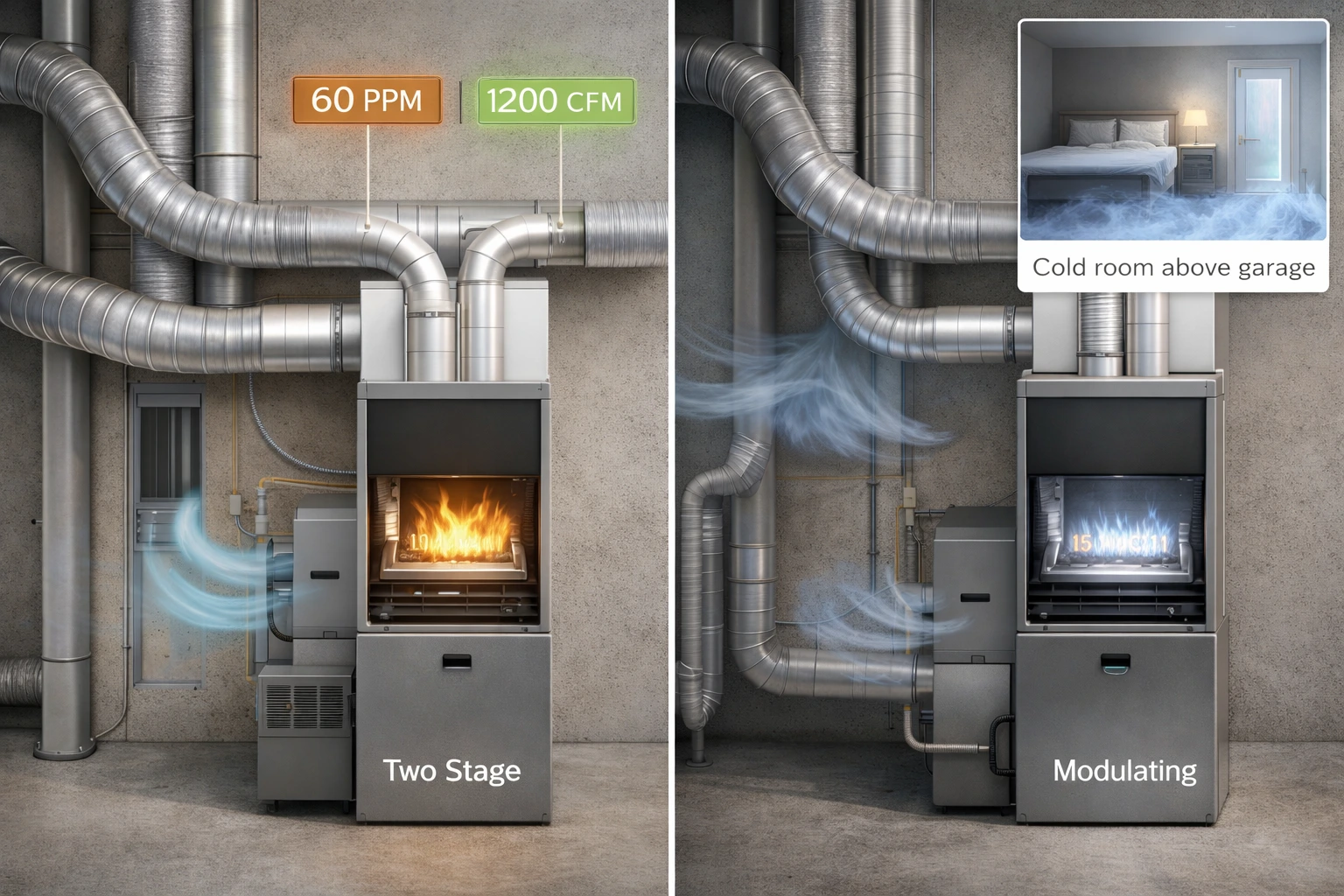
A two-stage furnace has two heating levels:
-
Low stage (typically around 60–70% capacity)
-
High stage (100% capacity)
Most of the time, the furnace runs at the lower stage, which provides steady heat without blasting the system at full power.
The high stage activates only when needed, such as:
-
During extremely cold weather
-
When the home temperature drops significantly
-
When the thermostat requires rapid heating
How It Feels in a Home
Instead of short bursts of intense heat, homeowners experience:
-
Longer heating cycles
-
More stable temperatures
-
Less noticeable furnace noise
For many homes, this creates a significant improvement in comfort compared with older single-stage systems.
What Is a Modulating Furnace?
A modulating furnace goes a step further.
Rather than having only two power levels, it can continuously adjust output, often in increments as small as 1% changes in heating capacity.
This allows the furnace to match the exact heating demand of the home.
For example:
-
Mild winter day: furnace runs at 35–40% capacity
-
Normal winter day: furnace runs at 50–60% capacity
-
Cold night: furnace ramps up gradually
Instead of cycling on and off, a modulating furnace often runs almost continuously at low power, maintaining a stable indoor temperature.
What Homeowners Notice
Homes with modulating furnaces often feel:
-
More consistently warm
-
Free of noticeable temperature swings
-
Quieter during operation
-
Better balanced between rooms
This is why modulating systems are sometimes compared to cruise control for your home’s heating system.
Cost Considerations in Canada
Cost is often the deciding factor when homeowners compare these systems.
Typical installed price ranges in Canada are roughly:
Two-Stage Furnace
-
$5,000 – $7,500 installed
Modulating Furnace
-
$7,000 – $10,000+ installed
Several factors influence the final cost:
-
Home size
-
Installation complexity
-
Ductwork condition
-
Brand and efficiency rating
-
Smart thermostat compatibility
The difference between the two options is often $1,500–$3,000.
For many households, the key question becomes:
Will the additional comfort and efficiency justify the extra cost?
Energy Savings and Efficiency
Most modern furnaces are rated by AFUE (Annual Fuel Utilization Efficiency).
High-efficiency furnaces in Canada typically fall between 95% and 98% AFUE, meaning most of the fuel is converted into usable heat.
Both two-stage and modulating systems operate in this high-efficiency range.
However, modulating furnaces can sometimes reduce energy use further because they:
-
Run longer at lower power
-
Reduce startup energy spikes
-
Maintain more stable indoor temperatures
That said, the difference in actual utility savings is often modest.
In many homes, homeowners may see:
-
5–10% additional savings with modulating systems
The larger benefit tends to be comfort and system longevity, rather than dramatic energy reductions.
Comfort Differences Homeowners Notice
While efficiency numbers matter, comfort is where the difference becomes obvious.
Two-Stage Furnace Comfort
Advantages include:
-
Reduced temperature swings
-
Longer heating cycles
-
Quieter operation than single-stage systems
But homeowners may still notice occasional cycling between stages.
Modulating Furnace Comfort
Advantages include:
-
Extremely consistent indoor temperatures
-
Minimal cycling
-
Very quiet operation
-
Even heating throughout the home
For homeowners sensitive to temperature changes, the difference can be noticeable.
Common Mistakes Homeowners Make
When replacing a furnace, several common mistakes lead to poor results.
Choosing Based on Price Alone
Many homeowners choose the lowest quote without considering:
-
Comfort improvements
-
Long-term operating costs
-
Home insulation levels
Heating systems should be selected based on home performance, not just equipment price.
Ignoring Home Efficiency First
Installing a premium furnace in a poorly insulated house often wastes money.
Better investments may include:
These upgrades reduce heating demand and improve comfort regardless of furnace type.
Oversizing the Furnace
Many contractors install furnaces that are too large for the home.
Oversized systems:
-
Short cycle frequently
-
Reduce efficiency
-
Increase wear and tear
Proper heat load calculations are essential.
Step-by-Step: How to Decide Between Two-Stage and Modulating
Choosing the right system becomes easier when you consider a few key factors.
Step 1: Consider Your Climate
In colder regions of Canada, heating systems run for much of the year.
Homes in these climates often benefit more from:
-
Longer heating cycles
-
Consistent temperature control
This can make modulating systems more appealing.
Step 2: Evaluate Your Home’s Size
Larger homes often experience uneven heating.
A modulating furnace can help balance temperatures across:
-
Multiple floors
-
Large open areas
-
Homes with complex duct systems
Smaller homes may see less difference.
Step 3: Think About Comfort Priorities
If your home frequently experiences:
-
Hot and cold spots
-
Temperature swings
-
Noisy furnace cycles
A modulating furnace may significantly improve comfort.
Step 4: Consider Budget and Long-Term Plans
If you plan to stay in your home long-term, investing in a higher-end system may make sense.
But if the furnace replacement is purely functional, a two-stage system often offers an excellent balance of cost and performance.
Rebates and Incentives in Ontario and Canada
Canadian homeowners upgrading heating systems may qualify for energy efficiency incentives depending on the program available at the time.
Programs are typically offered through:
-
Provincial energy efficiency initiatives
-
Utility companies
-
Federal retrofit programs
These programs often focus more heavily on heat pump adoption, but in some cases:
-
High-efficiency furnaces may qualify when paired with system upgrades
-
Hybrid heating systems may be eligible
Because incentives change frequently, homeowners should always verify current program details before making decisions.
When a Furnace Upgrade Makes Sense
Upgrading to a two-stage or modulating furnace typically makes sense when:
-
Your current furnace is 15–20 years old
-
Heating bills are rising
-
The system cycles frequently
-
Your home experiences uneven heating
-
Major home renovations are underway
Modern systems are significantly quieter and more efficient than older equipment.
When It Might Not Be the Best Investment
There are situations where upgrading to a premium furnace may not be the best choice.
Examples include:
-
Homes planning to transition fully to electric heat pumps
-
Houses with major insulation problems
-
Properties scheduled for large renovations or demolition
In many cases, improving the building envelope first provides better returns.
How Furnaces Fit Into a Net Zero Home Roadmap
As Canada moves toward electrification and net-zero housing, many homeowners are asking how gas furnaces fit into the long-term picture.
In many cases, furnaces become part of a hybrid heating strategy.
A common approach includes:
-
Cold-climate heat pump for most heating needs
-
High-efficiency furnace as backup during extreme cold
This approach allows homeowners to:
-
Reduce natural gas usage
-
Lower carbon emissions
-
Maintain reliable heating during Canadian winters
In these hybrid systems, two-stage or modulating furnaces can serve as effective backup heat sources.
However, homeowners planning full electrification may choose to invest more heavily in heat pump technology instead.
Conclusion
Choosing between a two-stage furnace and a modulating furnace ultimately comes down to comfort expectations, budget, and long-term plans for the home.
Two-stage furnaces offer a strong balance of efficiency, reliability, and affordability. For many Canadian homes, they represent a practical upgrade from traditional single-stage systems.
Modulating furnaces provide the highest level of temperature control and quiet operation, but they come at a higher upfront cost.
The most important decision is not simply choosing equipment. It is understanding how the heating system fits into the overall performance of the home, including insulation, air sealing, ventilation, and future electrification plans.
Homeowners who take a whole-house approach often achieve better comfort, lower energy costs, and a clearer path toward long-term efficiency improvements.