Your morning routine starts the same way most days. You turn on the shower, wait a few seconds, and hope the water reaches a comfortable temperature before someone else in the house starts the dishwasher or turns on a second tap.
Then the water goes lukewarm. Or you notice the utility bill creeping higher even though nothing else in the house has changed. For many Ontario homeowners, the water heater is one of those appliances that only gets attention when it fails or when energy costs become hard to ignore.
Water heating typically accounts for 15 to 25 percent of a household’s energy use in Canada. That makes the choice between a traditional storage tank and a tankless (on-demand) system more than a simple replacement decision. It affects monthly bills, available space, hot water reliability, and how well your home aligns with longer term efficiency goals.
This guide walks through the practical differences so you can decide what fits your household, your fuel type, and your plans for the next decade or two.
How Traditional Tank and Tankless Systems Work
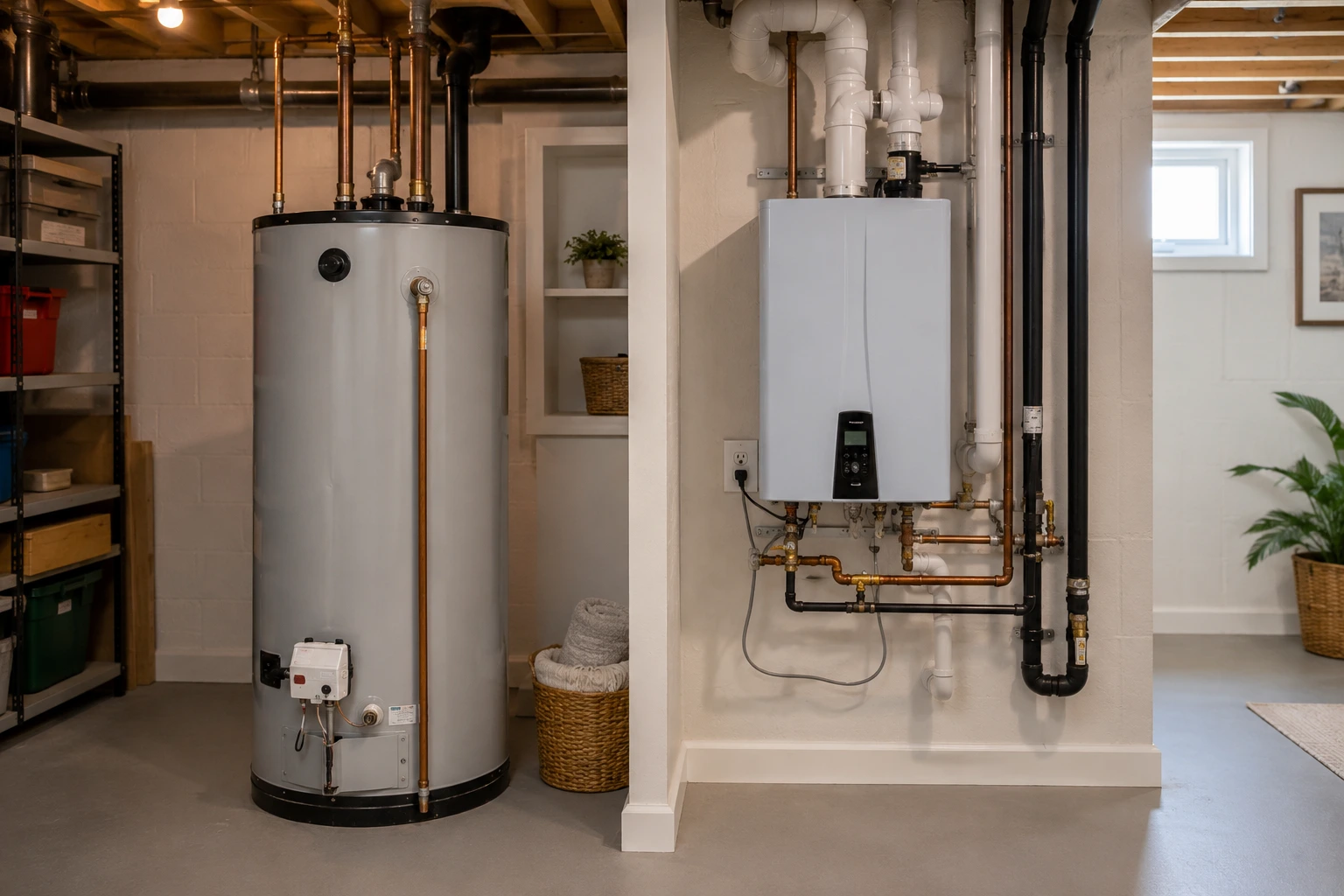
A conventional tank water heater stores a set volume of hot water—commonly 40, 50, or 60 gallons—and keeps it at a set temperature around the clock. When you open a hot water tap, water is drawn from the top of the tank while cold water enters the bottom to be heated. The burner or heating element cycles on as needed to maintain the stored temperature. This constant readiness creates what is known as standby heat loss: energy is used simply to keep the water hot even when no one is using it.
A tankless water heater has no storage tank. Cold water flows through a heat exchanger only when a tap is opened. A gas burner or electric element rapidly raises the temperature of the water as it passes through. Once the flow stops, the unit shuts off. There is essentially no standby loss. The system delivers hot water on demand, limited mainly by the unit’s flow rate capacity (measured in gallons or litres per minute) and the temperature rise required.
In colder Canadian climates, groundwater temperatures in winter can drop significantly. A tankless unit must work harder to achieve the same output temperature, which can reduce the maximum flow rate available during peak demand. Proper sizing accounts for this temperature rise.
Both systems are available in natural gas and electric versions. Gas units are still common in many Ontario homes with existing gas service. Electric models, including high-efficiency heat pump water heaters, are becoming more relevant as homes shift toward electrification.
Cost Considerations in a Canadian Context
Upfront costs differ substantially. A standard storage tank water heater, including basic installation, is generally the lower-cost option. A tankless unit typically costs more to purchase and install. Installation complexity often drives the difference. Gas tankless systems may require larger gas lines, upgraded venting (especially for high-efficiency condensing models), and proper condensate drainage. Electric tankless systems can demand significant electrical capacity and may require a panel upgrade in older homes.
Ongoing costs include energy use, maintenance, and eventual replacement. Tank systems are simpler to service. Tankless units, particularly in areas with hard water (common across parts of Ontario and other Canadian regions), usually need periodic descaling to prevent mineral buildup in the heat exchanger. Skipping this maintenance reduces efficiency and shortens equipment life.
Labour rates, permit requirements, and regional fuel prices all influence the total cost of ownership. Natural gas prices and electricity rates in Ontario fluctuate, so the relative operating cost advantage of one system over the other can shift over time. A professional assessment that factors in your current fuel type, household hot water demand, and local utility rates provides a clearer picture than national averages alone.
Energy Savings and Return on Investment
The primary efficiency advantage of tankless systems is the elimination of standby heat loss. Industry data and Natural Resources Canada guidance indicate that ENERGY STAR certified tankless units can use roughly 30 percent less energy than standard storage tank models under typical use patterns. Actual savings depend heavily on how much hot water your household uses and when it is used. Homes with high simultaneous demand or long periods of low use may see different results than smaller households with staggered schedules.
Heat pump water heaters (sometimes called hybrid electric water heaters) deserve separate mention. These units use a heat pump to move heat from the surrounding air into the water rather than generating heat directly through resistance elements. Their Uniform Energy Factor (UEF) is substantially higher than both conventional electric tanks and most electric tankless models. In suitable locations—typically a basement or utility room with adequate air volume and moderate temperatures—they can deliver the largest energy reductions among currently available residential options.
Return on investment is rarely dramatic when measured purely by energy bill savings. Payback periods for tankless systems often stretch beyond a decade when the higher installation cost is factored in. The financial case improves when you also account for longer equipment life (tankless units commonly last 15–20 years or more with proper care, versus 8–15 years for many tank models), avoided replacement costs, and potential space reclamation. For some households, the reliability of continuous hot water and the reduction in space taken by a large tank carry non-financial value that is harder to quantify but still meaningful.
Common Mistakes Homeowners Make
Several recurring issues reduce the performance or value of water heater upgrades:
- Choosing a tankless unit based solely on marketing claims of “endless hot water” without proper load calculation. If the unit is undersized for winter groundwater temperatures and peak simultaneous use, flow rates drop and temperature fluctuates.
- Ignoring water quality. Hard water accelerates scale formation inside tankless heat exchangers. Without a water softener or regular professional descaling, efficiency declines and repairs become more frequent.
- Assuming any tankless system will lower bills significantly. Savings are real but modest for many households. The biggest gains usually come from replacing an old, poorly insulated tank or switching to a heat pump water heater where conditions allow.
- Overlooking installation quality. Improper venting, inadequate gas supply, or incorrect electrical work can create safety issues, code violations, and performance problems that are expensive to correct later.
- Focusing only on the water heater while neglecting distribution losses. Long pipe runs, uninsulated pipes, and lack of a recirculation strategy (where appropriate) waste energy regardless of the heater type.
- Waiting until the existing unit fails. Emergency replacements limit options and often lead to the fastest, not necessarily the best, solution.
Step-by-Step Decision Guidance
A structured approach reduces the chance of an expensive mismatch:
- Measure current hot water use. Note how many people live in the home, typical shower lengths, laundry and dishwashing patterns, and whether multiple fixtures often run at once.
- Identify fuel type and infrastructure. Confirm whether the home has natural gas service, the capacity of the electrical panel, and the condition of existing venting or flue systems.
- Assess location constraints. Measure available space, proximity to exterior walls for venting, and ambient conditions if considering a heat pump water heater.
- Check water quality. If you have hard water or known mineral issues, factor treatment or higher maintenance into the decision.
- Obtain multiple detailed quotes. Ask each contractor for equipment model numbers, expected flow rates at your winter temperature rise, installation scope, and warranty details. Compare like for like.
- Review available incentives. Provincial and utility programs in Ontario periodically support higher-efficiency water heating equipment, particularly heat pump models. Eligibility and requirements change, so verify current offerings through official channels.
- Consider the full picture. Factor lifespan, maintenance needs, space recovery, and how the choice supports or limits future electrification or Net Zero goals.
Ontario and Canada Rebate Considerations
Ontario homeowners may find support through programs administered by Enbridge Gas and the Independent Electricity System Operator (IESO), including initiatives under the Home Renovation Savings framework. Heat pump water heaters have been eligible for incentives in recent program years. Federal and other provincial efficiency programs sometimes offer additional pathways. Requirements typically include specific ENERGY STAR or equivalent certifications, licensed installation, and documentation. Because program details and funding levels change, the practical step is to check current eligibility before finalizing equipment selection rather than assuming a particular rebate amount.
When This Upgrade Makes Sense—and When It Does Not
A tankless system tends to make sense when:
- Household hot water demand is moderate to high and simultaneous use is common.
- Space is limited and reclaiming the footprint of a large tank is valuable.
- The existing tank is near the end of its life and major plumbing or gas/electrical work is already planned.
- The homeowner prioritizes longer equipment life and is prepared for the required maintenance schedule.
It is often less compelling when:
- Hot water use is low and infrequent.
- The electrical panel or gas service would require costly upgrades that outweigh energy savings.
- Hard water is present and the household is unlikely to maintain a descaling schedule.
- A heat pump water heater is feasible and the priority is maximum energy reduction rather than continuous high flow rates.
Replacing a functional, relatively new tank purely for efficiency gains rarely pays for itself quickly. Timing the upgrade with other renovations or at the natural end of the existing unit’s life improves the overall value.
How Water Heater Choice Fits into a Net Zero Roadmap
Net Zero or deep energy retrofit pathways look at the whole house. Water heating is one of the end uses that remains after space heating and cooling loads are reduced through better envelopes and efficient HVAC. Choosing a high-efficiency water heater particularly a heat pump model where conditions allow lowers the residual energy demand that must eventually be met by on-site renewables or a cleaner grid.
Tankless systems reduce standby losses and free up floor space that can be used for other mechanical systems or storage. Heat pump water heaters offer the largest efficiency jump for electric homes and can provide a modest cooling and dehumidification benefit in the space where they are located. Both options pair more cleanly with future electrification than older, inefficient gas storage tanks.
The sequence matters. Addressing air sealing, insulation, and primary heating first usually yields larger total savings. Water heating upgrades then become more targeted and effective within a lower overall energy budget. A coordinated plan avoids installing equipment that later proves oversized or poorly matched to the finished home.
Conclusion
The choice between a tank and tankless water heater is less about which technology is universally superior and more about which one matches your household’s actual patterns, infrastructure, and long-term plans. Traditional tanks remain practical, lower-cost solutions for many homes. Tankless systems offer space savings, longer life, and the elimination of standby losses when properly sized and maintained. Heat pump water heaters currently deliver the strongest efficiency gains for suitable electric applications.
Start with a clear picture of your hot water demand, fuel type, and water quality. Obtain detailed quotes that account for Canadian climate realities, particularly colder inlet water temperatures. Review current incentive programs. Then weigh the full cost of ownership against the reliability and efficiency benefits that matter most to you.
If you would like a clear, house specific assessment of water heating options alongside other efficiency upgrades, Net Zero Homes Consulting can develop a customized upgrade roadmap that fits your home, budget, and goals.