Solar panels are no longer a simple “buy the highest-efficiency model” decision. In 2026, the right choice depends on your roof size, climate, energy goals and how solar fits into a complete home energy system.
Canadian and North American homeowners face unique conditions: cold winters, snow, shorter daylight hours, rising electricity prices and growing interest in heat pumps, batteries and EVs. The best solar panel technology for your home is the one that delivers reliable long-term energy production while supporting those larger goals.
This guide explains the main technologies available today monocrystalline, N-type, TOPCon, bifacial and related designs in plain language. It shows how they perform in Canadian climates, compares leading residential options from JA Solar, Canadian Solar, Jinko Solar and Qcells, and places solar in the context of a Net Zero Home strategy.
The core question is not “Which panel is the absolute best?” It is “Which technology and product best matches my roof, climate, electricity use and future plans?”
Short Answer: What Solar Technology Makes Sense in 2026?
For most Canadian homes, modern N-type TOPCon monocrystalline panels offer the best balance of efficiency (typically 22–24%), cost, reliability, and availability. Bifacial versions can add extra yield in snowy conditions through reflected light. Higher-efficiency back-contact or HJT panels suit space-constrained roofs. The right choice also depends on pairing solar with heat pumps, batteries, and EV charging rather than treating panels in isolation.
Why Solar Technology Choice Matters for Canadian Homes
Solar panels convert sunlight into electricity. Efficiency, temperature behaviour, degradation rate, and mechanical strength determine how much usable energy you get over 25–30 years.
In Canada, several factors shape performance:
- Cold temperatures improve electrical efficiency (panels produce more power per unit of light when cooler).
- Short winter days and low sun angles reduce total production.
- Snow can temporarily block panels but also reflects light onto bifacial modules.
- High snow and wind loads require strong mechanical ratings.
- Many homes are adding heat pumps, EVs, and batteries, which change annual electricity demand significantly.
A home that once used 8,000–12,000 kWh per year can jump to 15,000–25,000+ kWh once a cold-climate heat pump and Level 2 EV charger are added. Sizing solar only to today’s bill often leaves the system undersized for the future.
Before choosing panels, estimate total annual electricity needs after planned upgrades. A home energy assessment or detailed load calculation is the practical starting point.
Core Solar Cell and Module Technologies Explained
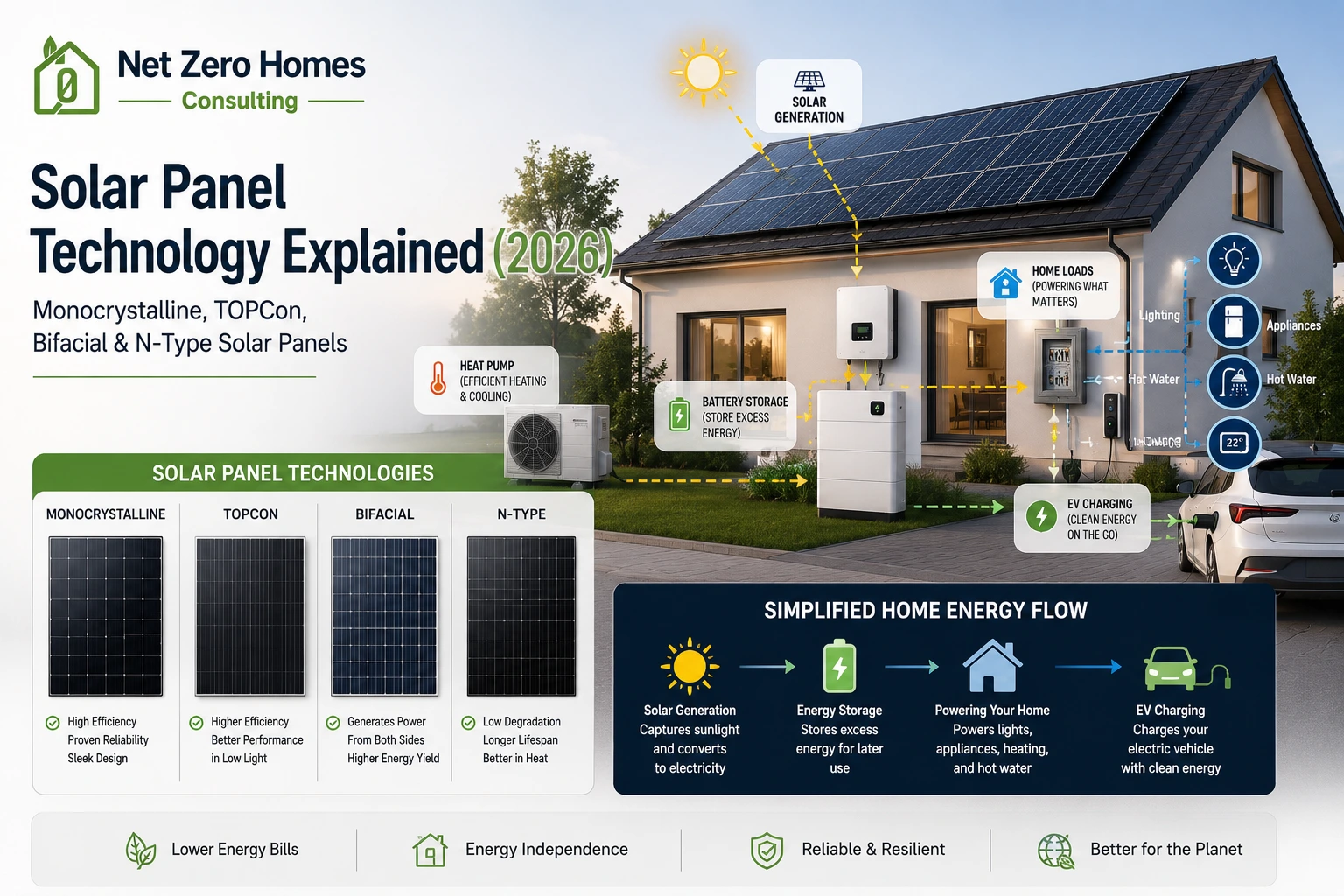
Monocrystalline
Almost all residential panels in 2026 use monocrystalline silicon cells. These are cut from a single high-purity crystal and deliver higher efficiency than older polycrystalline designs. Polycrystalline panels have largely left the market.
N-Type vs P-Type Cells
N-type cells dominate new production. They resist light-induced degradation (LID) better than older P-type cells, show lower annual degradation, and often perform better in real-world conditions. Most TOPCon, HJT, and back-contact panels use N-type silicon.
TOPCon (Tunnel Oxide Passivated Contact)
TOPCon is the mainstream residential technology in 2026. An ultra-thin oxide layer reduces electron losses and pushes module efficiencies into the 22–24.8% range for leading products. It offers a strong cost-to-performance balance and is widely available from major manufacturers.
HJT (Heterojunction)
HJT adds thin layers of amorphous silicon. It typically delivers excellent temperature coefficients (often around –0.24% to –0.26%/°C) and strong low-light performance. It remains a premium option rather than the volume leader.
Back-Contact / IBC / ABC / HPBC
These designs move electrical contacts to the rear of the cell, reducing front-side shading. Commercial efficiencies reach 24–25.5%+ on flagship models. They suit small or complex roofs where every watt per square metre counts but they usually cost more.
Bifacial vs Monofacial
Monofacial panels generate power from the front only. Bifacial panels also collect light from the rear. In Canada, snow reflection (albedo) can boost winter output. Real-world bifacial gains vary with roof height, surface reflectivity, and mounting. Dual-glass (glass-glass) construction is common on bifacial modules and improves durability.
Half-Cut Cells and Multi-Busbar
Most modern panels use half-cut cells and multi-busbar designs. These reduce internal resistance and improve shade tolerance and reliability.
Temperature Coefficient
Panels are rated at 25°C. As cell temperature rises, output falls. A coefficient of –0.26%/°C means roughly 0.26% less power for each degree above 25°C. In Canadian winters the coefficient works in reverse: colder panels produce more power than their nameplate rating under the same light. However, total winter energy is still limited by shorter days and possible snow cover.
Degradation
First-year degradation is typically ≤1% for quality N-type products. Annual linear degradation is often 0.35–0.40% thereafter. Performance warranties commonly guarantee around 87–89% output at year 25 or 30.
Mechanical Ratings
Look for snow-load ratings of 5,400 Pa or higher and strong wind-load ratings for Canadian conditions. Dual-glass modules generally handle mechanical stress well.
Solar Performance Across Canadian Climates
Cold temperatures boost instantaneous efficiency, yet winter production remains lower than summer because of fewer daylight hours and lower sun angles. Snow losses are usually modest (often 2–5% annually in many regions) when panels are properly tilted, but heavy accumulation can stop production for days until snow sheds.
Bifacial panels benefit from snow reflection. Dark module surfaces and slight operating heat help snow slide off tilted arrays. Never climb on a roof to clear snow; the risk outweighs the benefit.
Provincial differences matter:
- Ontario and Quebec – Good irradiance in southern regions, cold winters, and meaningful snow. Net metering or load-displacement options exist.
- British Columbia – Milder coastal climate, more cloud in some areas, lower snow loads in many cities.
- Alberta and Saskatchewan – High irradiance, cold winters, strong chinook effects in some zones that help clear snow.
- Manitoba and Prairies – Excellent summer production, very cold winters.
- Atlantic Canada – Lower average irradiance and more cloud, but still viable with proper design.
Cities such as Toronto, Ottawa, Montreal, Calgary, Edmonton, Vancouver, Winnipeg and Halifax each have distinct irradiance and temperature profiles. A site-specific production estimate using local weather data is more useful than national averages.
Brand and Product Family Comparison (2026 Residential Focus)
Manufacturers offer multiple product families. Efficiency and power claims apply only to specific models. The table below summarizes typical current residential or residential-suitable offerings based on available 2026 data. Exact values vary by model and datasheet; always verify the precise product quoted by your installer.
| Category | JA Solar (DeepBlue series examples) | Canadian Solar (TOPHiKu / TOPBiHiKu / Gen3 examples) | Jinko Solar (Tiger Neo series examples) | Qcells (Q.TRON series examples) |
|---|---|---|---|---|
| Cell technology | N-type TOPCon | N-type TOPCon (some HJT options) | N-type TOPCon | N-type TOPCon |
| Typical residential power | ~430–455 W (54-cell class); higher in larger formats | ~440–470 W residential; up to 650–670 W higher-power | ~430–485 W residential; higher-power up to 670 W | ~420–450 W |
| Module efficiency | Up to ~22.4–24.1% depending on series | Up to ~22.8–24.8% (Gen3 claims) | Up to ~22.5–24.8% | Up to ~22–22.5% |
| Temperature coefficient | Often ~–0.29%/°C | ~–0.26% to –0.29%/°C | ~–0.26% to –0.30%/°C | ~–0.28% to –0.30%/°C |
| First-year / annual degradation | ≤1% / ~0.35–0.40% | ≤1% / ~0.35% | ≤1% / ~0.35–0.40% | Typically low first-year / ~0.4% |
| Product / performance warranty | 12–25 yr product / 30 yr performance common | 12–25 yr product / 25–30 yr performance | 15–25 yr product / 30 yr performance | 25 yr product / 25 yr performance |
| Bifacial options | Yes | Yes (strong bifaciality claims) | Yes | Available on some models |
| Glass-glass | Common on higher models | Common | Common | Varies |
| Snow / wind load | High ratings typical | Often 5,400 Pa snow | High ratings | High ratings |
| Canadian / NA availability | Widely available | Strong Canadian brand presence | Widely available | Strong NA presence, some US manufacturing |
| Best use case | Value + solid TOPCon performance | Canadian climate familiarity + high-power options | High volume + competitive efficiency | Balanced specs + brand support |
Category observations (not absolute rankings):
- High efficiency / limited roof space: Premium TOPCon or back-contact options from the leading lines.
- Value and availability: Mainstream TOPCon from any of these Tier-1 brands.
- Snowy climates and bifacial gain: Dual-glass bifacial TOPCon models.
- Long-term degradation and warranty: Compare the exact linear performance guarantee on the quoted model.
- North American support and manufacturing: Qcells has notable US production; Canadian Solar maintains strong Canadian market presence.
The best panel is the one that fits your roof dimensions, matches inverter string design, carries a solid warranty backed by a bankable manufacturer and is installed by a competent local contractor.
Efficiency, Cost per Watt, and Total System Economics
Higher efficiency means more watts from the same roof area. On a small or partially shaded roof this can be decisive. On a large, unshaded south-facing roof the extra cost of the highest-efficiency modules may not repay itself quickly.
Installed system cost in Canada typically includes panels, inverter(s), racking, electrical work, permits and labour. Panel price is only one component. Focus on expected annual kWh production, the value of that electricity (self-consumption or net-metering credits), and net cost after any available incentives.
Connecting Solar to Heat Pumps, Batteries, and EVs
Solar + Cold-Climate Heat Pump
A heat pump can double or triple winter electricity use compared with a gas furnace. Size solar for the combined load. Example only (actual results vary widely): a 2,000 sq ft Ontario home moving from gas heat to a cold-climate heat pump might add 6,000–10,000 kWh of annual electricity demand. Solar that previously offset lighting and appliances will no longer cover the full bill without expansion or battery support.
Solar + Battery
Batteries increase self-consumption, provide backup, and enable energy shifting under time-of-use or ultra-low overnight rates. Battery capacity (kWh) is different from power output (kW). Match both to your critical loads and solar production profile.
Solar + EV Charging
A Level 2 charger can add several thousand kWh per year depending on driving distance. Future-proof the electrical panel and consider timed charging that aligns with solar production or low-rate periods.
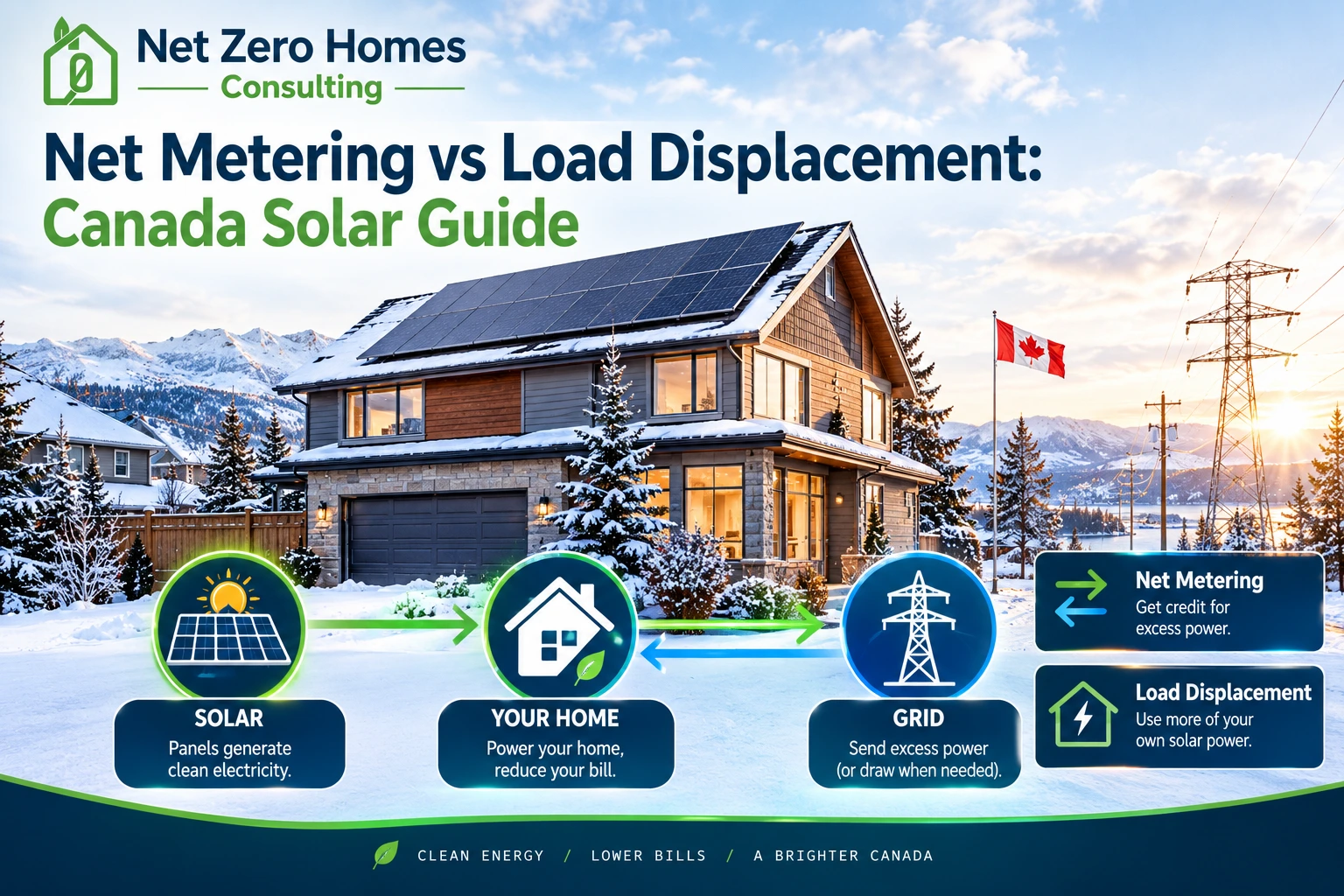
Load Displacement and Whole-Home Electrification
Using solar generation and storage to cover daytime loads, charge the battery, and supply evening heat-pump or EV demand is the practical core of a Net Zero Home approach. Electrical panel capacity, service size, and smart load management become critical when multiple large loads are added.
Realistic Homeowner Scenarios
Homeowner A – Small Roof
Limited south-facing area. Priority: highest practical efficiency and power density (premium TOPCon or back-contact). Every square metre must work hard.
Homeowner B – Ottawa / Cold Climate with Heat Pump Plans
High winter heating demand. Choose durable dual-glass TOPCon or bifacial modules with strong snow-load ratings. Size the array for post-heat-pump electricity use. Consider battery for evening heating loads.
Homeowner C – EV Owner Driving 20,000 km/year
Significant new load. Align solar size and any battery with daytime charging potential or overnight low rates. Ensure panel and electrical capacity support future Level 2 charging.
Homeowner D – Battery and Backup Focus
Wants resilience and rate arbitrage. Pair reliable TOPCon modules with a properly sized battery. Emphasize self-consumption over pure export.
Homeowner E – Full Net Zero Path
Plans solar + heat pump + EV + battery + insulation + air sealing. Start with a whole-home energy model. Choose panels that fit the long-term generation target and mechanical requirements of the roof. Coordinate electrical upgrades early.
Cost, Incentives, and Economics (Illustrative)
Installed residential solar costs in Canada vary by province, system size, roof complexity, and equipment. Typical ranges in 2026 often fall between roughly $2.50–$4.00+ CAD per watt before incentives, depending on scope. Always obtain local quotes.
Ontario examples include net metering under provincial regulation and the Home Renovation Savings Program options for solar and batteries (load-displacement path). Rules, caps, and eligibility change; confirm current details with your utility and program administrators. Other provinces have their own net-metering frameworks and occasional incentives. Federal programs and tax treatments also evolve. U.S. incentives such as the ITC do not apply in Canada.
Calculate potential annual energy value from expected production, then subtract system cost, ongoing maintenance, and financing to understand net economics. Do not rely on generic payback claims.
Frequently Asked Questions
What are the best solar panels for Canada in 2026?
Quality N-type TOPCon panels from established manufacturers generally offer the best balance for most homes. Match the specific model to your roof and climate.
Do solar panels work in Canadian winters?
Yes. Cold improves efficiency, but shorter days reduce total output. Snow is temporary for properly designed systems.
Are TOPCon panels better than older technologies?
For most new installations, yes. They deliver higher efficiency and lower degradation than mainstream P-type PERC.
Are bifacial panels worth it in Canada?
They can be, especially where snow reflection or elevated mounting provides rear-side light. Gains are site-specific.
Which is better: JA Solar, Canadian Solar, Jinko, or Qcells?
All are capable Tier-1 options. The specific model, warranty terms, local installer support, and fit to your roof matter more than the brand name alone.
How much do solar panels degrade each year?
Quality N-type modules typically show ≤1% first-year loss and 0.35–0.40% annual thereafter under warranty terms.
What efficiency should I look for?
22%+ is mainstream and strong. Higher efficiencies help most on limited roof space.
Do I need a battery with solar?
Not always, but batteries improve self-consumption, backup, and flexibility with time-of-use rates and heat-pump or EV loads.
Should I size solar for my current bill or future loads?
Future loads. Heat pumps and EVs change consumption substantially.
Is a higher temperature coefficient better or worse?
A lower absolute value (e.g., –0.26% vs –0.34%) is better because it loses less power in heat. Cold still benefits all panels.
Can solar panels handle Canadian snow loads?
Quality modules with 5,400 Pa ratings are designed for heavy snow. Proper mounting is essential.
How does solar fit a Net Zero Home?
It supplies renewable generation that pairs with efficiency upgrades, heat pumps, storage, and smart loads to approach or reach net-zero energy use.
Which Technology Right for Your Whole Home?
Choosing solar panels is only one decision inside a larger energy strategy. The highest-efficiency module on a poorly insulated house with an undersized electrical service and no plan for heat pumps or EVs will under-deliver on comfort, cost savings and carbon reduction.
Start with a clear picture of current and future electricity use. Evaluate the roof, structure, and electrical capacity. Then select panel technology and equipment that support the complete system solar generation, efficient heating, storage, and transportation electrification.
Net Zero Homes Consulting provides vendor-neutral education and planning support so homeowners can make informed decisions before purchasing. Book a consultation to review your home’s energy profile, roof potential, and integrated options for solar, heat pumps, batteries, and EV charging. A coordinated plan produces better long-term results than any single product choice