Buying a vehicle in 2026 is no longer just about horsepower, range, or monthly payments. For North American homeowners, it is a decision that reshapes your electricity bill, your electrical panel, your solar potential, your backup power strategy, and the long-term path toward a Net Zero Home.
This guide connects the vehicle choice to the rest of the home energy system. It is written for Canadian and U.S. homeowners—first-time EV buyers, families, rural residents, condo owners, cottage owners, renovators, and anyone planning electrification upgrades. The goal is simple: help you decide whether a battery electric vehicle (BEV), plug-in hybrid (PHEV, hybrid (HEV), or even keeping your current gasoline vehicle makes the most sense for your driving, your home, and your energy future.
We remain vendor-neutral on vehicles while explaining how each option interacts with home charging, solar, battery storage, heat pumps, and resilience. One home energy platform that frequently appears in integrated discussions is Sigenergy’s SigenStor system because of its modular design, AI optimization, and bidirectional readiness features that matter when an EV becomes part of the home energy ecosystem.
Understanding the Three Electrified Options (and Gasoline)
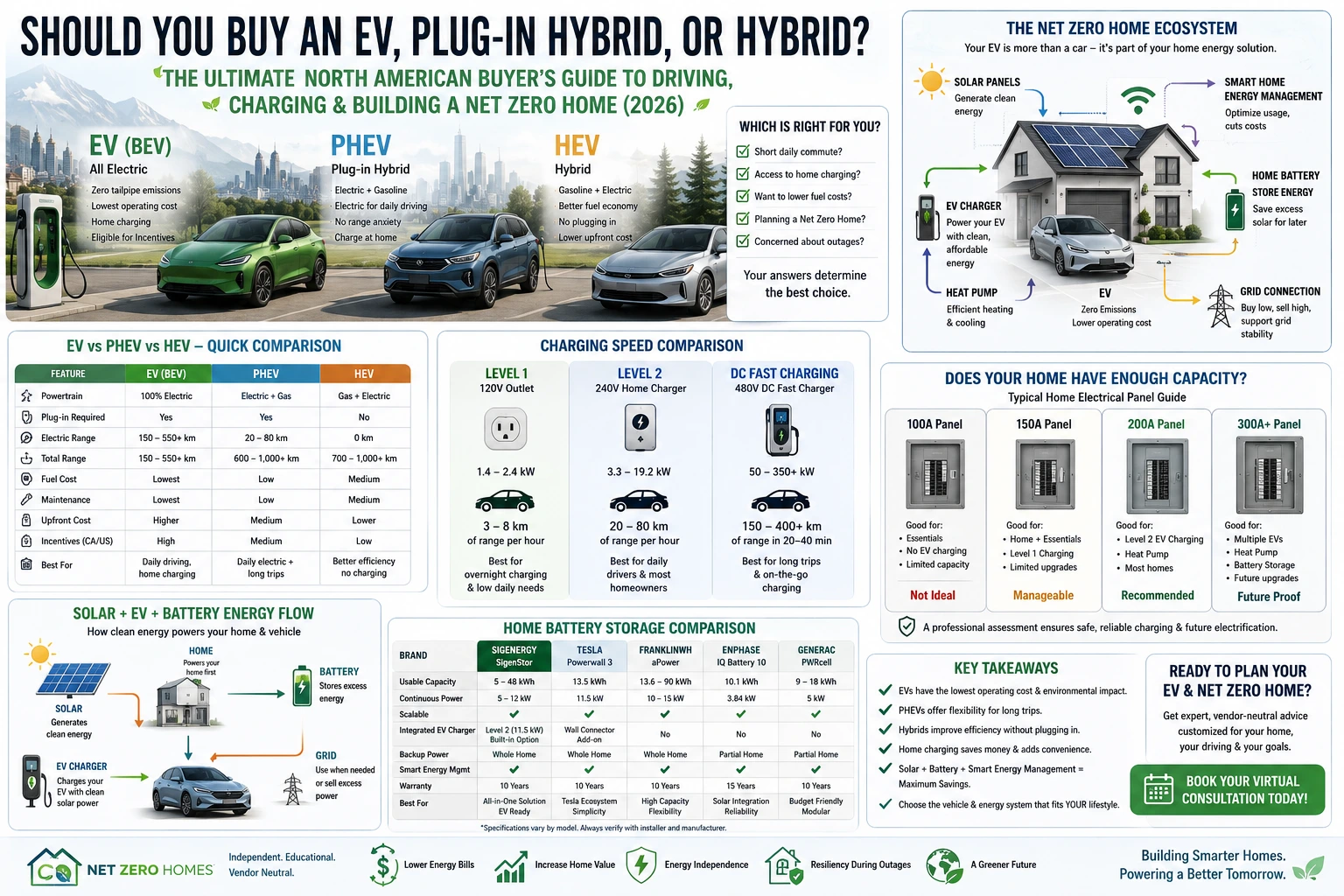
Battery Electric Vehicle (BEV) Runs only on electricity stored in a large battery. No gas engine. Zero tailpipe emissions. Lowest operating cost when charged at home. Requires access to charging. Typical range today: 250–400+ miles / 400–650+ km depending on model and conditions.
Plug-in Hybrid Electric Vehicle (PHEV) Combines a battery (usually 20–50+ miles / 30–80+ km of electric range) with a gasoline engine. You can drive short trips on electricity and switch to hybrid mode for longer trips. Higher purchase price than a regular hybrid, more complex maintenance than a pure EV.
Hybrid Electric Vehicle (HEV) Uses a small battery and electric motor to assist a gasoline engine. Never plugs in. Better fuel economy than a conventional gas car, especially in city driving. No charging infrastructure needed. Lowest step-up cost for many buyers.
Gasoline / Diesel Familiar. Widespread refueling. Higher fuel and maintenance costs over time. Increasingly restricted in some cities and subject to future policy pressure.
Consumer Reports and other independent testers continue to emphasize that the right choice depends on daily driving distance, access to home or workplace charging, climate, and how long you plan to keep the vehicle.
Who Should Buy What? A Practical Decision Framework
Buy a BEV if:
- You drive mostly under 50–60 miles / 80–100 km per day.
- You have (or can install) reliable home or workplace charging.
- You want the lowest energy cost per mile and lowest maintenance.
- You are ready to integrate the vehicle into a broader home energy plan (solar + storage).
- You live in an area with decent public fast-charging coverage for occasional longer trips.
Buy a PHEV if:
- Your daily commute fits within the electric range most days, but you frequently take longer trips or live in an area with sparse fast charging.
- You cannot install home charging easily (some apartments, rentals, or shared parking).
- You want a bridge technology while public charging and home infrastructure improve.
- You value the ability to use electricity for local driving without range anxiety on road trips.
Buy a regular Hybrid (HEV) if:
- You cannot charge at home or work.
- You drive long distances regularly and public charging is inconvenient.
- Budget is the primary constraint and you still want better fuel economy than a pure gas car.
- You plan to keep the vehicle a long time and prefer mechanical simplicity relative to a PHEV.
Consider waiting or keeping your current vehicle if:
- Your electrical service cannot support Level 2 charging without a costly upgrade and you are not ready for that work.
- You drive very few miles per year (the fuel savings take longer to pay back).
- You live in an extreme climate with poor public charging and no home charging option.
- Your current vehicle is reliable, paid off, and meets your needs for another 3–5 years while technology and incentives evolve.
Buyer Personas in Brief
- Daily urban/suburban commuter with driveway: BEV is usually the clear winner on cost and convenience.
- Family with kids and weekend trips: Mid-size BEV SUV or a longer-range PHEV.
- Rural or farm homeowner: BEV truck/SUV with strong towing and V2H capability, or a capable hybrid if charging access is limited.
- Cottage owner: PHEV or hybrid often wins because seasonal use and variable charging access favor flexibility.
- Condo / apartment dweller: Hybrid or PHEV unless the building has dedicated EV parking and charging.
- Long-distance traveler / sales rep: Longer-range BEV with good fast-charging network support, or a PHEV.
- Retiree with short trips: Compact or mid-size BEV; lowest operating cost and quiet operation are attractive.
- Uber/Lyft or high-mileage driver: BEV with home/workplace charging delivers the biggest savings; watch battery warranty and degradation carefully.
Home Charging: The Foundation of EV Ownership
Most EV miles in North America are charged at home. Understanding the three levels is essential.
Level 1 (120 V standard outlet) Adds roughly 3–5 miles / 5–8 km of range per hour. Fine for very short daily driving or overnight top-ups on a small battery. Slow for most modern BEVs.
Level 2 (240 V) The practical standard for homes. 7–19 kW depending on the charger and circuit. Adds 20–60+ miles / 30–100+ km of range per hour. A full charge overnight is realistic for most vehicles.
DC Fast Charging (public) 50–350+ kW. Useful for road trips. Significantly more expensive per kWh than home electricity and harder on the battery if used daily.
Installation realities in 2026 A hardwired Level 2 charger typically costs $800–$2,500 for the unit plus $500–$2,000+ for installation if the electrical panel and wiring are adequate. Panel upgrades (common when the service is 100 A or older and multiple large loads exist) can add $2,000–$8,000 or more depending on the utility and local codes. Always have a licensed electrician evaluate service capacity, available amperage, and future loads (heat pump, induction range, second EV, home battery).
Time-of-use (TOU) rates and demand charges matter. Charging overnight on off-peak rates can cut energy cost dramatically. Smart chargers and home energy management systems can automatically schedule charging and even pause it during peak periods.
How an EV Changes Your Home Electricity Picture
A typical BEV driven 12,000–15,000 miles / 19,000–24,000 km per year adds roughly 3,000–5,000 kWh of annual electricity use (at ~3–4 miles per kWh). At U.S. average residential rates around 18–19 ¢/kWh in mid-2026, that is roughly $550–$950 per year—still far below equivalent gasoline costs for most drivers. Canadian rates vary widely; Quebec and Manitoba hydro provinces are among the lowest, while some Atlantic and northern regions are higher.
Peak demand rises when the charger runs at the same time as other large loads. A 48 A Level 2 charger draws significant continuous power. Load management, smart panels, or scheduled charging solve most issues. Future loads (heat pumps, induction cooking, second vehicle, home battery) should be planned together so the electrical service is sized once.
Solar and the EV: Natural Partners
Rooftop solar produces electricity during the day; most home EV charging happens at night. Without storage or smart controls, the match is imperfect. With proper design, solar can offset a large portion (sometimes all) of EV charging costs over the year.
Key points:
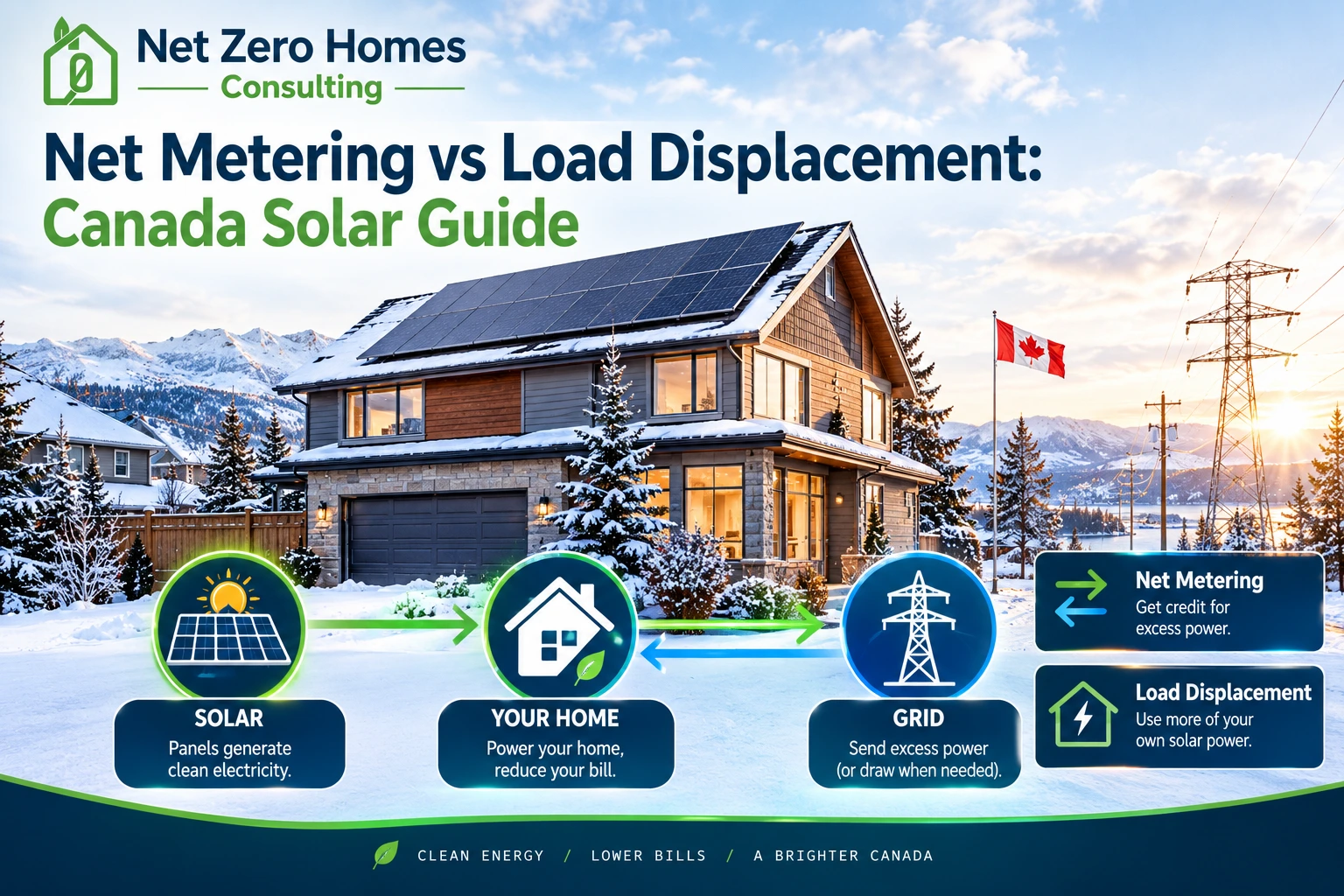
Net metering policies differ by province, state, and utility. Some still offer full retail credit; others have moved to avoided-cost or time-varying credits.
- Seasonal production is lower in Canadian and northern U.S. winters exactly when EV range also drops and heating loads rise.
- Payback periods for solar + EV combinations commonly fall in the 6–12 year range depending on incentives, electricity rates, and system size, but every home is different.
- Oversizing solar slightly and pairing it with battery storage improves self-consumption and resilience.
Energy independence rises when solar, storage, and the EV work as one system.
Home Battery Storage: Why EV Owners Should Care
A home battery does three main jobs for EV owners:
- Stores daytime solar for nighttime charging (load shifting / load displacement).
- Provides backup power during outages.
- Enables peak shaving and participation in utility demand-response or future grid services.
Leading systems available in North America in 2026 include:
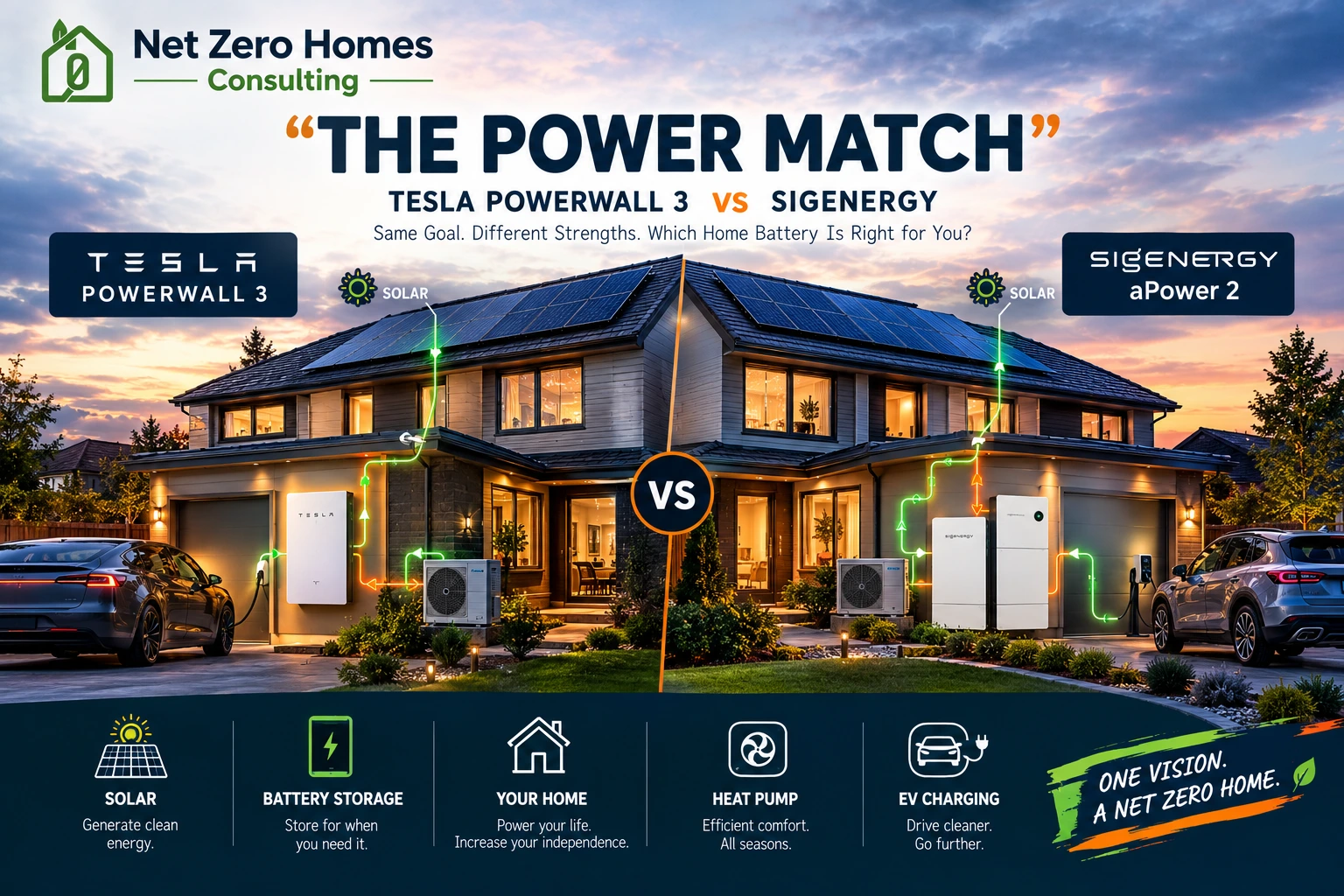
| Feature | Tesla Powerwall 3 | Sigenergy SigenStor | FranklinWH aPower 2 | Enphase IQ Battery |
|---|---|---|---|---|
| Usable capacity (per unit) | 13.5 kWh | 5.84 / 8.76 kWh modules | ~13.6–15 kWh | 3.84–5 kWh (5P) / higher modules |
| Max practical stack | ~54 kWh | 48+ kWh | Very high (100+ kWh) | Highly modular |
| Continuous power | 11.5 kW | Up to 11.5 kW | ~5–10 kW | Lower per module |
| Chemistry | LFP | LFP | LFP | LFP |
| Integrated hybrid inverter | Yes | Yes | Often AC-coupled | Pairs with microinverters |
| Whole-home backup | Yes | Yes | Yes | Yes (with sufficient capacity) |
| Bidirectional EV / V2X | Limited (Cybertruck Powershare) | Yes (V2H/V2X ready) | No | No |
| AI / smart optimization | Strong cloud app | Onboard AI + smart circuits | Smart circuits | Strong monitoring |
| Warranty | 10 years | 10 years | 15 years | 15 years |
Sigenergy SigenStor stands out for homeowners who want an integrated energy management platform. It combines modular battery capacity, hybrid solar inverter capability, onboard AI for time-of-use optimization and load prioritization, whole-home backup, and explicit readiness for vehicle-to-home / vehicle-to-everything applications.
Expandable capacity and relatively competitive installed cost per kWh make it attractive for phased Net Zero upgrades. Like any system, real-world performance depends on proper design, certified installation, and local utility interconnection rules. It complements future bidirectional EV ecosystems without requiring the homeowner to overstate current capabilities of every vehicle.
Other strong options exist. Tesla offers polished software and high continuous power. FranklinWH scales well for large homes and works as an AC-coupled retrofit. Enphase is the natural choice for homes already using Enphase microinverters and offers a long warranty.
Vehicle-to-Home (V2H) and Bidirectional Charging
V2H allows a compatible EV to power the home during an outage or to support loads when electricity prices are high. The vehicle’s large battery (often 60–130+ kWh) can provide far more energy than a typical residential battery pack.
Current production or near-term capability (2026):
- Ford F-150 Lightning: Mature Intelligent Backup Power system with Charge Station Pro and home integration hardware. Roughly 9.6 kW output. Proven multi-day backup potential depending on loads and battery size.
- Tesla Cybertruck: Powershare technology enables vehicle-to-home and vehicle-to-load with appropriate gateway and switchgear.
- Hyundai / Kia (E-GMP vehicles such as Ioniq 5, EV6, EV9): Bidirectional capability available with compatible DC bidirectional chargers (e.g., certain Wallbox models). Power levels typically in the 3.6–12 kW range depending on configuration.
- GM Ultium platform vehicles (Silverado EV, various SUVs): Higher power bidirectional capability with GM Energy equipment.
- Nissan (certain Leaf and future models): Limited V2H/V2L history; evolving.
- Other manufacturers have announced plans; actual production hardware and software readiness varies.
V2H is not yet universal. It requires compatible vehicle software/hardware, a bidirectional charger or integration system, proper electrical transfer equipment, and usually utility approval or notification. Benefits during multi-day outages (especially in rural or extreme-weather areas) are substantial. Pairing a V2H-capable EV with a home battery and solar creates layered resilience.
Winter Performance in Canada and Northern U.S. States
Cold weather reduces EV range—typically 15–35% depending on temperature, driving style, cabin heating, and whether the vehicle has a heat pump. Real-world Canadian testing (CAA and independent tests) shows wide variation:
Vehicles with heat pumps and good thermal management (many Teslas, certain Hyundai/Kia, Rivian, some GM and Ford models) retain a higher percentage of rated range. Preconditioning while plugged in is one of the most effective strategies. AWD models improve winter traction. Battery preconditioning before DC fast charging is also important in cold conditions.
Best winter performers in recent tests often include certain Tesla models, the Chevrolet Silverado EV (large battery), Polestar 2, and select Hyundai/Kia AWD models. Always check the latest real-world data for the specific model year.
Cost Analysis: Looking Beyond the Sticker Price
Purchase price BEVs and PHEVs still carry a premium over comparable gasoline vehicles, though the gap has narrowed. Incentives (federal, provincial/state, utility) can reduce the net cost significantly, but eligibility rules, income caps, and vehicle price caps change. Verify current programs with Natural Resources Canada, the U.S. Department of Energy / IRS guidance, and local utilities.
Operating costs (illustrative North American ranges)
- Home charging: often $0.04–$0.08 per mile / $0.025–$0.05 per km depending on electricity rates and vehicle efficiency.
- Gasoline equivalent: frequently 2–4× higher at 2026 pump prices.
- Maintenance: BEVs typically require less (no oil changes, fewer brake jobs due to regenerative braking, simpler drivetrain). PHEVs sit in the middle. Hybrids are better than pure gas but still need conventional service.
Home-side costs
- Level 2 charger + install: $1,500–$4,500 typical.
- Panel upgrade: $2,000–$8,000+ when needed.
- Solar: highly variable; $2.50–$4.00+ per watt installed before incentives, declining over time.
- Home battery: $10,000–$20,000+ per 10–15 kWh usable capacity installed, depending on brand and complexity.
Total cost of ownership (5–20 years) Over 10–15 years, a BEV with home charging and modest solar often wins on pure economics for high-mileage drivers in high-electricity-price or high-gasoline-price regions. PHEVs can be competitive when electric miles cover most daily driving.
Hybrids remain strong when charging is unavailable. Resale values, battery degradation (most modern warranties cover 8 years / 100,000–160,000+ km to 70% capacity), and insurance (sometimes higher for EVs) must be factored in. Location-specific electricity rates, incentives, and driving patterns dominate the outcome—run the numbers for your situation.
Comparison Tables (Summary Guidance)
EV vs PHEV vs HEV
- Energy cost: BEV lowest → PHEV middle → HEV highest of the three.
- Infrastructure needed: BEV high → PHEV medium → HEV none.
- Complexity / maintenance: BEV lowest → HEV medium → PHEV highest.
- Range flexibility: HEV/PHEV higher for long trips without planning; BEV requires charging access.
- Emissions (well-to-wheel): BEV lowest in most North American grids; improving as grids clean up.
Charging Types
- Level 1: cheapest hardware, slowest.
- Level 2: best daily home solution.
- DC Fast: travel tool, higher cost and battery stress if overused.
Vehicle Categories (illustrative 2026 landscape) Major players: Tesla (Model 3/Y, Cybertruck, etc.), Ford (Mustang Mach-E, F-150 Lightning), GM (Equinox EV, Silverado EV, Cadillac, etc.), Hyundai/Kia/Genesis (Ioniq 5/6, EV6/9, etc.), Toyota/Honda (strong hybrid and PHEV focus, growing BEV), Nissan, Volkswagen Group, BMW, Mercedes, Volvo/Polestar, Rivian, Lucid, and emerging options including limited BYD availability in Canada. Best “family,” “budget,” “luxury,” “work truck,” “winter,” and “long-distance” choices shift with model-year updates, incentives, and real-world data—check current EPA/NRCan ratings and independent tests.
Building the Net Zero Home Ecosystem
An EV is one node in a larger system:
- Heat pumps for space and water heating
- High-performance insulation, air sealing, and windows
- Solar generation
- Battery storage
- Smart electrical panel / energy management
- Level 2 (or bidirectional) EV charger
- Monitoring and automation
A home energy audit is the logical starting point. From there, prioritize measures with the best return and comfort impact. The EV accelerates the economics of solar and storage because it is a large, controllable, flexible load (and potential supply source via V2H).
Net Zero Homes positions itself as an independent educational resource helping homeowners map this integrated path rather than selling any single product.
Frequently Asked Questions (25+)
- Should I buy an EV or a hybrid? Depends on daily miles and charging access. See the decision framework above.
- Can my house charge an EV? Most can with a Level 2 circuit; older 100 A services may need evaluation or upgrade.
- Do I need a panel upgrade for an EV charger? Not always. An electrician can determine available capacity.
- How much does Level 2 charging cost to install? Typically $1,500–$4,500 all-in; more with panel work.
- Is solar worth it with an EV? Often yes, especially with storage or favorable net metering.
- Can my EV power my house? Only if it has bidirectional capability and you have the proper home equipment (V2H).
- Which EVs support Vehicle-to-Home today? Ford F-150 Lightning, Tesla Cybertruck (Powershare), select Hyundai/Kia with compatible chargers, GM Ultium models with GM Energy gear, and a growing list.
- Does cold weather kill EV range? It reduces it 15–35%. Heat pumps and preconditioning help significantly.
- Do I need a home battery if I buy an EV? Not required, but highly complementary for solar self-consumption and outage resilience.
- What is the best battery for EV owners? Depends on existing solar, desire for V2X, budget, and expandability. Sigenergy, Tesla, FranklinWH, and Enphase each have strengths.
- How much does it cost to charge an EV at home? Usually equivalent to $1–$3 per gallon of gasoline or less, depending on rates and efficiency.
- Are there still EV rebates in 2026? Federal, provincial, state, and utility programs exist but change frequently—verify current eligibility.
- Can I install a charger myself? Not recommended. Electrical work should be done by a licensed professional for safety and code compliance.
- Which EV has the best battery warranty? Most major brands offer 8 years / 100,000–160,000+ km to 70% capacity; check specifics.
- Is a PHEV better than a hybrid if I rarely plug in? Usually not—the extra battery weight hurts efficiency when running on gas.
- What happens during a power outage with an EV? Without V2H or a home battery, the EV cannot charge and cannot power the house. With proper equipment it can become a major backup source.
- How do I future-proof my home for EVs and electrification? Size the electrical service adequately, install conduit for future chargers, plan for heat pumps and storage, and choose open or widely supported energy management systems.
- Are EVs good for rural homeowners? Yes if you can charge at home; long-range models and V2H trucks are particularly useful.
- What about condo and apartment owners? Charging access is the limiting factor. Hybrids or PHEVs are often more practical until building infrastructure improves.
- How much range do I really need? Most drivers need far less than they think for daily use. 250–300 miles / 400–480 km covers the vast majority of days for most people.
- Will battery prices keep falling? Long-term trend is downward, but short-term fluctuations occur.
- Is bidirectional charging safe for the battery? Manufacturers design within warranty parameters; heavy daily cycling could accelerate wear—use for backup and high-value arbitrage rather than constant cycling unless the system is optimized for it.
- How do demand charges affect EV charging? In some commercial or certain residential rate structures they matter. Home energy management can mitigate them.
- Should I wait for better technology? If your current vehicle works and charging access is difficult, waiting can make sense. If you drive a lot and can charge at home, the operating savings start immediately.
- Where can I get personalized advice? A professional home energy assessment that includes vehicle, charging, solar, storage, and electrification options is the most reliable next step.
The best vehicle decision is the one that fits both your daily life and the long-term energy plan for your home. Whether you ultimately choose a pure electric vehicle, a plug-in hybrid, a conventional hybrid, or decide to wait, understanding the interaction between the car and your electrical system, solar potential, storage options, and resilience needs puts you in control.
Book a Virtual Net Zero Home Consultation to receive personalized guidance on:
- EV ownership and charging feasibility for your specific home
- Electrical panel and service evaluation
- Solar feasibility and production estimates
- Battery storage recommendations (including integrated platforms such as Sigenergy where appropriate)
- Heat pump and full home electrification sequencing
- Available incentives and a practical roadmap
You do not have to electrify everything at once. A clear, prioritized plan turns a vehicle purchase into the first (or next) step toward lower operating costs, greater energy independence, and a more resilient home.
This guide is educational and vendor-neutral. Technology, incentives, utility rates, and model availability change. Always verify current specifications, local codes, incentive eligibility, and professional installation requirements for your location.