Your water heater is one of the quietest energy users in the house until the bill arrives. In many Canadian homes it ranks second only to space heating. Whether you currently run a standard electric tank, a gas tank, or a tankless unit, the technology has not changed much for decades. That is starting to shift in 2026.
Homeowners exploring heat pumps for space heating, home electrification, and net zero renovations are increasingly looking at the next logical upgrade: heat pump water heaters. These systems use the same heat moving principle as cold climate heat pumps, but applied to domestic hot water. The result is dramatically lower energy use, lower operating costs, and a clear step toward a lower carbon home.
This guide explains how heat pump water heaters work in Canadian conditions, how they compare with traditional systems, what they cost after Ontario rebates, and whether they make sense for a typical home. The goal is practical clarity so you can decide if this is the right next move.
Short Answer
Heat pump water heaters (also called hybrid water heaters) use electricity to move heat from the surrounding air into a storage tank instead of generating heat with resistance elements. They typically deliver 2–4 times more hot water energy than the electricity they consume. In Ontario, installed costs run roughly $2,000–$5,500 before a $500 Home Renovation Savings rebate. They work well in Canadian homes when installed in a basement or utility space with adequate air volume and can cut water-heating energy use by 50–70% compared with a standard electric tank.
What Is a Heat Pump Water Heater?
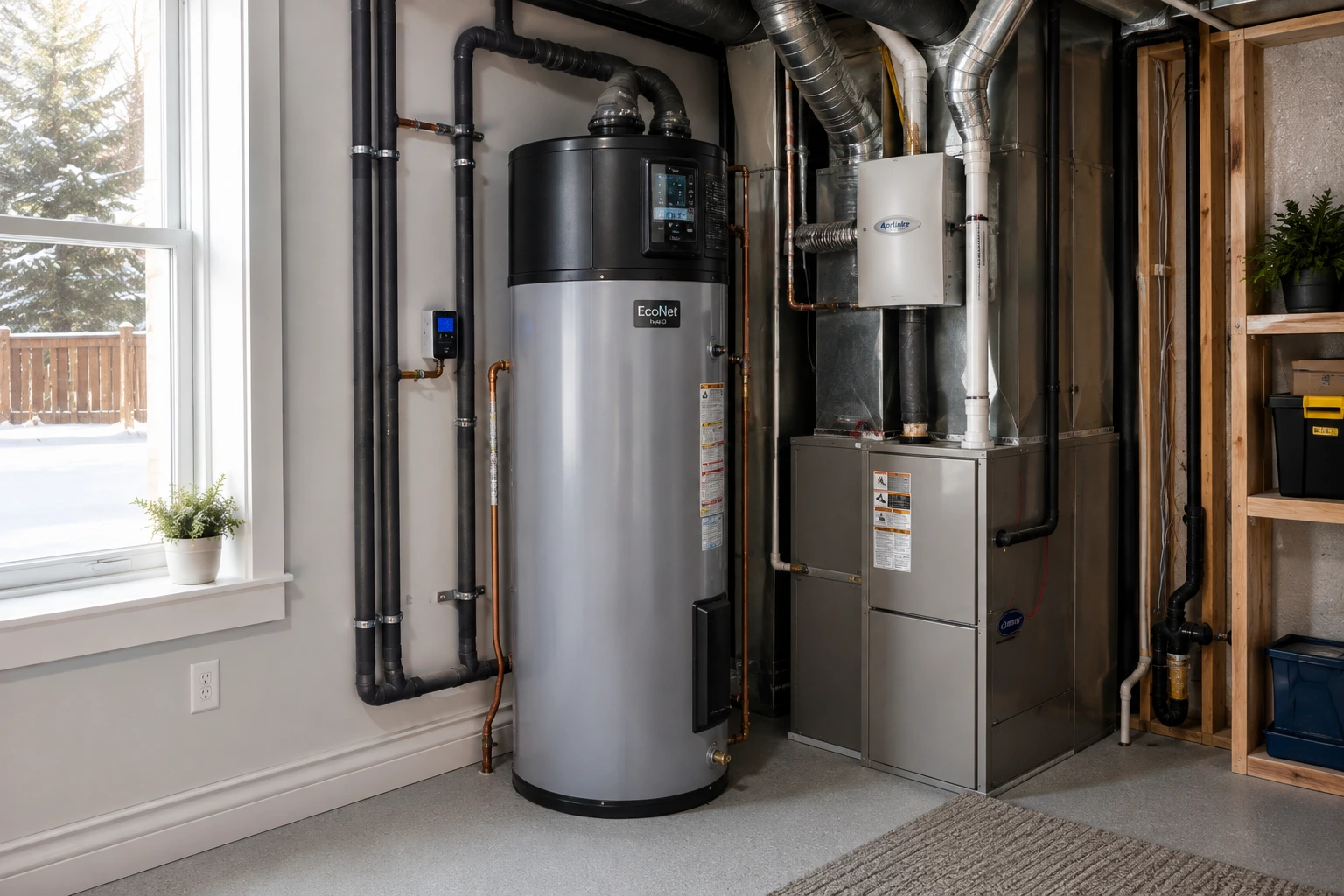
A heat pump water heater looks similar to a conventional tall electric tank, but the top section contains a small heat pump. It pulls warm air from the room, extracts heat from that air using a refrigerant cycle, and transfers the heat into the water stored in the tank.
The process is the same principle used in refrigerators and air conditioners just reversed. Because the system moves existing heat rather than creating it from scratch, efficiency is much higher. Most models are hybrids. They run primarily in heat-pump mode and switch to conventional electric resistance elements only when the surrounding air is too cool or when you need a large volume of hot water quickly.
Key efficiency metrics you will see:
- Uniform Energy Factor (UEF): modern heat pump water heaters typically rate 2.2 to 4.0 or higher. A standard electric tank sits around 0.90–0.95. A gas tank is usually 0.60–0.70.
- Coefficient of Performance (COP): often 3.0–4.0 under favourable conditions, meaning three to four units of heat delivered for every unit of electricity used.
These numbers translate directly into lower electricity consumption for the same amount of hot water.
Why This Matters for Canadian Homeowners
Hot water accounts for a large share of household energy use year-round. In homes still using older electric tanks, the cost and carbon impact add up quickly. Gas water heaters remain common where natural gas is available, but many homeowners are already electrifying space heating and want to eliminate combustion appliances entirely.
Canadian winters create specific conditions. Groundwater arrives colder in January and February, so every water heater works harder. At the same time, basements and utility rooms stay relatively cool exactly the kind of environment where a heat pump water heater can pull heat efficiently without overheating the living space.
Aging systems drive replacement decisions. When a tank reaches the end of its 10–15 year life, the upgrade window opens. Government direction continues to favour electrification and carbon reduction. Ontario’s Home Renovation Savings Program includes a specific rebate for qualifying heat pump water heaters, making the economics more attractive in 2026 than they were a few years ago.
For households already planning a cold climate heat pump for space heating, solar, or broader net zero work, adding a heat pump water heater completes a coherent electrification package and multiplies the long term savings.
How Heat Pump Water Heaters Work and What to Expect in Canada
The outdoor style cold climate heat pump extracts heat from outdoor air. A heat pump water heater does the same job indoors. It draws room air across an evaporator coil, the refrigerant absorbs heat, a compressor raises the temperature, and a condenser coil releases that heat into the water tank.
Most residential units are integrated the heat pump sits on top of the storage tank. Some newer split designs place the compressor outdoors, but the majority of Canadian installations remain integrated models placed in basements, mechanical rooms or heated garages.
Performance depends on ambient air temperature and volume. Manufacturers generally recommend a space with at least 700–1,000 cubic feet of air and temperatures ideally above roughly 5–10°C for optimal heat pump only operation. Below that threshold the unit automatically engages the electric resistance elements, so you never lose hot water. The hybrid design is the reason these systems remain practical across Canadian climates.
In summer the unit provides a small amount of free cooling and dehumidification to the room where it sits helpful in many basements. In winter it slightly increases the space heating load because it is removing heat from the indoor air. Independent Canadian studies show the net energy balance is still strongly positive when replacing a standard electric tank.
Installation considerations that matter:
- Adequate air volume and clearance around the unit for airflow.
- A condensate drain line (the unit produces condensate like an air conditioner).
- Proper electrical circuit (most require 240 V).
- Noise level—modern units are quieter than older models, typically in the mid-40s to low-50s dB range.
- Location away from bedrooms if possible, though many basements work fine.
Refrigerants in current models are typically low GWP options consistent with evolving Canadian standards. Trained installers handle charging and safety requirements.
Cost Breakdown: Equipment, Installation, Rebates and Savings
Typical 2026 Ontario installed costs for a quality heat pump water heater (50–80 gallon range) fall between $2,000 and $5,500, with mid-range hybrid models commonly landing around $3,500–$4,800 before incentives. Higher-end smart models with advanced controls and longer warranties sit toward the upper end. Electrical work, condensate plumbing, and old-tank removal are usually included in complete quotes.
Maintenance is straightforward: periodic filter cleaning (if the model has one), annual professional inspection of the heat-pump components, and the same anode rod and flushing attention any tank needs. Annual cost is usually modest similar to or only slightly higher than a conventional electric tank.
Ontario’s Home Renovation Savings Program currently offers a flat $500 rebate for an eligible ENERGY STAR heat pump water heater installed by a participating contractor. No full home energy audit is required for this single measure in most cases. Some municipal or utility top-ups may still be available depending on location. The Canada Greener Homes Loan can help finance larger electrification packages that include a water heater.
Long term operating costs are where the advantage appears. A typical four-person Ontario household using a standard electric tank might spend $500–$700 per year on water heating electricity. The same household with a heat pump water heater often sees $140–$250 per year under current rates. Savings versus gas are smaller or comparable depending on local gas and electricity prices, but the carbon reduction and elimination of combustion are additional benefits for many homeowners.
Simple payback against a standard electric tank commonly falls in the 4–8 year range after the rebate, depending on hot-water use, electricity rates, and exact installed cost. Against an aging gas tank the financial case is more nuanced and often hinges on whether the homeowner prioritizes full electrification.
Real-Life Example: 2,000 sq ft Ontario Home
Consider a typical 2,000 square foot two-storey home in the Greater Toronto or Ottawa area with a family of four. The existing water heater is a 10 year old 60 gallon electric tank. Annual electricity cost attributable to hot water runs approximately $550–$650. The tank is nearing end of life and the owners are already exploring a cold climate heat pump for space heating as part of a longer term electrification plan.
They install a mid range 65–80 gallon hybrid heat pump water heater in the basement mechanical room. Installed cost before rebate is $4,200. After the $500 Home Renovation Savings rebate the net cost is $3,700. The existing electrical circuit is adequate; only minor plumbing and a condensate drain are required.
After one full year:
- Measured electricity use for water heating drops by roughly 60–65%.
- Annual operating cost falls to approximately $180–$220.
- The basement feels slightly cooler and drier in summer.
- Hot water supply remains consistent; the hybrid mode handles occasional high demand periods without issue.
- Combined with the planned space heating heat pump, the household moves closer to an all electric, lower carbon profile.
Simple payback on the incremental cost versus replacing with another standard electric tank is approximately five to six years. Comfort is unchanged or improved, and the system fits cleanly into the broader net zero renovation path the family is following.
Pros and Cons of Heat Pump Water Heaters
| Aspect | Advantages | Considerations |
|---|---|---|
| Efficiency & Operating Cost | 2–4× more efficient than electric resistance; lowest electricity use | Higher upfront cost than basic tanks; savings smaller vs efficient gas |
| Environmental Impact | Significant carbon reduction, especially vs electric or oil | Refrigerant handling at end of life required |
| Installation | Fits most basements/utility rooms; no gas line or venting needed | Needs adequate air volume and condensate drain; may require 240 V circuit |
| Performance in Canada | Hybrid design maintains hot water in cold ambient conditions | Efficiency drops when air is very cool; slightly increases space heat load in winter |
| Lifespan & Maintenance | Typically 12–15+ years; smart features common on newer models | Slightly more complex than basic tanks; filter or coil cleaning needed |
| Comfort & Features | Consistent supply, some models offer vacation/eco modes and app control | Recovery can be slower than tankless in pure heat-pump mode |
| Rebates (Ontario 2026) | $500 HRS rebate available for qualifying units | Traditional tanks and most tankless units do not qualify for the same rebate |
Common Homeowner Questions
Are heat pump water heaters worth it in Canada? Yes for most homes currently using standard electric tanks, and increasingly attractive for households pursuing full electrification. The combination of energy savings, the $500 Ontario rebate, and carbon reduction makes the case strong in 2026. Versus high-efficiency gas the financial payback is longer, but the non financial benefits still matter to many owners.
Do heat pump water heaters replace tankless water heaters? They can, but the systems serve slightly different needs. Tankless units deliver endless hot water with no storage tank. Heat pump water heaters store a large volume and excel at efficiency. Many families find the stored capacity of a hybrid tank more than adequate. High-demand homes sometimes prefer tankless or a larger heat pump model.
How long does a heat pump water heater last? Typical lifespan is 12–15 years or more with proper maintenance comparable to or better than many conventional tanks and shorter than the best tankless units.
Will a heat pump water heater work in a cold Canadian basement? Yes. Basements are often ideal locations. Modern hybrid units switch to electric resistance elements when ambient temperatures drop, so hot water supply continues. Efficiency is highest when the surrounding air is milder.
How much space does a heat pump water heater need? Manufacturers recommend roughly 700–1,000+ cubic feet of surrounding air volume and clearances for airflow. Tight closets usually need ducting or are unsuitable without modifications.
Does it make the room colder? It removes some heat from the air, so the immediate space feels a few degrees cooler. In summer this is often welcome. In winter the effect is modest and the overall household energy balance remains positive when replacing an electric tank.
What size do I need? Most Canadian families of three to five people do well with 50–80 gallon units. A contractor will match first-hour rating and recovery performance to your peak demand.
Are there Ontario rebates for heat pump water heaters in 2026? Yes. The Home Renovation Savings Program offers $500 for qualifying ENERGY STAR models installed by participating contractors. Confirm current eligibility and any local top-ups at the time of purchase.
Can I install one myself? Professional installation is strongly recommended and usually required for the rebate. Electrical, plumbing, condensate, and proper commissioning matter for performance and warranty.
How noisy are they? Newer models are designed to be quiet often comparable to a refrigerator. Placement in a basement or mechanical room keeps any sound away from living areas.
Do they work with solar panels or time-of-use rates? Yes. Many units include scheduling features that let you heat water during cheaper overnight or solar-production hours, improving the economics further.
What about maintenance? Clean or replace any air filters as recommended, flush the tank periodically, and have the heat-pump components checked annually. It is only slightly more involved than maintaining a conventional tank.
Will my hot water run out faster? Not if the unit is properly sized. Hybrid mode and the large storage volume handle typical family peak periods. Very high simultaneous demand may still benefit from a larger tank or complementary strategies.
Can I keep my existing gas water heater as backup? Some dual setups exist, but most homeowners fully replace the old unit. Discuss options with your contractor if continuous redundancy is a priority.
Is a Heat Pump Water Heater Right for Your Home?
Heat pump water heaters represent a practical, high impact step in home electrification. They deliver large efficiency gains over traditional electric tanks, meaningful carbon reduction, and a clear path toward a more efficient, lower-emission home. In Ontario the current $500 rebate improves the upfront math, and the technology has matured enough to perform reliably in Canadian conditions when installed correctly.
The best results come from matching the unit to your actual hot-water use, available space, and overall energy plan. Homes already considering a cold climate heat pump, better insulation, or solar will find the water heater upgrade especially complementary.
Every house is different. Electrical service, basement layout, existing fuel type, and household demand all influence the recommendation. A professional assessment removes uncertainty and confirms whether a heat pump water heater is the right next step for your situation.
Net Zero Homes Consulting works with Canadian homeowners to evaluate options, navigate current rebates, and design practical electrification packages. Contact us for a consultation or energy assessment. We will provide customized recommendations based on your home, your goals, and the incentives available in 2026 so you can move forward with confidence.