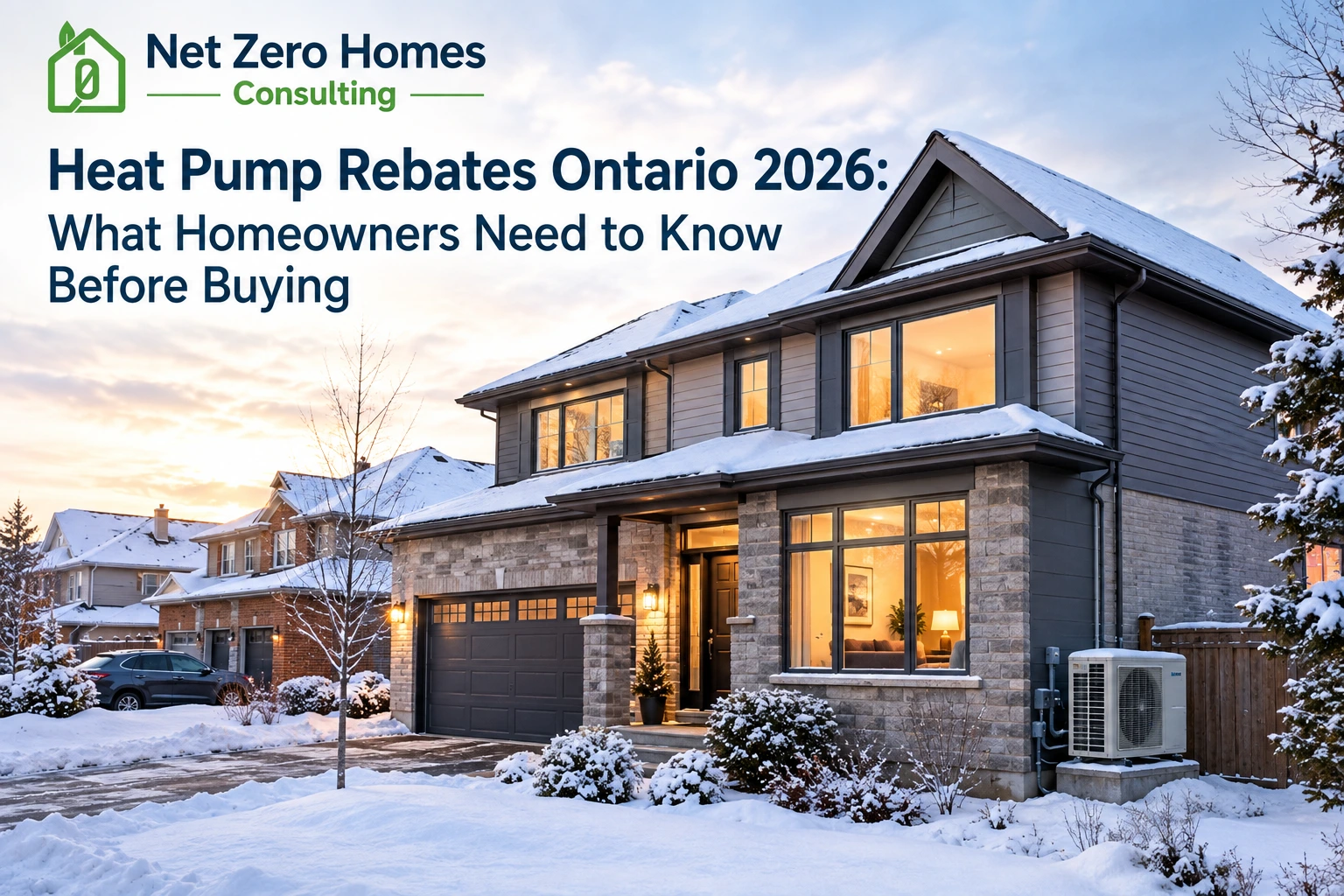
Ontario’s main heat-pump support in 2026 comes through the Home Renovation Savings Program (Save on Energy and Enbridge Gas). Cold-climate air-source heat pumps can receive up to $7,500 and ground-source systems up to $12,000, with the exact amount based on your current heating fuel and system size. Income-qualified households may access a no-cost cold-climate air-source heat pump through the Energy Affordability Program. Federal Oil to Heat Pump Affordability direct applications closed July 31, 2026; Ontario co-delivery continues for eligible oil-heated homes via the Energy Affordability Program. Most municipal offerings are financing (not cash rebates). Always verify current status and eligibility on official sites before acting.
The first question should not be “How much is my rebate?” It should be “Is a heat pump the right upgrade for my home?”
A rebate lowers the upfront cost. It does not automatically make an unsuitable system a good long-term investment. Your furnace age and condition, current fuel, ductwork, insulation, air leakage, electrical panel capacity, heat loss, cooling needs, and future plans for solar, battery storage or EV charging all matter more than the advertised incentive amount.
Net Zero Homes Consulting approaches this from a vendor-neutral perspective. We have completed more than 10,000 in-home energy consultations covering HVAC systems, heat pumps, solar, batteries, insulation, air sealing, windows and electrification planning. Our role is to help homeowners understand how different upgrades interact so they can make clearer decisions before calling contractors.
Ontario Home Renovation Savings Program
This is currently the primary open rebate pathway for most Ontario homeowners. It is delivered by Save on Energy and Enbridge Gas with provincial support.
Cold-climate air-source heat pump
- Non-gas homes (electricity, oil, propane or wood) connected to the Ontario electricity grid: $1,250 per ton, up to $7,500.
- Enbridge natural-gas homes: $500 per ton, up to $2,000.
Ground-source (geothermal) heat pump
- Non-gas homes: $2,000 per ton, up to $12,000.
- Gas homes: flat $3,000.
A heat pump counts as a single upgrade, so no home energy assessment is required for the heat-pump-only path. The equipment must appear on Natural Resources Canada’s qualified products list. Participating contractors submit the post-installation paperwork. Rebates are typically paid by cheque within about 60 days of approval.
The program also offers a bundled pathway (assessment + two or more upgrades) with separate incentives for insulation (up to $7,700), windows and doors ($100 per rough opening), air sealing (up to $250) and heat-pump water heaters ($500). A $600 assessment rebate and a multi-upgrade bonus may apply under current terms.
Program details can change and funding is not unlimited. Confirm current rates, eligible models and application rules on the official Home Renovation Savings site before purchasing equipment.
Energy Affordability Program
This is an income-qualified, direct-install program run by Save on Energy. Eligible households can receive a cold-climate air-source heat pump and related upgrades at no cost.
Who may qualify
- Electrically heated homes: homeowners and renters who meet income or social-assistance criteria.
- Oil-heated homes: currently limited to homeowners with above-ground oil tanks (limited-time support linked to remaining federal Oil to Heat Pump Affordability funding).
Income thresholds are based on household size (before-tax). The program includes professional installation, a 10-year parts-and-labour warranty, and follow-up visits. Propane- and wood-heated homes are not currently listed for the no-cost heat-pump path but may still access Home Renovation Savings rebates.
Applications remain open as of the verification date. Delivery agents handle the process after you apply online or by phone.
Federal Programs — Current Status
Oil to Heat Pump Affordability Program
Federal direct application intake closed July 31, 2026. Applications submitted by that date continue to be processed, with final receipts and attestation due January 31, 2027 and program closure March 31, 2027. In Ontario, co-delivery continues through the Energy Affordability Program for income-qualified oil-heated homes (no-cost installation valued up to roughly $25,000 including provincial support). No new federal direct applications are accepted.
Canada Greener Homes Grant and Loan
These programs are closed to new applicants. Existing approved participants may still complete work under prior rules. Do not rely on older articles advertising these as open 2026 options.
No new broad federal heat-pump grant for general homeowners was identified as open for new applications in September 2026. Canada Greener Homes Affordability Program expansions announced in other provinces do not currently apply to Ontario in the same form.
Utility Programs
Most major Ontario utilities (Hydro One, Toronto Hydro, Hydro Ottawa, Alectra, London Hydro and others) primarily direct homeowners to the provincial Home Renovation Savings and Energy Affordability programs.
- Toronto Hydro’s Heat Pump Assistance Program (income-qualified free installs) reached capacity; recruitment is complete and new applications are closed. Installations for accepted participants continue into 2026–2027.
- No widespread, open, utility-specific cash rebates for heat pumps beyond the provincial programs were verified for the major distributors listed.
Always check your own utility’s current offers page, but expect most pathways to route through Save on Energy.
Municipal Programs
Most municipal support takes the form of low-interest financing repaid through property taxes (Local Improvement Charges), not cash rebates.
Ottawa — Better Homes Ottawa
- Loan Program: low-interest loans up to the lesser of $125,000 or 10% of property value (minimum $10,000), 20-year terms available.
- Heat Pump Incentive (available only through the Loan Program): $700 per ton for qualifying cold-climate air-source systems; $1,000 per ton plus loop incentives for ground-source.
- Energy assessment rebate of up to $600 while funding lasts.
Confirm current rates and stacking rules on the official City of Ottawa / Better Homes Ottawa pages.
Toronto
- Home Energy Loan Program (HELP): financing up to $125,000 for eligible energy upgrades including heat pumps. Heat-pump-only projects no longer require an EnerGuide assessment. Repayment is through the property tax bill. Interest rates are fixed for the term (rates current as of September 2026 verification). This is financing, not a cash rebate.
- Furnace Upgrade Program and BetterHomesTO initiatives point homeowners toward heat pumps and the HELP loan.
- Toronto Hydro Heat Pump Assistance Program: closed to new applicants.
Other municipalities
No separate municipal cash heat-pump rebate was identified on the current official program pages for most major centres (Mississauga, Brampton, Hamilton, London, Kitchener-Waterloo, etc.) at the time of publication. Some offer general sustainability or financing pilots. Check your local municipal website directly. Programs can open or close during the year.
Ontario Heat Pump Rebates at a Glance
| Program | Level | Current Status | Maximum Incentive | Who May Qualify | Heat Pump Type | Important Conditions |
|---|---|---|---|---|---|---|
| Home Renovation Savings | Provincial | Open (verify funding) | Up to $7,500 (ccASHP); up to $12,000 (GSHP) | Most homeowners (gas vs non-gas rates) | Cold-climate ASHP, GSHP | NRCan qualified list; single-upgrade path available |
| Energy Affordability Program | Provincial / income-qualified | Open | No-cost install | Income-qualified electric or oil (above-ground tank) | Cold-climate ASHP | Direct install; warranty included |
| Oil to Heat Pump Affordability (federal direct) | Federal | Intake closed July 31, 2026 | Up to $10,000–$15,000 historically | Income-qualified oil homes (prior applicants) | Eligible heat pumps | Existing applications only |
| Better Homes Ottawa Heat Pump Incentive | Municipal | Open via loan | $700/ton (ASHP); $1,000/ton + loops (GSHP) | Ottawa loan participants | Qualifying ccASHP / GSHP | Must go through Loan Program |
| Toronto HELP | Municipal | Open | Up to $125,000 financing | Toronto low-rise homeowners | Heat pumps and other upgrades | Financing, not rebate |
| Toronto Hydro Heat Pump Assistance | Utility | Closed to new applicants | Free install (prior participants) | Income-qualified (accepted only) | Cold-climate ASHP | Research/pilot; installations continue |
Can You Stack Heat Pump Rebates in Ontario?
Do not assume every incentive can simply be added together.
Home Renovation Savings can generally be combined with municipal financing (Ottawa loan, Toronto HELP) because the rebate reduces the amount that needs to be financed. Income-qualified no-cost paths through Energy Affordability are usually exclusive of the standard rebate for the same equipment. Federal Oil to Heat Pump Affordability funding for new Ontario applicants now flows through the Energy Affordability Program rather than as a separate stackable grant.
Programs typically require disclosure of other incentives and may limit total support to project cost. Equipment purchase and installation timing rules vary, some require pre-approval or post-install submission only. Always confirm stacking rules with each program administrator before signing contracts.
A $7,500 rebate and a $125,000 low-interest loan are not the same type of support. One reduces the cash you pay; the other spreads the remaining cost over time and is repaid through property taxes.
What Heat Pump Equipment Qualifies?
Programs focus on cold-climate air-source heat pumps (ducted or ductless) and ground-source systems that meet specific performance criteria. Hybrid systems (heat pump with gas backup) are often eligible under Home Renovation Savings. Heat-pump water heaters have a separate, smaller incentive.
Exact model eligibility is determined by the Natural Resources Canada qualified products list and any additional program technical requirements (capacity maintenance at low temperatures, noise ratings, AHRI certification where applicable). Not every heat pump on the market qualifies. Contractor participation and proper installation are also required.
How Much Does a Heat Pump Cost in Ontario in 2026?
Installed costs vary widely. Approximate market ranges (before incentives) commonly seen in recent projects include:
- Ductless mini-split (single zone): several thousand dollars per head.
- Central ducted cold-climate air-source: often $10,000–$20,000+ depending on capacity, ductwork modifications and electrical work.
- Ground-source: substantially higher, frequently $20,000–$45,000+.
Factors that drive cost include system size, ducted vs ductless, hybrid configuration, electrical panel upgrades, line-set length, removal of old equipment, accessibility, geographic location and contractor pricing. There is no single “Ontario average.” Obtain multiple detailed quotes.
Gross installed cost − verified rebate/incentive = net project cost. Also evaluate expected operating costs, maintenance, any financing costs and future electrical loads.
Why the Biggest Rebate Isn’t Always the Best Reason to Buy
The common mistake is: “The government is giving me $7,500, so I should buy a heat pump.”
A rebate reduces the upfront cost. It does not change whether the system is correctly sized, whether the home’s envelope is ready, whether the electrical service can support it, or how it will perform on the coldest nights. Use this simple framework:
- Assess — Understand current heating, cooling, envelope and electrical situation.
- Prioritize — Decide which upgrades should happen first.
- Plan — Choose the appropriate heat-pump strategy and how it fits future upgrades.
- Upgrade — Select equipment and a qualified contractor.
Why Homeowners Should Talk to a Home Energy Consultant Before Calling a Heat Pump Contractor
Contractor-first approach
You call a contractor and ask “How much is a heat pump?” The contractor evaluates the installation opportunity and provides a quote.
Consultant-first approach
You first ask “What does my home actually need?” Then you evaluate heat pump, hybrid system, insulation, air sealing, windows, electrical upgrades, solar, battery and EV charging as parts of a broader plan.
Contractors are responsible for recommending and installing equipment. An independent, vendor-neutral consultant can help you understand the bigger picture before you select the contractor or the equipment. Net Zero Homes Consulting provides virtual, insured, no-pressure consultations focused on homeowner clarity rather than selling a specific brand or system.
Before you compare heat pump quotes, make sure you know what your home actually needs. Net Zero Homes Consulting can help you look at the heating system, home efficiency, electrical requirements and future upgrades before you commit to equipment or a contractor.
Hypothetical Example
An older detached home heated by a 15-year-old natural-gas furnace with existing central air is considering a heat pump after seeing an advertisement for a $7,500 rebate.
A contractor quotes a cold-climate central system. Because the home is on natural gas, the actual Home Renovation Savings amount is the lower gas rate ($500 per ton, capped at $2,000), not $7,500. Electrical panel capacity may require an upgrade. The existing furnace can remain as backup in a hybrid configuration. After verifying eligibility, the net installed cost is higher than the homeowner first expected. Operating-cost modelling and a review of insulation and air sealing change the priority order. The homeowner decides to complete air sealing and attic insulation first, then revisit the heat-pump decision with clearer numbers and a plan that also considers future EV charging.
This example is hypothetical. Actual results depend on the specific home, equipment and current program rules.
20-Point Heat Pump Rebate Checklist
Before signing a contract, confirm:
- Which specific rebate program am I applying for?
- Is the program currently accepting applications?
- Does my home qualify (fuel type, ownership, income if relevant)?
- Does this exact equipment model qualify (NRCan list)?
- Does the contractor participate and meet program requirements?
- Do I need pre-approval?
- Can I purchase equipment before approval?
- Can this incentive be combined with another program?
- What happens if the rebate application is denied?
- What is the total installed price before incentives?
- What is the verified net price after incentives?
- What electrical upgrades are required?
- What backup heating is included?
- What is the cold-weather capacity and performance data?
- What happens at very low outdoor temperatures?
- What warranty is included (parts, labour, compressor)?
- What maintenance is required and who provides it?
- What happens if the equipment fails under warranty?
- Does the quote include all electrical and HVAC work?
- Has the system been properly sized for this home’s heat loss?
Heat Pump Rebate Mistakes That Can Cost Homeowners Money
- Relying on outdated online articles advertising closed programs.
- Assuming the maximum advertised amount applies to every home.
- Buying equipment before confirming eligibility and timing rules.
- Treating a loan as if it were a cash rebate.
- Ignoring electrical capacity or backup heat needs.
- Choosing the highest rebate instead of the right system for the home.
- Falling for high-pressure claims such as “government-approved contractor,” “guaranteed $10,000 rebate,” “everyone qualifies,” or “rebate expires tonight.” Verify every claim on official program websites. The federal government has warned about unauthorized third parties claiming government affiliation.
Heat Pump Rebates You May Still See Online — But That Are Closed
- Canada Greener Homes Grant — closed to new applicants.
- Canada Greener Homes Loan — closed to new applicants.
- Federal Oil to Heat Pump Affordability direct intake — closed July 31, 2026 (Ontario co-delivery via Energy Affordability continues for eligible households).
- Older Enbridge Home Efficiency Rebate Plus (HER+) — replaced by Home Renovation Savings.
- Toronto Hydro Heat Pump Assistance Program — closed to new applications.
Existing approved participants under closed programs may still complete their projects under prior rules. Always check the official source for your specific situation.
Frequently Asked Questions
What is the heat pump rebate in Ontario for 2026?
The main open pathway is Home Renovation Savings: up to $7,500 for cold-climate air-source (non-gas rate) or up to $12,000 for ground-source, based on fuel type and size. Income-qualified households may receive a no-cost system through the Energy Affordability Program.
Does Ontario still offer heat pump rebates in 2026?
Yes. Home Renovation Savings remains open as of September 2026 verification. Confirm current funding and terms before proceeding.
How much does Ontario pay for a heat pump?
It depends on your current heating fuel and system size. Gas homes receive the lower rate; non-gas homes receive the higher rate, up to the published caps.
Who qualifies for heat pump rebates in Ontario?
Most homeowners meeting the program’s fuel and connection rules can access Home Renovation Savings. Income and social-assistance criteria apply for the no-cost Energy Affordability path.
Is there a heat pump rebate in Ottawa?
Ottawa offers a heat-pump incentive only through the Better Homes Ottawa Loan Program ($700/ton for qualifying air-source systems). The loan itself is financing.
Is there a heat pump rebate in Toronto?
Toronto’s primary tool is the Home Energy Loan Program (financing up to $125,000). The Toronto Hydro free-install program is closed to new applicants. Provincial rebates still apply.
Can I get a heat pump rebate if I already have a furnace?
Yes. Hybrid configurations are generally eligible under Home Renovation Savings. The rebate amount follows the gas rate if the home is currently heated by natural gas.
Can I get a heat pump rebate for a new home?
Programs typically target existing homes. Check specific eligibility rules; new construction often has different pathways.
Can I combine heat pump rebates in Ontario?
Sometimes. Provincial rebates can usually be paired with municipal financing. Income-qualified no-cost installs are typically exclusive for the same equipment. Always confirm with each administrator.
Does a cold-climate heat pump qualify for rebates?
Yes — that is the primary equipment category under current programs, provided the specific model meets technical requirements and appears on the NRCan list.
Does a ductless heat pump qualify?
Often yes, if it is a qualifying cold-climate model. Confirm the exact unit against the program list.
Does a geothermal heat pump qualify?
Yes, with higher maximum incentives under Home Renovation Savings for non-gas homes.
Do I need an energy audit to get a heat pump rebate?
Not for the single-upgrade heat-pump path under Home Renovation Savings. Bundled upgrades and some municipal financing may require an assessment.
Can I get a rebate after installing my heat pump?
Most programs require the correct sequence (contractor participation, post-install submission). Installing first without following the rules can void eligibility.
Should I get a heat pump quote before checking rebates?
Obtain quotes, but verify eligibility, equipment qualification and stacking rules before signing. Understanding the home first usually produces better decisions.
fore You Buy a Heat Pump, Ask These Five Questions
- Is my home suitable for a heat pump?
- What type and size of system actually fits my home?
- What rebates am I genuinely eligible for?
- What will my total installed cost be after verified incentives?
- How does this upgrade fit with my next 5–10 years of home improvements?
Final Thoughts: Check the Rebate — Then Check the Home
Rebates and financing can make a good project more affordable. They do not turn an unsuitable system into a good one. Start with a clear understanding of your home’s needs, then determine whether a heat pump — and any available incentive — actually makes sense for your situation.
Don’t start with the contractor. Start with the plan.
Net Zero Homes Consulting helps homeowners understand their home’s needs, identify appropriate upgrades, review available incentives, compare options, understand contractor quotes, avoid unnecessary work, and plan future solar, battery storage, EV charging, insulation and air sealing.