You are standing in the driveway looking at a 10-year-old gasoline SUV that is starting to need expensive repairs. Winter is coming, fuel prices keep moving, and you keep hearing about electric vehicles, plug-in hybrids, and regular hybrids. At the same time you are thinking about a heat pump, maybe solar panels, and whether your electrical panel can handle more load.
The question is not just “which car should I buy?” It is ,which powertrain fits my driving, my climate, my home, and my long-term energy goals and which one will actually cost less over the next 10 years?
This guide is written for North American homeowners. It compares battery electric vehicles (BEVs), plug-in hybrids (PHEVs), and conventional hybrids (HEVs) on purchase price, fuel/electricity costs, maintenance, insurance, incentives, winter performance, home charging needs, solar and battery storage opportunities, Vehicle-to-Home capability, and how each choice fits into a Net Zero or high-performance electrified home.
All figures are realistic 2026 ranges; actual numbers vary by location, driving habits, electricity rates, and incentives.
Quick Answer
- Best pure money saver for most drivers who can charge at home and drive moderate distances: A well-chosen battery electric vehicle (BEV), especially after incentives where available and with home Level 2 charging. Lowest energy and maintenance costs over 10 years in most scenarios.
- Best bridge / no-range-anxiety option: A plug-in hybrid (PHEV). Electric for daily commuting, gasoline for long trips and extreme cold. Higher purchase and maintenance costs than a pure hybrid or efficient BEV, but flexible.
- Best simple, lowest-upfront, no-charging-needed option: A conventional hybrid (HEV). Excellent reliability and fuel economy with no plug required. Usually higher long-term energy costs than a BEV charged at home.
- Best overall for homeowners planning solar, a heat pump, or whole-home electrification: A BEV paired with Level 2 charging and, when possible, solar + storage. The vehicle becomes part of a larger energy system.
The right answer depends on annual kilometres/miles, access to reliable home charging, local electricity vs. gasoline prices, climate, and whether you value simplicity or maximum long-term savings and resilience.
Understanding the Three Vehicle Types
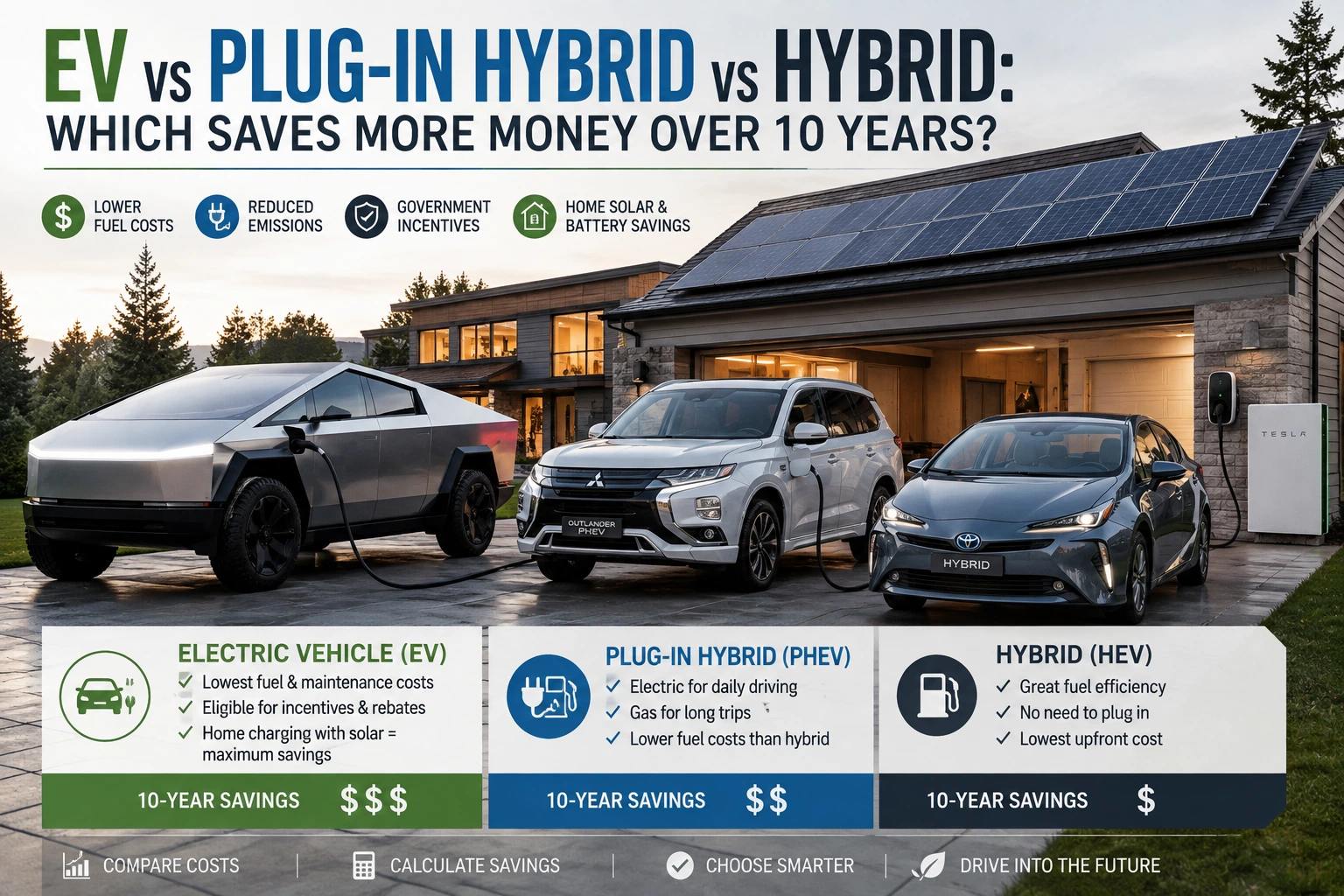
Battery Electric Vehicle (BEV) Runs only on electricity stored in a large battery. Charged from a wall outlet, Level 2 home charger, or DC fast charger. Zero tailpipe emissions. Examples: Tesla Model 3/Y, Hyundai IONIQ 5, Kia EV6/EV9, Ford Mustang Mach-E, Chevrolet Equinox EV, Ford F-150 Lightning, Rivian R1T/R1S.
Plug-in Hybrid Electric Vehicle (PHEV) Has both a battery (typically 10–20+ kWh) that can be charged from a plug and a gasoline engine. Can drive 30–80+ km (20–50+ miles) on electricity alone before the engine starts. Examples: Toyota RAV4 Prime, Mitsubishi Outlander PHEV, Hyundai Tucson PHEV, Kia Sportage PHEV, Ford Escape PHEV, Volvo XC60 Recharge.
Hybrid Electric Vehicle (HEV) Uses a gasoline engine and a small battery that is charged only by the engine and regenerative braking. Cannot be plugged in. Excellent fuel economy, especially in city driving. Examples: Toyota RAV4 Hybrid, Prius, Camry Hybrid, Honda CR-V Hybrid, Accord Hybrid, Ford Maverick Hybrid.
Simple way to remember:
- BEV = all electric, needs charging.
- PHEV = electric for short trips + gasoline backup, benefits from plugging in.
- HEV = gasoline with electric assist, no plug needed.
Which Saves More Money Over 10 Years?
Ownership cost has several major pieces:
- Purchase price (after incentives)
- Energy (electricity or gasoline)
- Maintenance and repairs
- Insurance
- Depreciation / resale value
- Home charging equipment and any electrical upgrades
Incentives (2026 status)
- Canada: Federal Electric Vehicle Affordability Program (EVAP) offers up to $5,000 for eligible battery-electric vehicles and up to $2,500 for eligible plug-in hybrids (subject to price caps and other rules; Canadian-made vehicles have more flexibility). Conventional hybrids generally do not qualify. Provincial programs vary and some have been reduced or paused.
- United States: The major federal new clean vehicle tax credit (up to $7,500) ended for most vehicles acquired after September 30, 2025. In 2026, new BEV and PHEV buyers generally cannot claim that credit. Some state, utility, and local incentives remain. Always verify current rules.
Energy costs Home electricity is usually far cheaper per kilometre/mile than gasoline. U.S. residential average is roughly 18–19 ¢/kWh (varies widely by state). Canadian averages are often lower, especially in hydro-rich provinces (Quebec, Manitoba, parts of B.C.). Gasoline prices fluctuate; recent North American figures have been in the $3–4+ USD per gallon / $1.40–2.00+ CAD per litre range depending on location and timing.
A typical efficient BEV uses about 15–20 kWh per 100 km (roughly 3–4 miles per kWh). At 15 ¢/kWh that is very low operating cost. A hybrid might achieve 5–6 L/100 km or better; a PHEV’s cost depends heavily on how often it is charged.
Maintenance BEVs generally have the lowest maintenance: no oil changes, fewer brake jobs (regenerative braking), no exhaust or transmission service of the traditional kind. PHEVs have both electric and gasoline systems, so maintenance is usually higher than a pure BEV or a simple HEV. HEVs are proven and reliable but still require engine-related service.
Sample 10-year scenarios (illustrative, not guarantees) Assume 15,000–20,000 km (≈9,000–12,500 miles) per year, home charging available, moderate climate with some winter driving, and average North American energy prices.
- High home-charging BEV: Higher purchase price (offset by any remaining incentives), very low energy and maintenance costs. Often the lowest 10-year total cost of ownership for drivers who charge at home most of the time.
- PHEV driven mostly on electricity: Competitive if the electric range covers daily needs and the owner plugs in regularly. Loses advantage if rarely charged.
- Efficient HEV: Lowest or near-lowest purchase price, no charging infrastructure cost, solid fuel economy. Usually higher energy cost than a home-charged BEV over 10 years, but simplest ownership.
Regional differences are large. In low-electricity-rate areas with good incentives, the BEV advantage grows. In areas with very high electricity rates or no reliable home charging, a hybrid or carefully used PHEV can win.
Winter Performance
Cold weather affects all three, but differently.
- BEVs: Range typically drops 15–40 % in real Canadian winter testing (depending on model, temperature, and use of cabin heat). Heat pumps help. Preconditioning while plugged in is essential. Charging speed slows until the battery is warm. Modern AWD BEVs with good tires handle snow well.
- PHEVs: Electric range shrinks in the cold, but the gasoline engine provides reliable backup heat and power. Good practical choice for snowbelt drivers who still want electric daily driving.
- HEVs: Least affected by cold in terms of “range anxiety.” Cabin heat comes from the engine. Fuel economy drops somewhat in extreme cold, as with any gasoline vehicle.
For pure Canadian prairie or northern winters with long distances and limited charging, many buyers still prefer a PHEV or capable HEV. For most suburban and urban drivers with home charging, a modern BEV with heat pump and preconditioning is fully usable year-round.
Home Charging
- Level 1 (standard outlet): 5–12 km of range per hour. Fine for low-mileage PHEV or as backup.
- Level 2 (240 V): The practical standard for BEVs. Adds 30–60+ km per hour. Most homeowners install a 40–48 A or higher circuit.
- Installation cost: Typically $800–$3,000+ USD/CAD for a straightforward garage install; higher with long runs, outdoor installation, or panel upgrades.
Many homes need a panel or service upgrade (100 A to 200 A is common) when adding an EV charger plus a heat pump or other loads. Load-management devices can sometimes avoid a full upgrade. Smart chargers that schedule charging for off-peak rates deliver the biggest savings.
PHEVs benefit from Level 2 but can function on Level 1. HEVs need no charging infrastructure.
Solar + EV
An average BEV driven 15,000–20,000 km/year may use 2,500–4,500 kWh annually. Rooftop solar can offset most or all of that in many North American locations, especially with net metering.
Pairing solar with a BEV (and ideally a home battery) turns the vehicle into a high-value use of self-generated electricity. Payback depends on local rates, incentives, solar resource, and net-metering rules.
Higher electricity-rate regions and strong solar resource shorten payback. Low-rate hydro provinces see longer paybacks but still gain energy independence and future rate protection.
Home Battery Storage
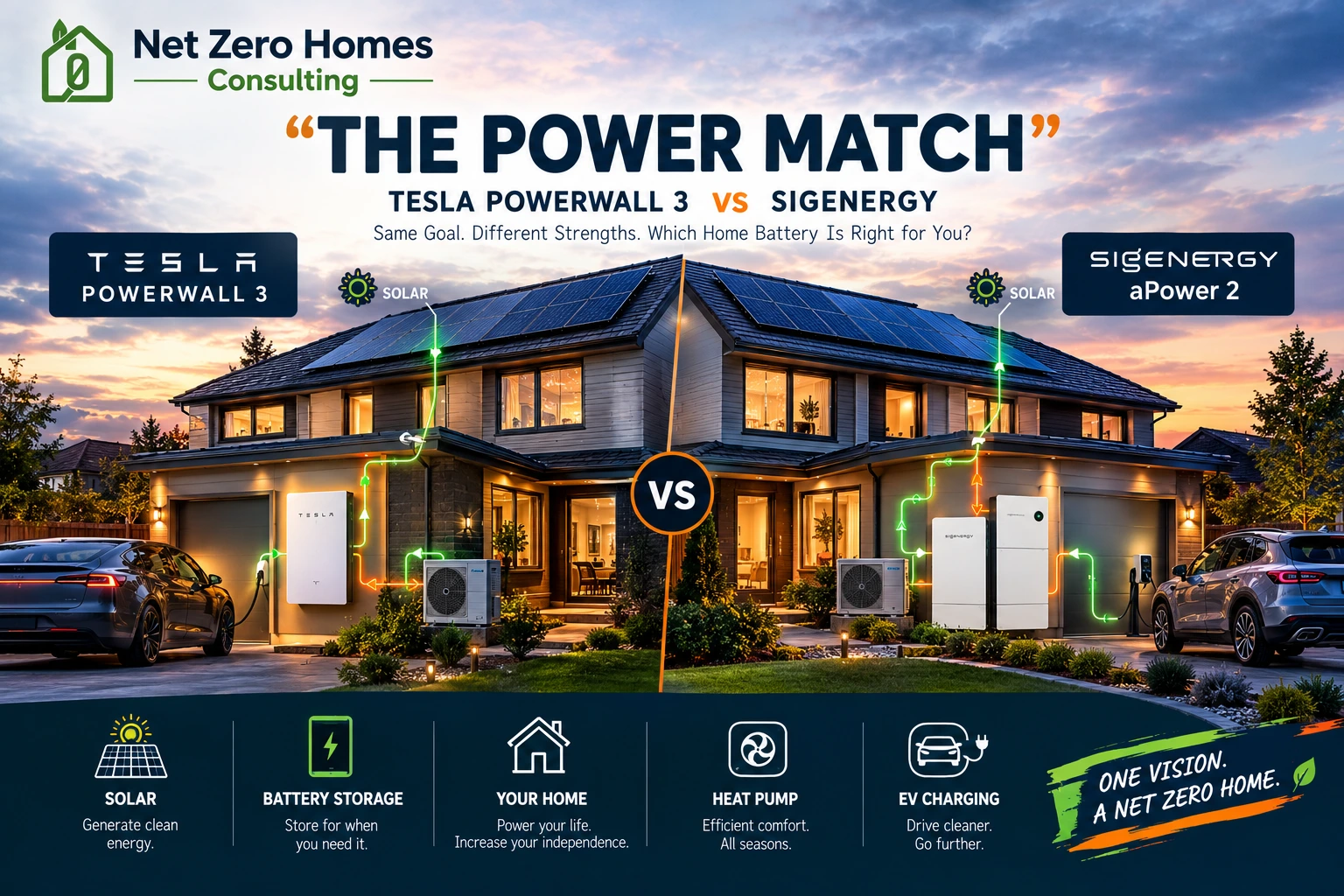
Popular options include Tesla Powerwall, Sigenergy SigenStor, FranklinWH, and Enphase IQ Battery. Key comparison points: usable capacity, continuous/peak power (important for heat pumps and EV chargers during outages), scalability, software/energy management, solar and EV integration, warranty, and installed cost.
Batteries enable time-of-use arbitrage, greater solar self-consumption, and whole-home or partial backup. A BEV can later add Vehicle-to-Home capability on supported models; a home battery provides daily flexibility that most current V2H systems do not yet match for everyday use.
Vehicle-to-Home (V2H)
V2H lets a compatible vehicle power a home during outages or for bill management. The Ford F-150 Lightning with Intelligent Backup Power is one of the more established commercial examples. Other manufacturers (certain Hyundai, Kia, GM, Tesla Cybertruck configurations, Nissan) have bidirectional capability or roadmaps, but availability, required home equipment, power levels, and utility approval vary widely.
Distinguish what is actually available and certified today from announced future features. For most homeowners a dedicated home battery remains the more flexible daily solution, with V2H as valuable supplemental backup when the vehicle supports it.
Net Zero Home Strategy
Vehicle choice is one piece of a larger system:
- Air sealing and insulation (attic, walls, basement)
- High-performance windows
- Cold-climate heat pump(s) for space and water heating
- Right-sized electrical service and smart load management
- Solar + storage
- Efficient appliances and smart controls
- EV charging integrated into the energy management system
A BEV fits most naturally into a fully electrified, solar-powered home. A PHEV offers a lower-risk transition. An HEV keeps things simple while the home is upgraded. An independent energy assessment is the practical starting point for most existing houses.
Cost Analysis Summary (Illustrative Ranges)
Over 5 / 10 / 15 years the ranking often looks like this for a homeowner who can charge at home:
- Efficient BEV (lowest operating costs, especially with solar)
- Well-used PHEV or efficient HEV (close, depending on fuel vs. electricity prices and charging behaviour)
- Inefficient gasoline vehicle or rarely-charged PHEV (highest energy cost)
Insurance can be higher for some BEVs. Resale values have been volatile; strong brands and desirable models hold value better. Always run numbers with your local electricity rate, gasoline price, annual distance, and available incentives.
Comparison Tables (Conceptual Summary)
| Factor | BEV | PHEV | HEV |
|---|---|---|---|
| Purchase price | Highest | High | Lowest |
| Energy cost (home charge) | Lowest | Low if charged regularly | Medium |
| Maintenance | Lowest | Highest of the three | Low-Medium |
| Winter flexibility | Good with planning | Excellent | Excellent |
| Home charging needed | Yes (strongly recommended) | Beneficial | No |
| Solar synergy | Highest | High | Limited |
| V2H potential | Growing | Limited | None |
| Simplicity | Medium | Medium | Highest |
Best-by-persona guidance appears in the full decision section of the article (daily commuter → BEV or PHEV; rural long-distance → PHEV or capable BEV + planning; apartment dweller without charging → HEV or carefully chosen PHEV; etc.)
Common Mistakes
- Buying a long-range BEV when daily driving is short and home charging is easy (or the opposite).
- Ignoring real winter range and charging speed.
- Skipping an electrical panel assessment.
- Assuming federal incentives still apply without checking 2026 rules.
- Treating the vehicle decision separately from heat pump, solar, and storage plans.
- Underestimating how much a PHEV’s economics depend on actually plugging it in.
Actionable Takeaways
- Track your real annual kilometres/miles and typical trip lengths for 2–4 weeks.
- Confirm whether you can install reliable Level 2 charging.
- Get current electricity and gasoline prices for your location and any time-of-use rates.
- Check current Canadian EVAP or remaining U.S. state/utility incentives.
- Obtain an electrical assessment if you are considering a heat pump or major electrification.
- Model 10-year costs with conservative assumptions.
- Consider the vehicle as one component of a home energy system rather than an isolated purchase.
The vehicle you choose will be with you for years. The energy system in your home will be with you even longer. The smartest decisions treat them together.
Book a Virtual Net Zero Homes Consultation for independent, vendor-neutral guidance. You will receive personalized recommendations on whether an EV, PHEV or hybrid best fits your driving and climate, a home charging and electrical panel assessment, solar and battery storage feasibility, heat pump integration advice, and a practical whole-home electrification roadmap.
Get clear numbers and a clear plan so you can choose the vehicle—and the home energy strategy—that saves money, improves comfort, and future-proofs your household for the next decade and beyond.