
Canadian homeowners evaluating solar in 2026 face a practical question: which panel technology actually delivers reliable performance through short winter days, snow, cold temperatures, and the growing electricity loads of heat pumps, EVs and home batteries? The answer is never a single “best” brand. It depends on roof size, orientation, local climate, energy goals, and how solar fits into a broader Net Zero Home strategy.
Solar panels are not an isolated purchase. Before choosing modules, homeowners should first understand how much electricity their home will actually need after air sealing, insulation upgrades, high-performance windows, a cold-climate heat pump, Level 2 EV charging, and possible battery storage. Only then does panel selection make sense.
This guide explains current 2026 cell technologies in plain language, examines real Canadian winter conditions across provinces, compares current residential product families from JA Solar, Canadian Solar, Jinko Solar and Qcells, and shows how panel choice changes for different homeowner scenarios. It prioritizes verified manufacturer trends and climate realities over marketing claims.
Why Canadian Winters Change the Solar Decision
Cold temperatures improve the electrical efficiency of crystalline silicon panels. Solar modules are tested at 25 °C under Standard Test Conditions. As cell temperature drops, output generally rises. Temperature coefficients of modern N-type modules typically range from about −0.24 %/°C to −0.30 %/°C. A colder panel therefore produces more power per unit of sunlight than the same panel on a hot summer roof.
However, winter energy production is still lower in most of Canada for three dominant reasons: fewer daylight hours, lower sun angle, and snow or ice that can temporarily block the active surface. Cloud cover in coastal British Columbia and parts of Atlantic Canada further reduces irradiance. The net result is that annual yield remains strong in sunny prairie regions, while winter contribution is modest everywhere.
Natural Resources Canada photovoltaic potential maps show typical annual production in the range of roughly 1,000–1,300 kWh per installed kW depending on location and orientation. Saskatchewan, Alberta, and Manitoba generally rank highest. Coastal British Columbia ranks lower. Cities such as Calgary, Edmonton, Winnipeg, Ottawa, Toronto, Montreal, Vancouver and Halifax illustrate the spread: prairie sites benefit from clearer skies and colder operating temperatures, while Vancouver faces more cloud and milder winters.
Snow performance depends more on roof pitch, module surface, and mounting than on brand alone. Steeper pitches (common on many Canadian houses) promote natural shedding. Dark module surfaces absorb heat and accelerate melting once sunlight returns. Glass-glass bifacial modules can sometimes capture reflected light from snow on the ground or roof, but the primary benefit remains front-side production once the surface clears. Mechanical load ratings matter: most quality residential modules carry snow-load ratings of 5,400 Pa and wind-load ratings of 2,400 Pa or higher, sufficient for the majority of Canadian residential applications when properly racked according to local building code and National Building Code of Canada requirements.
Homeowners should never climb onto a roof to clear snow. Professional assessment is appropriate only when structural concerns or prolonged heavy accumulation exist. In most cases, waiting for sun and mild weather is the practical approach.
Core Solar Cell Technologies in 2026
Modern residential modules are almost entirely monocrystalline. Within that category the important distinctions are doping type and passivation structure.
P-type vs N-type cells
P-type cells (boron-doped) dominated for years via PERC technology. They are cheaper to manufacture but experience higher light-induced degradation (LID) and generally higher annual degradation. N-type cells (phosphorus-doped) show far lower LID, better low-light response, and slower long-term degradation. By 2026 N-type has become the mainstream choice for new residential product lines.
TOPCon (Tunnel Oxide Passivated Contact)
TOPCon adds a thin tunnel oxide and doped polysilicon layer that reduces recombination losses. Commercial module efficiencies commonly fall in the 22–24 % range, with temperature coefficients around −0.26 %/°C to −0.30 %/°C. First-year degradation is typically ≤1 % and annual degradation after that around 0.35–0.40 %. TOPCon offers the best balance of efficiency, cost, availability, and reliability for most Canadian homes in 2026. It is the volume technology from the major manufacturers.
HJT (Heterojunction)
HJT sandwiches crystalline silicon between thin amorphous silicon layers. It delivers excellent temperature coefficients (often −0.24 %/°C to −0.26 %/°C) and strong bifaciality. Module efficiencies sit in a similar or slightly higher band than TOPCon. The main trade-off is higher manufacturing cost and more limited residential availability compared with TOPCon. HJT shines in hot climates where temperature losses matter most; the advantage is smaller in cold Canadian winters but still useful for overall annual yield and longevity.
IBC / Back-Contact
Interdigitated Back Contact and related architectures move all electrical contacts to the rear surface, eliminating front-side shading. This yields the highest commercial efficiencies (often 24 %+ in premium lines) and clean aesthetics. Cost is higher and residential supply more limited. These modules suit space-constrained roofs where maximum power density is the priority.
Additional design features
Half-cut cells reduce resistive losses and improve shade tolerance. Multi-busbar or busbar-free designs further lower resistance. Bifacial modules generate additional power from the rear side when light reflects from the roof or ground; the gain is modest on typical dark residential roofs but can be meaningful on light-coloured or elevated installations. Glass-glass construction improves durability, moisture resistance, and mechanical strength compared with glass-backsheet in many cases. PID (potential-induced degradation) and LID resistance are now standard expectations on quality N-type modules.
Efficiency numbers must always be read with the model in mind. A manufacturer does not have “one efficiency.” Different product families within the same brand can differ by several percentage points.
Brand and Product Family Comparison (Current Residential Focus)
Manufacturers continuously refresh lines. The following reflects 2025–2026 residential-relevant families based on publicly available manufacturer information and independent listings. Exact wattages, efficiencies, and warranties vary by specific model and market. Always verify the datasheet for the exact module quoted by an installer.
| Category | JA Solar (DeepBlue 4.0 / 5.0 TOPCon families) | Canadian Solar (TOPHiKu / TOPCon series) | Jinko Solar (Tiger Neo TOPCon) | Qcells (Q.TRON TOPCon / Q.PEAK) |
|---|---|---|---|---|
| Cell technology | N-type TOPCon | N-type TOPCon | N-type TOPCon | N-type TOPCon (Q.TRON); older PERC (Q.PEAK) |
| Typical residential power | ~430–475 W range common | ~430–470 W residential; higher for larger formats | ~430–480 W common | ~410–440 W |
| Module efficiency | Up to ~22.4–24.1 % depending on model | Up to ~22–23.5 % residential; higher announced for Gen3 | ~22.3–23.9 % depending on series | ~22 % (Q.TRON); lower for PERC |
| Temperature coefficient | ~ −0.26 to −0.29 %/°C | ~ −0.26 to −0.29 %/°C | ~ −0.29 %/°C | ~ −0.30 %/°C (Q.TRON) |
| First-year degradation | Typically ≤1 % | Typically ≤1 % | Typically ≤1 % | Model-dependent |
| Annual degradation | ~0.35–0.40 % | ~0.35–0.40 % | ~0.35–0.40 % | ~0.33–0.50 % depending on line |
| Product warranty | Often 12–25 years | Often 12–25 years | Often 15–25 years | Typically 25 years |
| Performance warranty | Frequently 30 years linear | Frequently 30 years linear | Frequently 30 years linear | Typically 25 years |
| Bifacial options | Yes | Yes | Yes | Limited / model-dependent |
| Glass-glass availability | Yes on many high-end lines | Yes | Yes | Model-dependent |
| Snow / wind load | Typically 5,400 Pa / 2,400 Pa | Typically 5,400 Pa / 2,400 Pa | Typically 5,400 Pa / 2,400 Pa | Similar industry standard |
| Canadian / NA availability | Widely available through distributors | Strong Canadian brand presence | Widely available | Strong NA presence, some US manufacturing |
Category winners (context-dependent)
- High efficiency / limited roof space: higher-efficiency TOPCon or back-contact options from the leading lines.
- Cold-climate value and availability: TOPCon modules from Canadian Solar, JA Solar, or Jinko.
- Warranty and long-term degradation: look for 30-year linear performance warranties common on current N-type lines.
- North American manufacturing preference: some Qcells lines.
- Overall Net Zero Home integration: any current Tier-1 N-type TOPCon module that pairs cleanly with modern hybrid inverters and batteries.
No brand is universally “best.” The right choice is the module whose datasheet, warranty terms, local support, and installer experience best match the specific roof, climate and energy plan.
Connecting Solar to the Rest of the Net Zero Home
A heat pump, especially a cold-climate model, can more than double a home’s electricity consumption compared with a natural-gas furnace plus modest electric loads. An EV driven 15,000–20,000 km per year can add another 3,000–5,000 kWh annually. Induction cooking, electric water heating, and other electrification measures compound the increase.
Illustrative example only, actual results depend on the home
A 2,000 sq ft house in Ottawa currently using 10,000–12,000 kWh/year for lights, appliances, and water heating might rise to 18,000–25,000 kWh/year after a cold-climate heat pump and moderate EV use. A 8–12 kW solar array sized to historical bills would then cover a much smaller fraction of total needs. Proper system design starts with a home energy audit, air sealing, insulation, and window upgrades that reduce the heating load before the heat pump and solar are sized.
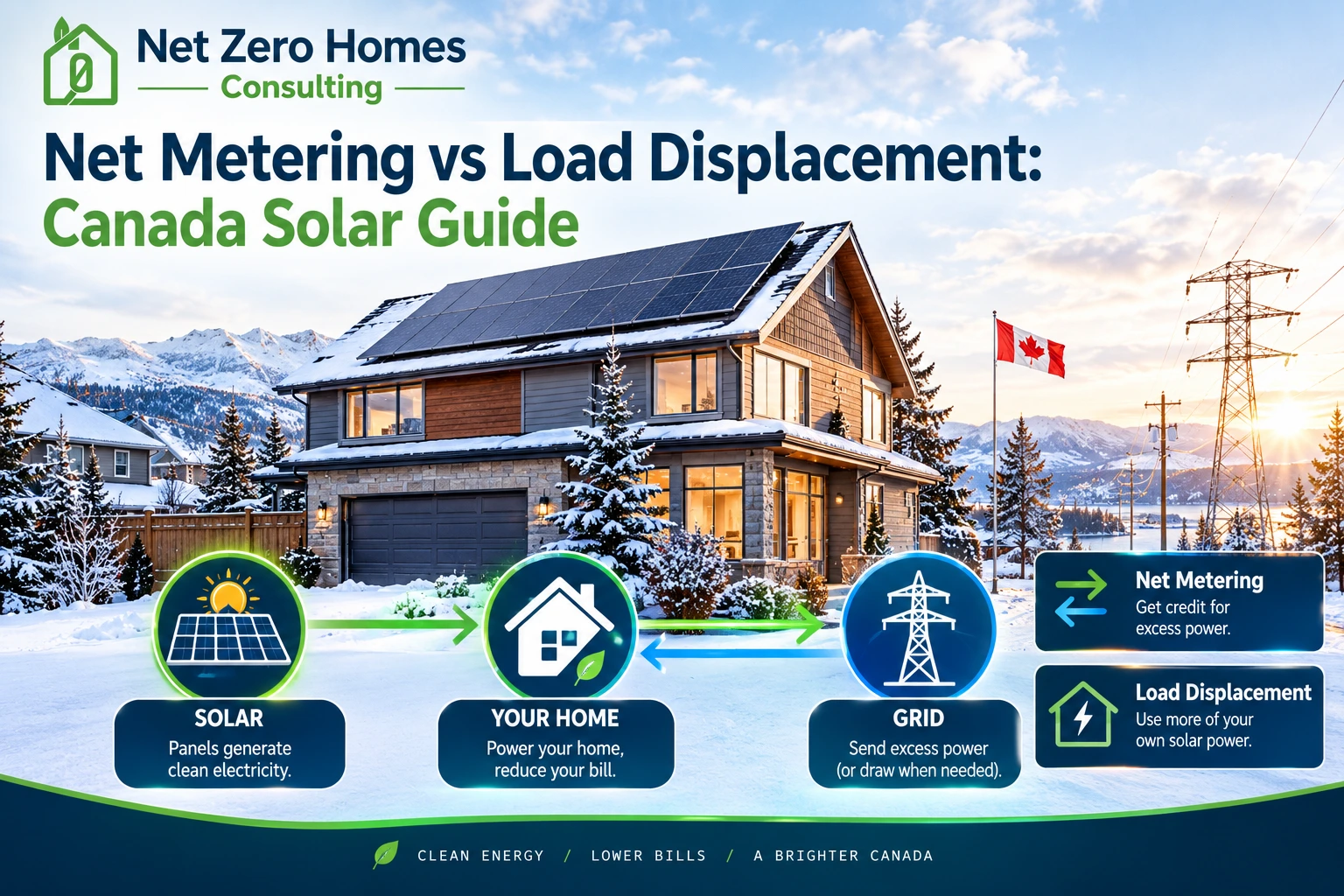
Battery storage enables self-consumption, time-of-use shifting where rates apply, and backup power. Battery capacity (kWh) and power output (kW) are different: capacity determines how long loads can run; power determines which loads can run simultaneously. Load displacement — using solar and battery to serve evening EV charging, heat-pump operation, or water heating improves the economics of solar under net-metering or net-billing regimes.
Electrical panel capacity and service size must be evaluated early. Adding a heat pump, Level 2 EV charger, and battery often requires a panel upgrade or load management. Vehicle-to-home (V2H) capability is emerging on some platforms but remains limited by vehicle, charger, and utility rules.
Net metering rules differ sharply by province. Ontario generally credits at retail rates with a 12-month carry-forward. British Columbia transitioned new customers toward net billing at a fixed lower rate around mid-2026. Quebec offers low retail rates that lengthen payback. Alberta operates under micro-generation rules with retailer-dependent details. Always confirm current utility rules before final sizing.
Five Realistic Homeowner Scenarios
Homeowner A — Small or complex roof
Limited usable area or multiple roof planes. Priority: highest practical efficiency and power density so the system meets a larger share of post-electrification load. Premium TOPCon or back-contact modules make sense even at a higher cost per watt.
Homeowner B — Ottawa / cold-climate heat-pump focus
High winter heating demand. Cold temperatures help panel efficiency, but short days limit winter generation. Size the array for annual rather than winter production. Pair with a hybrid inverter and consider modest battery capacity for evening heat-pump support. Standard high-quality TOPCon modules perform well.
Homeowner C — EV owner driving 20,000 km/year
Significant daytime or evening charging load. Solar generation during the day can directly charge the vehicle when home, or charge a battery for later use. Over-sizing relative to current bills becomes more attractive if the EV is a permanent load. Ensure Level 2 charger and solar share a coordinated energy-management strategy.
Homeowner D — Backup power and energy shifting
Frequent outages or desire for resilience. Battery capacity and inverter backup capability matter as much as panel choice. Choose modules compatible with the hybrid inverter ecosystem the battery requires. Focus on reliability ratings and warranty support.
Homeowner E — Full Net Zero pathway
Plans sequential upgrades: air sealing and insulation first, then heat pump, solar, battery, and EV. Panel selection should leave room for future expansion or higher self-consumption. A slightly larger array of durable N-type modules with strong long-term degradation performance supports the 25–30 year horizon.
In every case the sequence is the same: reduce loads through building science, quantify remaining electricity need, then size and select the solar system.
Cost, Economics, and Realistic Expectations
Installed residential solar costs in Canada typically fall in a broad range that depends on system size, roof complexity, electrical work, permits, and local labour. Panel cost itself is only one component; inverters, racking, labour, and electrical upgrades often dominate. Battery and EV charger costs are additional. Provincial incentives, where available, and net-metering or net-billing rules heavily influence payback.
A simple illustrative calculation: annual generation × value of displaced or exported electricity provides potential annual energy value. Subtract ongoing monitoring or maintenance costs and consider financing. Do not treat any published “ROI” figure as a guarantee. Actual results vary with electricity rates, system performance and future rate changes.
Practical Selection Checklist for Canadian Homeowners
- Complete a home energy audit and prioritise efficiency measures.
- Project future electricity use including heat pump and EV.
- Confirm electrical panel capacity and utility interconnection rules.
- Evaluate roof structure, pitch, orientation, and shading.
- Request datasheets for the exact module models proposed.
- Compare temperature coefficient, degradation rates, warranties and mechanical ratings.
- Ensure compatibility with intended hybrid inverter and battery platform.
- Verify local installer experience with the chosen brand and with cold-climate installations.
Frequently Asked Questions
Do solar panels work in Canadian winters?
Yes. They produce electricity whenever sunlight reaches the cells. Cold temperatures improve efficiency, but shorter days and snow reduce total winter output compared with summer.
Are TOPCon panels better than older PERC for Canada?
In most cases yes. N-type TOPCon offers higher efficiency, lower degradation, and better temperature coefficients than typical P-type PERC.
Are bifacial panels worth it on a residential roof?
They can add modest rear-side gain, especially over light-coloured surfaces or elevated mounts. On typical dark residential roofs the benefit is smaller. Front-side performance and durability remain primary.
Which is better for cold climates — JA Solar, Canadian Solar, Jinko, or Qcells?
All four offer competent current N-type TOPCon residential lines. Choice depends more on specific model datasheet, installer support, warranty terms, and price than on brand name alone.
How much does snow affect production?
Temporary coverage stops generation until the surface clears. Steeper roofs and dark modules shed snow faster. Proper mechanical design handles the load.
Should I size solar for my current bill or future heat-pump + EV load?
Future load. Undersizing relative to planned electrification reduces long-term self-sufficiency.
What temperature coefficient should I look for?
Lower absolute value is better (e.g., −0.26 %/°C is preferable to −0.34 %/°C). The difference is most noticeable on hot days but still contributes to annual yield.
Do I need glass-glass modules?
Not always. They often improve durability and bifacial performance. Quality glass-backsheet modules remain common and effective when properly specified.
How important is product warranty versus performance warranty?
Both matter. Product warranty covers defects; performance warranty guarantees minimum output over 25–30 years. Linear performance warranties with low annual degradation are preferable.
Can solar power a cold-climate heat pump in winter?
Solar contributes, but winter generation is lowest when heating demand is highest. Annual net metering or battery shifting bridges the seasonal mismatch.
Is a battery necessary with solar in Canada?
Not required for grid-tied net-metered systems, but valuable for self-consumption, backup, and load shifting as electricity rates and utility rules evolve.
What about EV charging from solar?
Daytime solar can directly charge an EV when the vehicle is home. A battery or smart charger further improves solar utilisation.
How do I know if my roof can handle the snow and wind loads?
A qualified installer and structural assessment per local building code and National Building Code requirements determine suitability.
Should I wait for even higher-efficiency panels?
Current TOPCon modules already deliver strong real-world performance. Waiting for marginal future gains may delay benefits from today’s electricity prices and incentives.
Educational Next Step
Solar technology in 2026 is mature, efficient, and well-suited to Canadian conditions when chosen and installed thoughtfully. The highest-performing system is the one that matches your roof, climate, electrical infrastructure, and long-term electrification plans.
Net Zero Homes Consulting approaches solar as one integrated piece of a whole-home energy strategy that includes efficiency, heat pumps, storage, and EV readiness. Before selecting panels, consider a consultation that examines the complete picture rather than any single product. Book a Net Zero Homes consultation to evaluate how solar, a cold-climate heat pump, battery storage, and home performance upgrades can work together for your specific house and goals.