The definitive guide connecting vehicle ownership to home electrification, solar, battery storage, heat pumps, and Net Zero Home strategies.
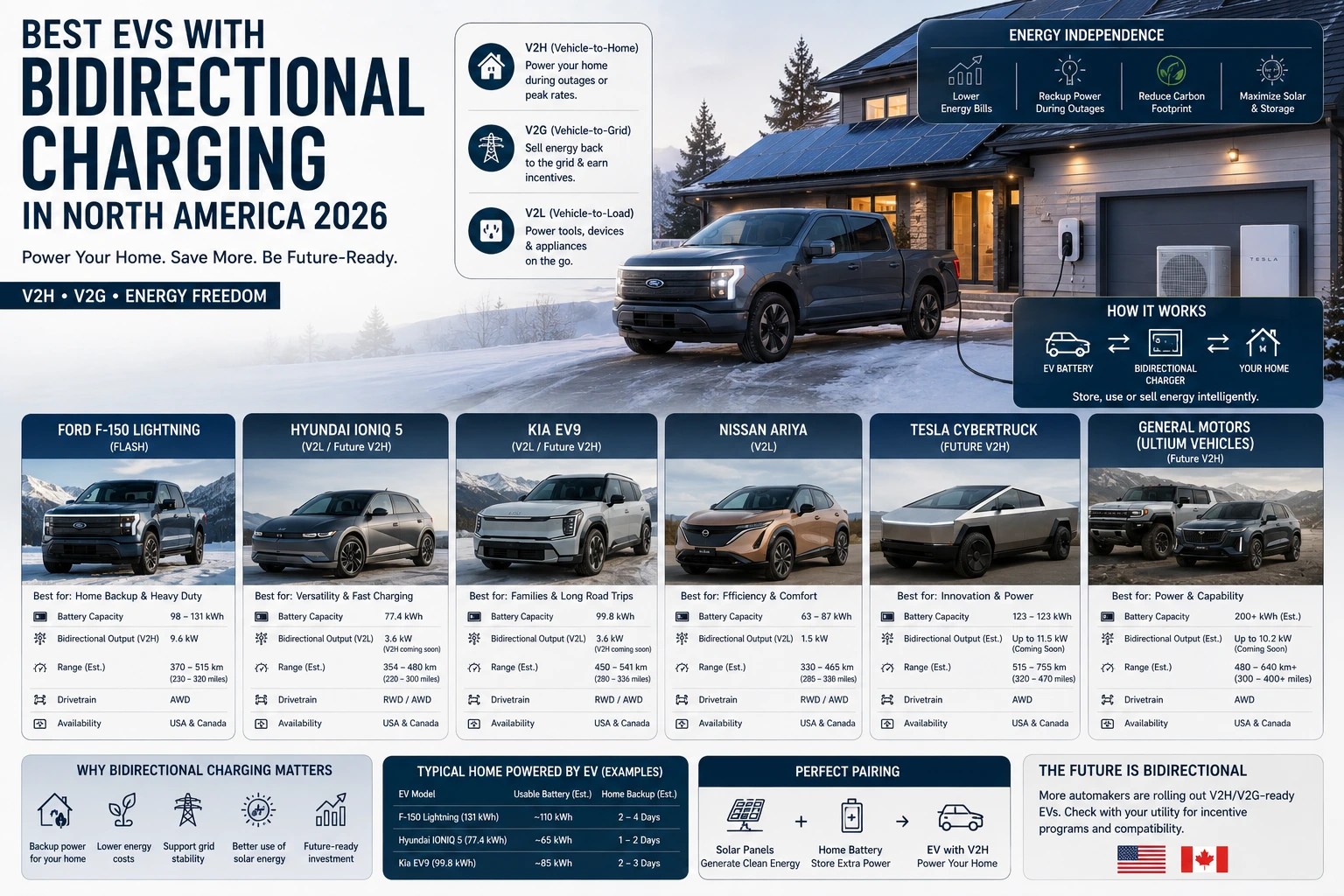
Bidirectional charging Vehicle-to-Load (V2L), Vehicle-to-Home (V2H), and Vehicle-to-Grid (V2G) transforms an EV from a pure transportation asset into a mobile energy resource.
In 2026 North America, a growing set of production vehicles can export power to appliances, critical home circuits, or (in limited utility programs) the grid. When paired with Level 2 charging, time-of-use (TOU) rates, solar, home batteries, and efficient electrification (heat pumps, induction, heat-pump water heaters), these EVs become central to a Net Zero Home roadmap: lower operating costs, resilience during outages, optimized solar self-consumption, and reduced reliance on fossil fuels.
This guide evaluates the leading bidirectional-capable models available in the USA and Canada, explains electrical service, load management, solar sizing, battery storage, and V2H/V2G realities, and shows how the vehicle fits into a complete home energy system. Net Zero Homes serves as an independent educational resource helping homeowners evaluate EVs alongside insulation, air sealing, high-performance windows, heat pumps, and smart energy management.
Why Bidirectional Charging Matters for Homeowners in 2026
- Resilience: Large EV batteries (80–200+ kWh) can supply essential loads for days during outages—far beyond most portable generators.
- Economics: Charge on off-peak/TOU or excess solar; discharge during peak rates or outages.
- Net Zero alignment: Displaces grid imports, supports higher solar self-consumption, and pairs with heat pumps and efficient envelopes.
- Future-proofing: Standards (ISO 15118-20) and utility programs are expanding; early adopters gain experience and potential grid-service revenue.
True whole-home V2H still requires specific vehicle + charger + transfer switch/gateway hardware and, for grid-parallel or export modes, utility interconnection approval. Most systems start as islanded backup (V2H) with limited or pilot V2G.
Leading Bidirectional EVs Available in North America (2026)
Data drawn from manufacturer specifications and verified capability matrices as of mid-2026.
Ford F-150 Lightning (Extended Range preferred)
- Battery: ~98–131 kWh usable.
- Output: Up to 9.6 kW continuous via Ford Charge Station Pro + Home Integration System (HIS/Sunrun).
- Capabilities: Strong V2L (Pro Power Onboard outlets), mature V2H backup (typically 2–5+ days depending on loads and battery size), limited grid-parallel/V2G in select utility pilots.
- Strengths: Proven real-world outage performance, truck utility, high towing.
- Considerations: Proprietary system; HIS hardware evolution has required attention from early owners. Installation typically $5,000–$8,000+ all-in.
GM Ultium Family (Chevrolet Silverado EV, GMC Sierra EV, Blazer EV, Equinox EV, Cadillac Lyriq, Escalade IQ, Hummer EV, etc.)
- Batteries: 85–200+ kWh (Silverado/Sierra Max Range stand out).
- Output: ~9.6 kW class with GM Energy PowerShift Charger + V2H Enablement Kit.
- Capabilities: Broad V2H support across the lineup (some 2024 models need software update). Firmware pathways toward fuller V2G in utility partnerships (e.g., DTE, PG&E). Onboard V2L varies by model.
- Strengths: Widest vehicle selection, large batteries for multi-day backup (Silverado can approach a week for average homes under light loads), polished app integration. Bundle pricing around $7,000–$10,000 installed range.
- Ideal for: Families, contractors, rural homeowners needing range and capability.
Tesla Cybertruck (and emerging Model 3/Y Powershare pathways)
- Battery: Large pack on Cybertruck (~122 kWh class).
- Output: Up to ~11.5 kW continuous with Universal Wall Connector + Powershare Gateway (Powerwall integration available).
- Capabilities: Robust V2L and V2H; Grid Support features in select markets.
- Strengths: High continuous power, tight ecosystem with Powerwall/solar.
- Notes: Full interoperability and export depend on local rules.
Kia EV9 (and expanding E-GMP family)
- Battery: ~99–100 kWh.
- Output: Onboard V2L ~1.9–3.6 kW; full V2H/V2G via Wallbox Quasar 2 + Power Recovery Unit (~12 kW class).
- Capabilities: V2H commercially available in select states with incentives; V2G pilots expanding.
- Strengths: Family-friendly three-row SUV, fast charging, standards-oriented charger (better future-proofing than pure proprietary systems).
- Rollout: Initial focus on California, Connecticut, and other states with program support.
Other notables
- Volvo EX90 / Polestar 3: V2H via dcbel Ara Home Energy Station.
- Nissan Leaf (CHAdeMO): Mature but aging V2G via Fermata systems (more commercial/fleet oriented).
- Emerging: Additional Hyundai/Kia models, Rivian pathways, Honda/Acura future platforms, and standards-based ISO 15118-20 vehicles expected to broaden options through 2027–2028.
Quick comparison table (approximate 2026 values)
| Vehicle | Battery (kWh) | V2H Output | Typical Backup Duration (avg home) | Primary Hardware | Notes |
|---|---|---|---|---|---|
| F-150 Lightning ER | 131 | 9.6 kW | 2–5 days | Charge Station Pro + HIS | Mature truck solution |
| Silverado EV Max | 200+ | ~9.6 kW | 5–7 days | GM PowerShift + V2H Kit | Highest capacity |
| Cybertruck | ~122 | ~11.5 kW | Multi-day | Powershare Gateway | High continuous power |
| Kia EV9 | ~100 | Up to ~12 kW (Quasar 2) | 2–4 days | Wallbox Quasar 2 | Standards-friendly |
| Equinox/Blazer EV | 85–107 | ~9.6 kW | 2–4 days | GM V2H Bundle | More accessible price points |
Actual duration depends on home loads, state of charge reserve, temperature, and critical-load subpanel design.
Buyer Personas and Fit
- Daily commuter / urban mixed driving: Equinox EV, Blazer EV, or future compact Ultium models + V2H for apartment/condo edge cases or small homes. Prioritize Level 2 + TOU optimization.
- Family / three-row needs: Kia EV9 or larger GM crossovers. V2L for devices + V2H for resilience.
- Rural homeowner / contractor / fleet: F-150 Lightning or Silverado/Sierra EV. High capacity, towing, job-site power, multi-day backup.
- Cottage / seasonal / backup-focused: Any high-capacity truck or SUV with mature V2H; pair with modest home battery for seamless transition.
- Net Zero / solar-forward: Any of the above + solar + home battery (Tesla Powerwall, FranklinWH, Enphase, Sigenergy). Bidirectional EV acts as additional flexible storage.
Total Cost of Ownership, Charging Costs, and Savings
Assumptions (illustrative North America averages, mid-2026):
- US residential electricity ≈ 18.4 ¢/kWh average (wide state variation; TOU peak often 2–3× off-peak).
- Gasoline ≈ $4.08/gal US; Canada ≈ CAD 1.67–2.02/L.
- Typical mixed driving efficiency: EV 3–4 mi/kWh; comparable ICE 25–30 mpg.
- Annual miles: 12,000–15,000.
Charging cost example (15,000 miles, 3.5 mi/kWh ≈ 4,286 kWh):
- At 18 ¢/kWh flat: ≈ $770/year.
- Aggressive TOU + off-peak solar: often 30–60% lower.
- Public DC fast charging raises cost significantly home Level 2 is the economic foundation.
Fuel savings: Versus a 28 mpg ICE at $4.08/gal, annual fuel cost ≈ $2,185. EV electricity savings frequently $1,200–$1,800+ before incentives or solar. Maintenance is typically lower (fewer fluids, brakes last longer with regen).
Battery degradation: Modern packs with thermal management and warranty (often 8 years/100k–150k miles to 70% capacity) show 1–2% annual loss under normal use. Bidirectional cycling is managed by software limits (depth-of-discharge caps, weekly energy transfer limits on some systems) to protect longevity. Real world data continues to support modest impact when properly managed.
Resale: Bidirectional capability and large batteries are increasingly valued, especially in regions with high outage risk or high electricity rates. Trucks with proven V2H history command premiums among preparedness-minded buyers.
Incentives (2026 snapshot)
- USA: Federal Clean Vehicle Credit ($7,500 new / $4,000 used) expired for vehicles acquired after Sept. 30, 2025. State, utility, and local rebates remain highly variable check current programs. Charger credit (30C) also wound down.
- Canada: Electric Vehicle Affordability Program (EVAP) offers up to $5,000 point-of-sale for eligible BEVs (declining in later years) with transaction-value caps (exceptions for Canadian made). Provincial top-ups still available in several jurisdictions. Always verify eligibility, MSRP/transaction limits, and stacking rules at purchase time.
Home Charging, Electrical Service, and Load Management
Level 1 (120 V): 3–5 miles of range per hour—acceptable for low daily mileage or temporary use. Level 2 (240 V, 32–48 A typical): 20–40+ miles per hour essential for most owners. DC Fast: Public only for most; bidirectional systems are primarily AC or proprietary DC for home.
Panel capacity realities
- 100 A service: Frequently requires upgrade or aggressive load management for a 40–48 A charger plus other electrification.
- 150–200 A: Usually sufficient with proper load calculation (NEC Article 220).
- 400 A: Ideal for multi-EV, large heat pumps, and high solar.
Typical Level 2 install (near panel, capacity available): $800–$2,500 all-in. Panel upgrade 100→200 A: $1,500–$4,500+. Long runs, detached garages, or complex permitting raise costs. Load management devices, smart splitters, or dynamic current sharing often avoid full upgrades.
Permits and utility interconnection are mandatory in most jurisdictions. Hire a licensed electrician experienced with EVSE and, for V2H, transfer switches or listed bidirectional equipment.
Integrating Solar, Home Batteries, Heat Pumps, and TOU
Solar sizing recommendation: Size for annual home loads + EV charging (or a high fraction). A 8–12 kW system is common for many households adding an EV; larger for trucks or all electric homes. Excess midday solar can charge the EV or home battery; evening discharge or V2H covers peak periods.
Battery storage:
- Tesla Powerwall, FranklinWH, Enphase, Sigenergy or GM Energy home systems.
- Role: Seamless backup, solar time-shifting and (where supported) coordination with EV bidirectional flow.
- Economics improve with high TOU differentials, frequent outages or high solar penetration.
Heat pumps: High efficiency cold climate heat pumps dramatically cut winter heating loads versus resistance or fossil systems. Pair with the EV’s flexible storage for further optimization. In cold climates, precondition the EV while still plugged in and size critical load panels carefully.
TOU and load displacement: Program the vehicle and home energy management system to charge only off-peak or when solar is abundant. Discharge during peak or outages. Some systems already support limited “Home Power Management” modes that offset high-rate grid power.
V2H / V2G practical notes
- V2H typically requires a listed bidirectional charger/inverter, automatic transfer switch or gateway, and properly designed critical load or whole home subpanel.
- Islanded (off-grid during outage) is the most common and reliable mode today.
- Grid-parallel or export (true V2G) is still largely pilot or utility program dependent and requires interconnection agreements.
- Battery warranty and cycle limits apply—follow manufacturer guidance.
Real Homeowner Scenarios
- Suburban family, 200 A service, existing solar, mixed driving: Equinox or Blazer EV + GM V2H kit. Charge midday on solar, discharge evenings on TOU, backup critical loads (fridge, lights, heat pump, internet) for 2–4 days.
- Rural contractor, frequent outages, 150 A panel: F-150 Lightning Extended Range + Ford system + modest home battery. Job-site power via V2L, multi-day home backup, eventual panel upgrade path to 200/400 A as heat pumps and more solar are added.
- Net Zero aspirational homeowner: Kia EV9 or Cybertruck + solar + Sigenergy/FranklinWH stack + cold-climate heat pump. Vehicle acts as additional seasonal storage and resilience layer while the stationary battery handles daily cycling.
Pros, Cons, and Actionable Recommendations
Pros of bidirectional-capable EVs
- Resilience and potential bill savings
- Higher utilization of the expensive battery
- Alignment with electrification and Net Zero goals
Cons / caveats
- Higher upfront hardware and installation cost
- Proprietary ecosystems still dominate
- Utility approval and interconnection complexity for advanced modes
- Battery cycle management requires discipline
Action checklist
- Confirm your electrical service size and perform a professional load calculation.
- Map daily/weekly driving and identify TOU rate structure.
- Prioritize vehicles with mature V2H hardware available in your region.
- Design critical load panel and transfer strategy before or with charger install.
- Size solar and stationary storage with the EV as flexible capacity.
- Verify current incentives, permits, and utility programs.
- Engage a Net Zero Homes virtual consultation for integrated modeling (vehicle + envelope + HVAC + solar + storage).
Ready to evaluate how a bidirectional EV fits your specific home, utility rates, solar potential, and electrification goals? Book a Net Zero Homes virtual consultation. Our Certified Home Energy Advisors model the complete system vehicle charging, panel, solar, storage, heat pumps and envelope so you can make data-driven decisions that maximize savings, resilience and progress toward Net Zero.
This guide is educational and independent. Vehicle availability, hardware pricing, incentives and utility programs change; verify all details with dealers, electricians and local utilities before purchasing or installing.