Solar export programs, utility rates, rebate rules and interconnection requirements can change. Confirm current requirements with your electricity utility before purchasing equipment.
There is no single Canadian net-metering program. Rules and compensation mechanisms vary by province, utility and customer type. Measurement Canada notes that net-metering programs and rates vary by province and territory.
What is the difference between net metering and load displacement?
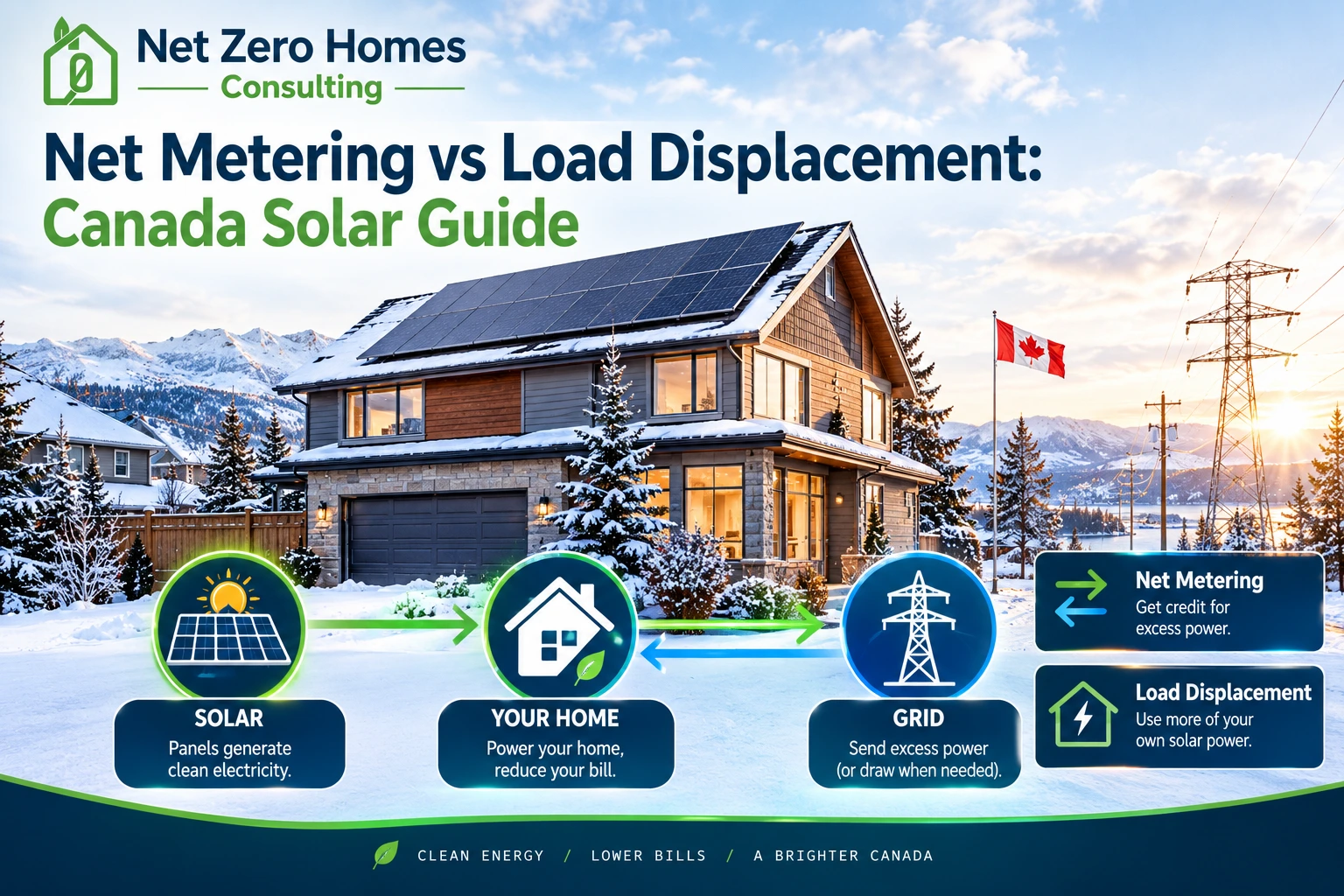
Net metering (or similar export arrangements) lets a solar system power your home first, then send excess electricity to the grid for credits or compensation under local utility rules. Load displacement means generating electricity primarily to reduce what you buy from the grid at that moment using solar on-site, often with a battery, with limited or no export depending on the configuration and utility. The better approach depends on your province, utility rates, household use patterns, future loads such as an EV or heat pump, and available incentives.
Net Metering vs Load Displacement: The Short Answer
If you install solar panels, should you send excess electricity to the grid for credits, or design the system to use more of your solar power inside your home?
The answer depends on your province, utility, electricity rate structure, export compensation, household consumption, solar production timing, battery storage, future EV charging or heat pumps, interconnection rules, incentives and your goals. There is no universal “best” choice across Canada.
What Is Net Metering?
In general terms, net metering (or a similar export program) allows a renewable generation system to:
- Generate electricity
- Serve the home’s electrical load
- Send excess electricity to the grid
- Receive some form of bill credit or compensation for exported electricity
- Draw electricity from the grid when generation is insufficient
The exact credit mechanism differs across Canada. Some programs use kWh credits, dollar credits, avoided-cost compensation, retail-rate compensation, monthly or annual settlement, fixed export rates, retailer-specific rates, or other arrangements. Do not treat all of these as identical “net metering.”
What Is Load Displacement?
Load displacement means generating electricity on-site primarily to reduce the electricity the property needs to purchase from the grid at that moment.
Example
- Home is using 5 kW
- Solar is producing 4 kW
- Solar supplies approximately 4 kW of the home’s load
- Homeowner needs approximately 1 kW from the grid
The 4 kW used directly by the home is load displacement. No export is required for that portion.
Net Metering vs Load Displacement: The Key Difference
Net Metering / Export Model
Solar generation can exceed the home’s instantaneous demand. Excess electricity can be exported to the grid. The homeowner receives credits or compensation according to the applicable program.
Load Displacement Model
Solar electricity is primarily used on-site to reduce grid consumption. Depending on the system and utility rules, excess generation may be prevented from exporting, stored in a battery, curtailed, or exported under another approved arrangement.
Load displacement can describe an energy-use strategy or interconnection configuration. Net metering, net billing, self-generation or micro-generation can describe a utility billing or compensation arrangement. Different utilities use different terminology.
Manitoba Hydro describes “load displacement only” and “load displacement plus excess to grid” options. SaskPower distinguishes net metering from non-exporting self-generation, noting that non-export systems suit homeowners who want to consume or store generation without sending excess to the grid.
Why the Difference Matters to Homeowners
The central question is not simply “How many panels can I fit?” It is: How does this home use energy now, and what will that look like five years from now?
Solar electricity has value whether it is used inside the home or exported but the value of each kWh depends on where you live, how your utility compensates exports, how much electricity the home uses, and when that electricity is needed.
How Solar Self-Consumption Works
Self-consumption is solar electricity used directly by the home. Examples include a refrigerator, HVAC, heat pump, water heater, dishwasher, laundry, EV charging or battery charging. Using solar electricity directly can avoid purchasing electricity from the grid at the full retail rate.
What Happens to Excess Solar Electricity?
Depending on the province, utility and system design:
- It can be exported for credits or payment
- It can charge a battery for later use
- It can be curtailed (production limited)
- It may not be allowed to export under certain rebate or interconnection rules
Net Metering, Net Billing, Self-Generation and Micro-Generation Explained
Consumers and installers often use “net metering” as a generic phrase, but the actual billing mechanism may differ:
- Net metering – typically banks energy credits (kWh) that offset later consumption
- Net billing – converts excess to a dollar credit, often at a different rate than the retail purchase rate
- Self-generation – BC Hydro’s current term for new customers
- Micro-generation – Alberta’s framework
- Non-export / load displacement only – systems designed or configured to minimize or prevent export
Always confirm the exact program name and rules with your utility.
Net Metering vs Load Displacement Across Canada
Ontario
The Ontario Energy Board describes net metering as generating renewable electricity primarily for your own use while sending excess to the grid for bill credits. Credits can be carried forward for up to 12 months. Local distribution companies (Hydro One, Toronto Hydro, Hydro Ottawa, Alectra, Elexicon and others) administer interconnection.
Ontario’s Load-Displacement Solar Rules Matter
Under the Home Renovation Savings Program (current 2026 terms), rooftop solar must be grid-connected and sized for load displacement. Net metering is not permitted for the program’s solar/battery incentive. Solar must be paired with a new eligible battery. Standalone batteries are not eligible for the solar stream. The system must operate for load displacement for the life of the system. Homeowners cannot subsequently enter a net-metering agreement after receiving the incentive. Verify current program terms before proceeding.
British Columbia
BC Hydro closed its old net-metering service rate (Rate Schedule 1289) to new customers effective July 1, 2026. New customers use the self-generation service rate (Rate Schedule 2289). Existing customers can remain on the former net-metering rate for up to 10 years from their initial net-metering start date (subject to specific transition rules, including for rebate recipients).
The new self-generation rate compensates excess generation at a fixed rate of 10 cents/kWh rather than banking kWh credits. Compensation is applied each billing cycle under a net-billing approach. Solar and battery rebates have specific eligibility conditions tied to the self-generation rate.
Alberta
Alberta uses a micro-generation framework under the Micro-Generation Regulation. Small micro-generators (typically under 150 kW for residential) receive credits for electricity supplied to the grid. Compensation depends on the arrangement with the electricity retailer and is often at the retail rate for small systems. Alberta should not simply be described using Ontario-style “net metering” terminology retailer choice and rate plans matter.
Saskatchewan
SaskPower offers Net Metering and distinguishes Non-Exporting Self-Generation. Non-export systems can be appropriate when the homeowner intends to use generation on-site or store it in a battery. The current net-metering credit rate is 7.5¢/kWh through March 31, 2029 (verify current posting). Credits apply to energy charges and carry forward for the life of the account at that location for newer participants.
Manitoba
Manitoba Hydro uses net billing rather than traditional net metering. Excess energy from generators under 100 kW can be sold at the excess energy price (updated yearly; recently in the $0.04–$0.07/kWh range). Manitoba Hydro identifies load displacement only, load displacement plus excess to grid, and independent power generation as different approaches.
Quebec
Hydro-Québec offers self-generation with a Net Metering Option I for eligible renewable sources. Credits are in kWh and the surplus bank resets every 24 months. A self-generation option without compensation also exists. Solar grants have been available; confirm current details.
New Brunswick
NB Power currently operates a net-metering program. In June 2026, NB Power announced proposed changes as part of a rate-design application before the Energy and Utilities Board. These are proposed, not final. Existing participants and those approved before changes take effect may have grandfathering provisions (proposed 10-year period in filings). Distinguish current rules from any approved future changes.
Nova Scotia
Nova Scotia Power’s Self-Generating Option supports residential systems (up to 27 kW simplified path). Credits are generally at the retail rate with rollover. The former SolarHomes residential rebate closed to new homeowners in 2025. Community solar options also exist.
Prince Edward Island
Maritime Electric and provincial programs support customer generation and net metering. Confirm current compensation and size limits with the utility and provincial sources.
Newfoundland and Labrador
The province has a Net Metering Policy Framework allowing customers to generate renewable electricity for their own use and supply surplus to the utility. Newfoundland Power and Newfoundland and Labrador Hydro implement the rules. Verify current residential eligibility, compensation and interconnection requirements.
Yukon, Northwest Territories and Nunavut
Residential net-metering or load-displacement programs are limited or differ significantly due to smaller grids and higher generation costs. Check local utility and territorial government sources for any current residential options. Do not assume southern Canadian programs apply.
Net Metering vs Load Displacement Comparison Table
| Province | Common Program/Term | Export Allowed? | How Excess Is Compensated | Load Displacement Option? | Battery Role | Important 2026 Note |
|---|---|---|---|---|---|---|
| Ontario | Net metering / HRS load displacement | Yes (net metering path) | Credits (up to 12 months) | Yes – required for HRS rebate | Often required for rebate | HRS prohibits net metering for incentivized systems |
| British Columbia | Self-generation (RS 2289) | Yes (up to limits) | Fixed 10¢/kWh (new customers) | Possible | Useful for self-consumption | Old RS 1289 closed to new customers July 1, 2026 |
| Alberta | Micro-generation / net billing | Yes | Retailer-dependent (often retail rate for small systems) | Possible | Useful | Retailer choice matters |
| Saskatchewan | Net metering / non-export self-generation | Yes or no | 7.5¢/kWh (to Mar 2029) | Explicit non-export option | Useful for non-export | Credits do not expire for newer accounts |
| Manitoba | Net billing / customer generation | Yes (under rules) | Excess energy price (market-linked) | Explicit load-displacement options | Useful | Net billing, not traditional net metering |
| Quebec | Self-generation / Net Metering Option I | Yes (eligible) | kWh credits (24-month bank) | Possible | Useful | Confirm current grant terms |
| New Brunswick | Net metering | Yes | Current retail-style; proposed changes pending | Possible | Useful | Proposed changes announced 2026 – not yet final |
| Nova Scotia | Self-Generating Option | Yes | Generally retail rate | Possible | Useful | SolarHomes closed to new residential applicants |
| PEI | Net metering / customer generation | Yes | Utility-specific | Possible | Useful | Verify with Maritime Electric |
| Newfoundland & Labrador | Net Metering Policy Framework | Yes | Framework-based | Possible | Useful | Confirm utility implementation |
| Territories | Limited / varies | Varies | Varies | Limited | Case-by-case | Check local utility |
Varies by utility in multi-utility provinces verify locally.
Solar + Battery: Does Storage Change the Equation?
A battery can increase solar load displacement.
Basic sequence
- Daytime: Solar → Home; excess Solar → Battery
- Evening: Battery → Home
- Overnight: Grid → Home if battery is depleted
A battery shifts solar generation from high-production periods to higher-demand periods. Consider battery efficiency, usable capacity, charge/discharge limits, degradation, backup functionality, inverter limitations, electrical panel capacity, financing, cost and warranty. A battery does not automatically produce a positive financial return economics depend on local rates, export rules and load profile.
Do You Need a Battery If You Have Net Metering?
Not necessarily. Export credits can provide a form of virtual energy balancing. Batteries provide physical energy shifting and can enable backup power if properly designed. Some programs restrict battery + solar configurations.
Solar + EV Charging: A Major Load-Displacement Opportunity
An EV can become a significant electrical load. Daytime charging, workplace charging, overnight charging, smart EV chargers, Level 2 charging, electrical service capacity and future EV ownership all affect solar sizing and self-consumption potential. Plan for future electricity consumption before finalizing system size.
What Happens When You Add a Heat Pump?
Electrification (cold-climate heat pump, heat-pump water heater, electric appliances, EV) can significantly change annual and seasonal electricity demand. A solar system designed before electrification may not match future needs. Do not automatically oversize assess the full future load profile.
Can Solar Rebates Require Load Displacement?
Yes. Some incentive programs impose conditions on system sizing, self-consumption, battery pairing, export and net metering. Ontario’s Home Renovation Savings Program is a clear example. BC Hydro solar/battery rebates also have specific eligibility and rate conditions. Always read current program terms.
How Solar System Sizing Changes the Decision
Size based on current annual and hourly electricity consumption, roof characteristics, local solar resource, future heat pump/EV/battery loads, utility rules and export limits. Annual energy offset is different from real-time load displacement. A system can produce enough annual electricity to match consumption without producing it at the same time the home needs it.
What Happens During a Power Outage?
Net metering does not automatically mean your solar panels will power your house during a grid outage. A standard grid-tied system generally shuts down for safety unless it includes a hybrid inverter, battery, backup gateway, critical-load panel or whole-home backup capability designed for islanding.
How to Compare the Financial Value of Solar Electricity
A kilowatt-hour of solar electricity can have different economic value:
- Used directly – may avoid purchasing grid electricity at the full retail rate
- Stored in a battery – may later avoid grid purchases, subject to efficiency losses and battery costs
- Exported – receives the utility’s credit or payment rate
One kWh generated does not necessarily have the same financial value in every scenario. The more valuable exported electricity is relative to the retail rate, the more attractive export-based arrangements may become. The higher the value of avoided grid purchases relative to export compensation, the more important self-consumption becomes.
Hypothetical illustration (not a market projection)
Solar produces 10,000 kWh/year; home consumes 12,000 kWh/year.
- Case A: 4,000 kWh used directly, 6,000 kWh exported
- Case B: 6,500 kWh used directly, 3,500 kWh exported
The economic outcome depends on export compensation, retail rates, battery costs (if used to increase self-consumption), efficiency, load profile and utility rules. Label any dollar examples as hypothetical.
Rate structures (flat, tiered, time-of-use, retailer-specific) further influence results. Fixed utility charges still apply even with solar.
12 Common Homeowner Mistakes
- Assuming all provinces use the same rules
- Assuming net metering means free electricity
- Ignoring fixed utility charges
- Assuming every exported kWh receives the full retail rate
- Ignoring future EV charging
- Ignoring future heat-pump electricity use
- Oversizing based only on annual consumption
- Ignoring battery losses and costs
- Assuming solar works during an outage
- Assuming rebates can always be combined with net metering
- Buying equipment before checking program and interconnection rules
- Comparing contractor quotes without comparing system assumptions and utility rules
Why Homeowners Should Understand the System Before Calling a Solar Contractor
ASSESS → PRIORITIZE → PLAN → UPGRADE
- ASSESS – Understand current electricity use and home systems
- PRIORITIZE – Identify the upgrades that matter most
- PLAN – Consider solar, heat pumps, batteries, EVs, insulation and electrical capacity together
- UPGRADE – Install systems in an appropriate sequence
The objective is not necessarily to maximize solar exports. It is to understand how much electricity the home will actually need, when it will need it, and how solar generation should be used.
Net Zero Homes Consulting is a vendor-neutral, independent, insured, virtual, information-based, no-pressure, homeowner-focused consulting service. Experience includes more than 10,000 in-home energy consultations covering solar, heat pumps, HVAC, batteries, insulation, air sealing, windows, home maintenance, energy efficiency and electrification. Historical average project savings in the $3,000–$5,000 range are experience-based and not guaranteed.
A solar contractor focuses on system design, equipment, installation, electrical work and interconnection. An independent consultant helps the homeowner step back and ask the right questions about current and future electricity use, utility rules, incentives and whole-home sequencing before choosing an installer. The installer builds the system; the consultant helps the homeowner understand what system makes sense.
20 Questions to Ask Before Buying Solar
- What is my province’s current export program?
- What is my utility’s current program?
- Is this net metering, net billing, self-generation or another arrangement?
- What happens to excess electricity?
- What is the current export compensation?
- Does the rate change over time?
- Are credits in kWh or dollars?
- Do credits expire?
- Is there a system-size limit?
- Is there an export limit?
- Can I install a battery?
- Can I receive a solar/battery rebate?
- Does the rebate require load displacement?
- Do I need pre-approval?
- What happens during a grid outage?
- How much electricity does my home use now?
- What will my future electricity use be?
- Will I add an EV?
- Will I install a heat pump?
- What is my total project cost after incentives?
Frequently Asked Questions
What is the difference between net metering and load displacement?
Net metering allows excess solar to be exported for credits under local rules. Load displacement prioritizes using solar on-site to reduce grid purchases, with export limited or prevented depending on configuration and utility rules.
Is net metering available everywhere in Canada?
No. Programs, terminology and compensation differ by province and utility. Some use net billing, self-generation or micro-generation frameworks.
What is load displacement solar?
A system designed primarily so that solar electricity is used by the home (or stored) rather than exported, reducing the electricity purchased from the grid in real time.
Is load displacement the same as self-consumption?
Self-consumption is the electricity used on-site. Load displacement is the strategy or interconnection approach that emphasizes that on-site use.
Can solar panels work without net metering?
Yes. Non-export or load-displacement configurations, often paired with batteries, are used in several provinces and under certain incentive rules.
Can I use a battery instead of net metering?
A battery can increase self-consumption and provide backup, but it does not replace the utility program. Economics and rules vary.
Does load displacement require a battery?
Not necessarily, but a battery often helps shift solar production to evening or overnight periods.
Can I export excess solar electricity?
It depends on your utility program, system design and any rebate conditions. Confirm with your utility.
How does net billing differ from net metering?
Net billing typically converts excess to a dollar credit (often at a different rate), while traditional net metering banks kWh credits.
Does solar work during a power outage?
Not automatically. Special equipment (hybrid inverter, battery, backup systems) is required for safe islanded operation.
Can I use solar to charge my EV?
Yes, and daytime charging can improve self-consumption. Plan for the added load when sizing the system.
Can a heat pump change how much solar I need?
Yes. Electrification can substantially increase annual and seasonal electricity demand.
Should I oversize my solar system for future electricity use?
Assess future loads carefully. Oversizing purely for annual offset without considering timing, export rules and costs is a common mistake.
Does every province have the same solar rules?
No. Rules, terminology, compensation and incentives vary significantly.
Should I talk to a solar contractor or energy consultant first?
An independent consultant can help clarify the home’s energy picture, future loads and utility options before you select an installer. The contractor then designs and builds the system.
Final Thoughts
Solar electricity has value whether it is used inside the home or exported to the grid—but the value of each kWh depends on where the homeowner lives, how their utility compensates exports, how much electricity the home uses, and when that electricity is needed.
Don’t start with “How many panels can I fit?” Start with “How does this home use energy, and what will that look like five years from now?”
Use the ASSESS → PRIORITIZE → PLAN → UPGRADE approach. Understand the system before you buy the equipment.
One Plan. One Clear Direction.
Before you call the contractor, understand what your home actually needs.