A homeowner in Ontario gets three quotes for attic insulation. One contractor recommends topping up to R-50. Another pushes R-60. A third suggests spray foam for “better performance.” Which is right?
The decision feels like it hinges on the product or the highest number. In reality, bigger questions often matter more: Is the attic properly air-sealed? Is moisture entering through penetrations? Are soffit vents clear? Is existing insulation damaged or compressed? Are there combustion-safety or ventilation concerns? And is the attic even the home’s biggest problem or are basement rim joists, walls, or air leakage elsewhere losing more heat?
The most expensive insulation mistake is not always choosing the wrong material. Sometimes it is insulating the wrong place, at the wrong time or without fixing the problem that caused the discomfort in the first place.
More insulation is not automatically a better retrofit. Successful projects depend on understanding how heat, air, and moisture interact with building materials, ventilation and HVAC systems. Natural Resources Canada (NRCan) emphasizes that insulation must be protected from uncontrolled airflow and that air sealing is a distinct task. Fibreglass and mineral-fibre products, for example are generally poor air-sealing materials.
Insulation slows heat transfer. Air sealing controls uncontrolled air movement. A thicker layer of insulation cannot automatically fix a moisture problem, thermal bridge, air leak or poorly designed wall assembly.
What Is the Biggest Insulation Mistake Homeowners Make?
The biggest mistake is treating insulation as an isolated product purchase instead of part of a complete building-envelope system that manages heat, air, moisture, structure, ventilation and HVAC performance.
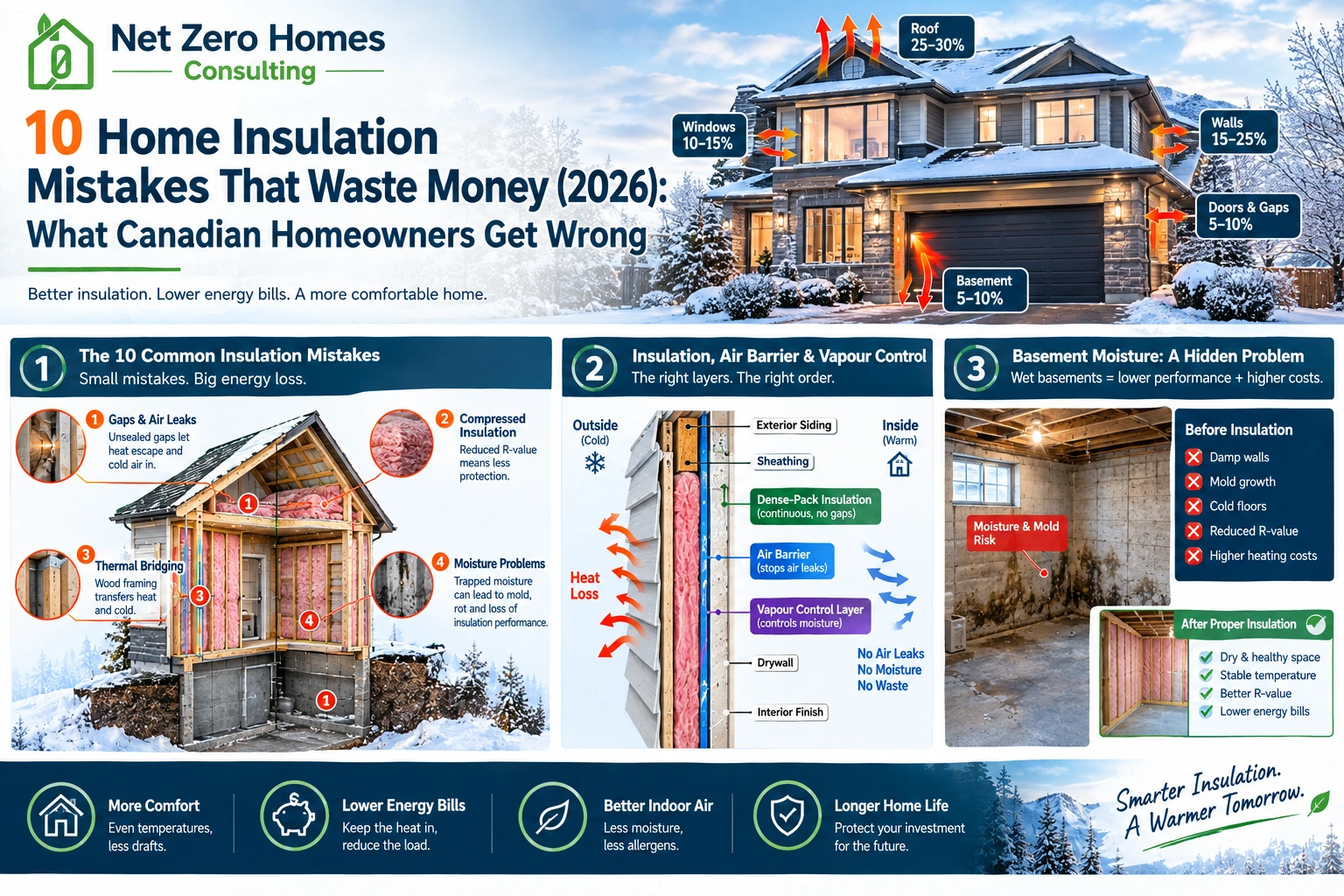
10 Home Insulation Mistakes at a Glance
| # | Mistake | Why It Can Waste Money |
|---|---|---|
| 1 | Insulating before air sealing | Leaves major leakage paths |
| 2 | Chasing maximum R-value | May not address the actual problem |
| 3 | Insulating wet areas | Can hide moisture problems |
| 4 | Treating insulation as air sealing | Drafts can remain |
| 5 | Ignoring the existing assembly | Can create performance/moisture problems |
| 6 | Choosing material by marketing | Product may not suit the application |
| 7 | Ignoring thermal bridging | Heat can bypass insulation |
| 8 | Treating every comfort problem as insulation | Problem may be HVAC/airflow |
| 9 | Missing renovation opportunities | Areas may be harder to access later |
| 10 | Insulating without a priority plan | Money may be spent in the wrong place |
Mistake #1: Insulating Before Air Sealing
This is one of the most common and costly errors. NRCan identifies comprehensive air leakage control as the single most important retrofit activity and recommends considering it first in any upgrade strategy.
Air leakage occurs at attic penetrations (plumbing stacks, electrical wiring, recessed lights, duct boots), top plates, wall-to-attic connections, basement rim joists, windows and doors, service penetrations and cracks. Warm indoor air rising through these paths (stack effect) bypasses insulation entirely, carrying heat and moisture with it.
Insulation and air sealing solve different problems. Adding insulation over unsealed gaps improves conductive resistance while leaving convective pathways open. The result is money spent without solving the underlying leakage. Air sealing first, then insulating, delivers better performance and durability.
Mistake #2: Chasing the Highest R-Value Without Understanding the Assembly
R-value (and its metric counterpart RSI) measures resistance to heat flow through a material. Higher is better but only within the context of the whole assembly. Nominal insulation value (the number on the bag) differs from whole-assembly or effective performance because framing, air films, sheathing and other components affect the total.
A homeowner should not choose a target simply because “R-60 is better than R-50.” The real question is what this particular house and assembly need, given climate, existing insulation, moisture risk, and access. Installation quality, air barriers, vapour control and thermal bridging all matter more than chasing a single number. For detailed R-value guidance specific to Canadian homes, see dedicated resources on effective thermal resistance.
Mistake #3: Insulating a Wet or Damaged Area Before Fixing the Moisture Problem
Do not bury a building problem behind new insulation. NRCan specifically warns against insulating basement walls that already have moisture problems before correcting the cause. Interior insulation can make foundation walls colder, increase condensation risk and hide ongoing leaks, dampness, efflorescence, mould or rot.
Common sources include roof leaks, foundation water intrusion, poor exterior drainage, plumbing leaks and condensation. Health Canada and building-science guidance stress that excessive moisture promotes mould growth. If staining, mould, rot, dampness, or repeated condensation is present, investigate and correct the source first. Moisture first. Insulation second.
Mistake #4: Assuming Insulation Automatically Stops Drafts
Thermal resistance and air leakage are different. A wall can have excellent insulation yet still feel drafty if air moves through gaps around outlets, windows, doors, framing, pipes, ducts, wiring, or rim joists. Batts are not an air barrier.
| Issue | Insulation | Air Sealing |
|---|---|---|
| Heat transfer | Yes | Indirectly |
| Drafts | No | Yes |
| Thermal resistance | Yes | No |
| Air leakage | No | Yes |
| Moisture carried by air | No | Helps control |
| Comfort | Can help | Can help |
Both measures are often required. Insulation slows conduction; continuous air control stops bulk air movement.
Mistake #5: Installing Insulation Without Understanding the Existing Wall or Ceiling
Retrofit work differs from new construction. Before adding insulation, investigate wall construction, framing depth, existing insulation, vapour and air barriers, sheathing, moisture, wiring, plumbing, fire blocking, exterior cladding, drainage plane, and previous renovations.
Canadian homes include wood-frame, solid brick or stone, concrete block, older plaster walls, and mixed assemblies from additions. NRCan notes that different wall types exist and that moisture or structural problems should be addressed before insulating. Assuming a cavity exists or that a one-size approach works can create new performance or moisture issues.
Mistake #6: Choosing Insulation by Product Marketing Instead of by Application
There is no single “best” insulation for every Canadian home. Evaluate materials against the specific location, assembly, moisture exposure, access, fire requirements, air-sealing needs, thermal bridging, installation quality, cost, durability and renovation scope.
| Material | Where It May Make Sense | What Must Be Considered |
|---|---|---|
| Fibreglass | Cavities | Installation quality, air sealing |
| Mineral wool | Walls / non-combustible needs | Detailing, density |
| Cellulose | Blown-in / dense-pack | Density, settling, moisture |
| Rigid foam | Continuous insulation | Detailing, moisture, fire |
| Spray foam | Certain air-sealing + insulation applications | Cost, professional installation, fire protection, moisture |
Link to dedicated comparisons of insulation types for cold climates and spray foam versus fibreglass for deeper guidance. Choose by application not marketing claims.
Mistake #7: Ignoring Thermal Bridging
Thermal bridges are paths of higher conductivity wood studs, floor joists, roof framing, concrete, masonry, rim joists, window frames, structural connections that allow heat to bypass insulation. A wall can show a high nominal R-value on paper while the overall assembly performs significantly lower because heat flows preferentially through the framing.
Continuous exterior insulation can reduce bridging in many cases, but application-specific detailing is required. Effective (whole-wall) performance accounts for these bridges; nominal values do not.
Mistake #8: Assuming Every Room With a Comfort Problem Needs More Insulation
A cold room has many possible causes: insulation gaps, air leakage, thermal bridging, HVAC distribution problems, undersized ducts, poor return-air paths, windows or doors, solar exposure, thermostat location, building orientation, moisture or pressure differences.
Before adding insulation, diagnose: Is there a draft? Is the wall or floor surface cold? Is the HVAC delivering adequate air? Is the return path clear? Are windows contributing? Is humidity unusual? Is the room above a garage or on an exposed elevation? Comfort problems should be diagnosed before choosing the retrofit.
Mistake #9: Doing Insulation as a Standalone Project When a Bigger Renovation Is Already Planned
NRCan encourages integrating energy-efficiency measures into renovation and repair activities. Opportunities arise during roof replacement, siding replacement, basement finishing, drywall work, window replacement, garage renovation, additions or HVAC upgrades. Access is often the hidden cost of retrofit work. If siding is already coming off, exterior continuous insulation becomes more practical. Coordinate rather than treat insulation in isolation without assuming it is always cheaper.
Mistake #10: Insulating Without a Whole-Home Priority List
Homeowners often jump to “I need more insulation.” The actual home may have higher-priority needs: air sealing, attic or basement work, windows, HVAC, heat-pump readiness, ductwork, ventilation, moisture control or other envelope issues.
Use a simple process:
ASSESS → Understand the home (condition, comfort, energy use, assemblies).
PRIORITIZE → Identify what deserves attention first.
PLAN → Coordinate work and sequence.
UPGRADE → Complete the improvements.
The goal is not maximum insulation. The goal is the right improvement in the right place at the right time.
How Do You Know Which Insulation Upgrade Should Come First?
Evaluate:
- Condition (water damage or deterioration?)
- Comfort (where are the actual problems?)
- Energy performance (where is heat or air lost?)
- Access (can the area be upgraded during another renovation?)
- Cost and benefit
- Timing and future upgrades (heat pump, solar, HVAC)
Attic, Basement, Wall, and Garage Insulation Mistakes
Attic: Insulating without air sealing, blocking ventilation, ignoring moisture, disturbing hazardous materials, or overlooking recessed lights, chimneys, and combustion equipment. NRCan stresses air sealing before increasing attic insulation and highlights safety hazards.
Basement: Insulating a wet foundation, ignoring drainage, incomplete rim-joist sealing, or poor vapour/moisture detailing. Correct moisture first.
Walls: Not investigating existing construction, assuming open cavities, ignoring air/vapour control or thermal bridging, incomplete filling.
Garage: Focusing on warming a detached garage when the real issue is house leakage or a room above the garage; ignoring fire separation and garage-to-house air paths.
Spray Foam, “Too Much” Insulation, and Related Questions
Spray foam is a tool, not a universal solution. Consider cost, access, moisture, ventilation during installation, fire protection, thickness, manufacturer requirements, and future renovations. Proper specification and professional installation matter.
Insulation itself is rarely “too much.” Problems arise when changes alter temperature profiles, vapour control, drying potential, condensation risk, or ventilation balance. Air sealing sequence depends on the assembly; the goal is a continuous air-control layer.
Insulation can reduce heat transfer and may lower heating/cooling demand, but results depend on existing conditions, area upgraded, air leakage, climate, HVAC, energy prices, installation quality, and occupancy. NRCan reported that Greener Homes participating households averaged $386 in annual energy-cost savings—this is a program-level historical average across multiple measures and must not be presented as expected savings from insulation alone. The grant program is closed to new applicants.
Value involves cost versus energy, comfort, durability, noise, renovation opportunity, and home quality not simple payback alone.
Insulation and heat pumps (or solar) are related but not interchangeable. Sequence depends on the home’s condition, heating load, existing systems, and priorities. Solar generates electricity; insulation reduces heat transfer. Choose based on actual needs rather than which sounds more “energy efficient.”
How Much Does Insulation Cost in Canada in 2026?
There is no single national price. Drivers include location and accessibility, existing insulation and removal needs, material and labour, drywall or framing work, air sealing, electrical work, moisture repairs, project size, regional labour rates, and renovation timing. Obtain site-specific quotes. In Ontario, programs such as the Home Renovation Savings Program have offered attic and multi-measure insulation rebates in 2026 (amounts and eligibility vary; confirm current status, as programs change). Federal Greener Homes Grant is closed; other financing or provincial options may exist depending on location and home type. Always verify eligibility.
10 Questions to Ask an Insulation Contractor Before Signing
- What problem are you solving?
- What insulation is currently there?
- What is the existing wall/ceiling assembly?
- What R-value/RSI are you proposing and why?
- How will air leakage be addressed?
- How will moisture be handled?
- What happens around electrical and plumbing penetrations?
- How will ventilation be maintained?
- What areas are included and excluded?
- What preparation or repairs are required first?
Ask why this level and method are appropriate for your specific house.
When You Should Get a Home Energy Assessment Before Insulating
Consider an EnerGuide-style assessment (or equivalent) when you have multiple comfort problems, planned major renovations, high energy bills, an older home, significant air leakage, upcoming heat-pump or solar work, basement or siding projects, conflicting contractor recommendations or uncertainty about priorities.
How Net Zero Homes Consulting Approaches Insulation
We provide vendor-neutral, independent, homeowner-focused guidance. The purpose is not to sell insulation. It is to help you understand what the home needs, where insulation and air sealing matter, what should come first, what can be coordinated, what can wait, and how insulation relates to HVAC, heat pumps, solar and resilience.
ASSESS → PRIORITIZE → PLAN → UPGRADE
One Plan. One Clear Direction.
Book your consultation to map the right sequence for your house.
Why Older Canadian Homes Need a Different Insulation Strategy
Older homes often have plaster, solid masonry, mixed assemblies, previous renovations, and possible hazardous materials. NRCan and Health Canada note risks from asbestos-containing vermiculite (especially pre-1990 Zonolite-type attic insulation), UFFI, and other materials. Do not disturb suspected hazardous materials yourself have them tested and handled by qualified professionals.
Moisture, air leakage, and structural considerations differ from modern wood-frame construction. Investigation first.
Insulation, Ventilation, Moisture, and Durability
Making a home more airtight does not make ventilation irrelevant. Air sealing can create indoor-air-quality and humidity considerations if adequate controlled ventilation is not maintained. Moisture moves as bulk water, by air movement, and by vapour diffusion. A moisture problem is not automatically solved by adding insulation. Good retrofits improve performance without creating new condensation, drying or durability issues.
Conclusion
The goal is not to insulate everything. The goal is to understand where insulation will actually improve the home—considering heat, air, moisture, comfort, durability, HVAC, renovation timing, and budget.
ASSESS → PRIORITIZE → PLAN → UPGRADE
One Plan. One Clear Direction.
Before you spend thousands, understand what your house actually needs. Book your consultation with Net Zero Homes Consulting.