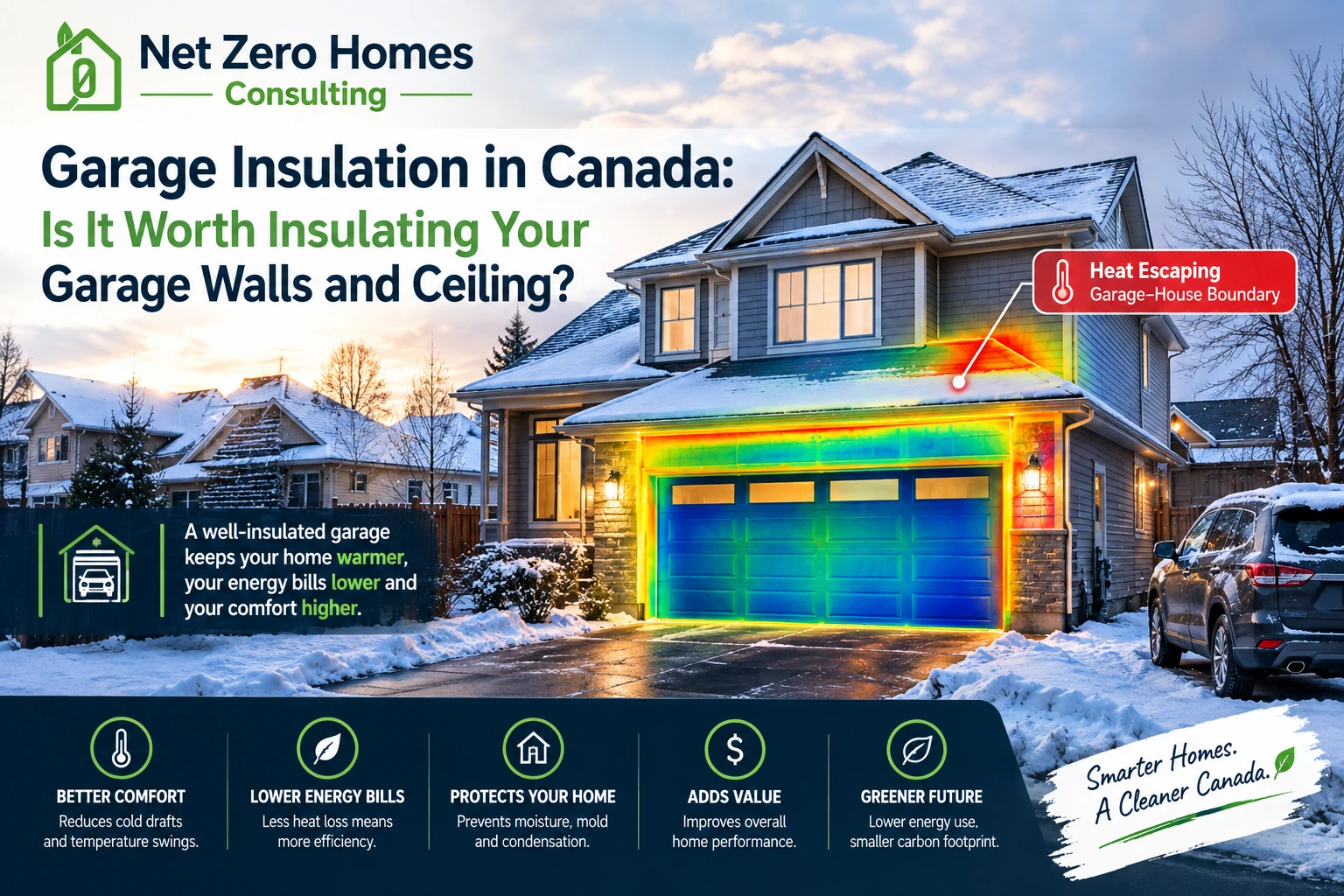
You open the garage door on a January morning in Ontario and the space feels almost as cold as the driveway. The car is freezing, the tools are cold to the touch, and a draft seems to slip under the door into the house. Does that matter?
If the garage is detached and used only for parking and storage, the answer is often “not much.” But if that garage shares a wall with your kitchen, sits under a bedroom or connects directly to the basement, the answer can be very different.
The central idea is simple: you are not necessarily insulating the garage because you want a warmer garage. You may be insulating and especially air-sealing the garage because you want to improve the boundary between the garage and the heated part of your home.
Natural Resources Canada (NRCan) puts it clearly in Keeping the Heat In: heat moves in all directions, so walls and floors should be insulated where they separate heated space from unheated space. For an attached unheated garage, NRCan specifically recommends insulating and air-sealing the walls, ceiling, and door that adjoin the house.
This article examines when garage insulation makes sense in Canadian homes (especially Ontario), which parts of the garage matter most, how insulation differs from air sealing, cost drivers, indoor-air-quality concerns, and how the decision fits into a whole-home energy plan. It does not assume every garage needs insulation.
Is Garage Insulation Worth It in Canada?
Short answer: It depends on what the garage separates from the heated part of the house, not simply on whether the garage itself feels cold.
Key factors include:
- Attached versus detached
- Heated versus unheated
- Living space or bedroom above the garage
- Shared walls with kitchens, living rooms, or basements
- Existing insulation and air leakage
- Condition of the connecting door
- Planned renovations
- Homeowner priorities (comfort, energy use, indoor air quality, future conversion)
| Garage Situation | Potential Priority |
|---|---|
| Detached, unheated garage | Usually lower |
| Attached, unheated garage | Moderate to high, depending on the boundary |
| Bedroom or living space above garage | Often important |
| Shared wall with heated rooms or basement | Moderate to high |
| Heated garage | High |
| Garage undergoing renovation or finishing | Good opportunity |
| Major air leakage to the house | High priority for air sealing first |
| Garage converted to living space | Major building-envelope project |
No universal savings figure applies across Canada. The financial and comfort impact varies with climate, construction, existing insulation and how the garage interfaces with conditioned space.
Why Does an Attached Garage Matter to Home Energy Performance?
Heat flows from warmer areas toward colder ones. An unheated attached garage becomes a cold adjacent volume. Walls, floors and ceilings that separate conditioned living space from that cold volume form part of the home’s thermal envelope.
Air leakage pathways matter at least as much as insulation. Cracks, penetrations for wiring and plumbing, gaps around the connecting door and unsealed joist cavities can allow both heat and garage air (including vehicle-related pollutants) to move into the house.
NRCan guidance treats the shared walls, ceiling and door of an attached unheated garage as assemblies that should be insulated and air-sealed for both heat-loss control and fume prevention.
Thermal bridging through framing, rim joists, and band joists can also reduce performance even when insulation is present. The practical question is not “Is the garage cold?” but “How well does the boundary between the garage and the house perform?”
Should You Insulate Garage Walls?
Focus first on walls that separate the garage from heated space: shared walls with kitchens, living rooms, hallways, mechanical rooms or basements.
If the wall is already insulated, the real issues may be air leakage, thermal bridging, gaps, compressed or missing insulation, or penetrations. Adding more insulation without addressing those problems yields limited benefit.
If the wall is uninsulated, adding insulation can reduce heat transfer into the garage and improve comfort in the adjacent room. Exterior walls of the garage itself are a lower priority unless you plan to heat the garage or convert it.
Material choice depends on access, moisture risk, fire-protection requirements, and whether the wall will be finished. Fibreglass or mineral-wool batts, dense-pack cellulose, rigid insulation, and spray foam are all used in Canadian garages. None is universally “best.” Installation quality and continuity of the air barrier usually matter more than the brand of insulation.
Should You Insulate the Garage Ceiling?
This is frequently the highest-priority surface when living space sits above the garage.
A floor assembly over an unheated garage is an exposed floor. Canadian code guidance (National Building Code and provincial energy standards such as Ontario’s SB-12) treats floors over unconditioned spaces as assemblies that require meaningful thermal resistance. Typical minimum effective values in Climate Zone 6 (much of Ontario) fall in the R-26.5 to R-28 range or higher, depending on the compliance package; colder zones require more.
NRCan notes that when the garage ceiling is open, the space can be treated similarly to an open foundation. When a finished ceiling already exists, dense-pack insulation may be blown into the cavity, but every access hole must be carefully resealed so garage air cannot migrate upward. Spray foam applied to the underside of the floor is another approach sometimes used by contractors because the space is difficult to air-seal thoroughly.
If the garage has only an attic or roof above it (no living space), ceiling insulation is far less critical for the house itself unless you intend to heat the garage.
Why Is the Room Above My Garage So Cold?
Common causes include:
- Insufficient, compressed, or missing insulation in the floor joists
- Air leakage through penetrations, recessed fixtures, or the perimeter
- Thermal bridging through joists and rim/band joists
- Poorly sealed ductwork or other services running through the cavity
- HVAC supply or return imbalance
- Windows or exterior walls of the room above also performing poorly
Simply adding more insulation without diagnosing the actual pathway often fails to solve the cold-floor complaint. Air sealing the plane between the garage and the room above is frequently as important as the R-value itself.
Garage Insulation vs Garage Air Sealing: What’s the Difference?
| Improvement | Controls Heat | Controls Air | Main Benefit |
|---|---|---|---|
| Insulation | Yes | No (or only indirectly) | Thermal resistance |
| Air sealing | Indirectly | Yes | Reduces uncontrolled airflow and pollutant migration |
| Both together | Yes | Yes | More complete envelope improvement |
Insulation slows conductive and radiative heat transfer. Air sealing controls bulk air movement. Garage fumes, gasoline vapours and exhaust do not stop at a layer of fibreglass. Health Canada research has shown that homes with attached garages can have elevated levels of certain vehicle-related pollutants (including benzene and other VOCs). Source control, a well-sealed connecting door, and sometimes exhaust ventilation in the garage are the primary tools; insulation alone is not a pollution barrier.
What Parts of a Garage Should Be Insulated?
Priority order typically follows the boundary with conditioned space:
- Shared wall with the house
- Ceiling under living space or bedroom
- Connecting door (weatherstripping, threshold, self-closing hardware)
- Wall adjacent to basement or other heated areas
- Exterior garage walls and roof (mainly if heating the garage)
- Garage door (comfort inside the garage more than house performance)
- Garage floor/slab (usually low priority unless converting the space or installing radiant heat)
Not every surface has equal value.
Garage Wall and Ceiling Insulation Options
Walls
Open studs allow batts (fibreglass or mineral wool), dense-pack cellulose or spray foam. Finished walls may require removal of drywall, dense-pack through access holes, or exterior insulation during siding replacement. Rigid foam can be added as a continuous layer to reduce thermal bridging. Fire-rated drywall is commonly required on the garage side of shared assemblies under the Ontario Building Code and similar provincial rules.
Ceiling / floor above
Open joists permit careful air sealing first, then cavity insulation or a combination of spray foam and fibrous insulation. Finished ceilings can sometimes be dense-packed, but resealing is critical. Contractors often prefer spray foam on the underside because it simultaneously insulates and air-seals a difficult geometry. Any foam exposed in the garage must meet thermal-barrier (usually drywall) requirements.
Avoid the advice “just spray foam everything.” Material choice should match the assembly, moisture conditions, fire requirements and access.
Should You Insulate the Garage Door?
An insulated garage door and good weatherstripping improve comfort and moderate temperature swings inside the garage. They do not replace insulation and air sealing of the wall or ceiling that separate the garage from the house. Treat door insulation as a secondary comfort measure not as the primary house-envelope upgrade.
What About the Door Between the Garage and the House?
This door is part of both the thermal and the air barrier. Weatherstripping, a proper threshold seal, a self-closing device, and a tight fit matter. Building codes generally require an effective barrier to gas and exhaust fumes. Do not assume the door is performing well simply because it closes.
Garage Insulation and Indoor Air Quality
Attached garages can introduce carbon monoxide, VOCs from gasoline and stored products, and other contaminants into the house through doors, cracks, and penetrations. Health Canada has documented higher concentrations of certain garage-associated pollutants in homes with attached garages and has shown that an exhaust fan venting the garage outdoors can reduce indoor levels of BTEX compounds and carbon monoxide.
Insulation does not solve this problem by itself. Air sealing the garage-to-house boundary, keeping the connecting door closed and well sealed, avoiding idling vehicles or running gas equipment in the garage, and storing fuels and solvents outside the house (or in a detached shed) are the practical controls.
Does Garage Insulation Save Money?
Savings depend on the area of the shared surfaces, climate severity, existing insulation levels, air leakage, the temperature difference and local energy prices. The largest returns often appear when insulation is combined with another planned project (drywall, basement finishing, siding replacement, or conversion of the space above the garage). Bundling avoids paying for labour and access twice.
Do not expect a single national average or guaranteed payback period.
Garage Insulation Cost in Canada
Costs vary widely by region, access, and scope. Major drivers include:
| Cost Factor | Why It Matters |
|---|---|
| Garage size and surface area | More area = more material and labour |
| Existing insulation condition | Removal, supplementation, or dense-pack |
| Open vs finished walls/ceiling | Access and drywall work |
| Number of penetrations | Air-sealing complexity |
| Drywall and fire-rated finishes | Often a large share of total cost |
| Spray foam vs fibrous insulation | Material and labour differences |
| Electrical, plumbing, or duct work | Detailing required |
| Local labour rates | Significant regional variation |
| Renovation timing | Bundling can reduce duplicate costs |
Obtain multiple detailed quotes that separate insulation, air sealing, and finishing. Treat any online “average” as illustrative only.
Is Garage Insulation Worth It If the Garage Is Unheated?
Yes, when the garage is attached and borders heated rooms or has living space above it, when the connecting wall or ceiling is poorly insulated or leaky, when garage air is entering the house or when the garage is already being renovated.
It is usually lower priority when the garage is detached, does not border conditioned space, the budget is limited, or larger envelope deficiencies exist elsewhere (attic, basement, major air leaks).
Is It Worth Heating an Insulated Garage?
Insulating and heating are separate decisions. Heating an uninsulated garage is inefficient and can create condensation risks. Once the envelope is improved, the decision to heat depends on intended use (workshop, vehicle storage, occasional comfort), moisture control, combustion safety, and electrical capacity. A qualified professional should assess any heating appliance installation.
Garage Insulation for Canadian Winters and in Ontario
Canada’s climate zones range from mild coastal British Columbia to extreme northern conditions. The same garage boundary performs differently under different temperature differentials and wind loads. Ontario’s cold winters, prevalence of attached garages, and common rooms-above-garage designs make the shared ceiling and walls particularly relevant. Older Ontario homes frequently have limited or poorly detailed garage-to-house transitions.
Ontario Building Code requirements address fire separation, air barriers between the garage and dwelling and energy-efficiency standards (SB-12) for floors over unconditioned spaces. Local building departments should be consulted for permit and inspection requirements on any significant work.
Garage Insulation in Older Canadian Homes
Older homes may have little or no insulation in garage walls or ceilings, mixed framing, previous unpermitted additions, outdated electrical, moisture issues, or unusual transitions between the original house and a later garage. Never assume the assembly based solely on the age of the house. Investigate before covering surfaces with new insulation.
10 Signs Your Garage May Need Insulation or Air Sealing
- Cold floor in the room above the garage
- Bedroom or living space above the garage is hard to heat
- Shared garage wall feels cold to the touch
- Garage ceiling is visibly uninsulated or has gaps
- Connecting door has obvious drafts
- Large temperature difference between garage and house
- Snow or ice melt patterns suggest heat loss
- Garage odours or exhaust enter the house
- Garage is being renovated or finished
- Insulation is missing, damaged, or compressed
These are indicators, not proof. Diagnosis is still required.
12 Garage Insulation Mistakes Canadian Homeowners Make
- Insulating over moisture, rot, or mould problems
- Assuming insulation alone stops air leakage and fumes
- Ignoring the garage-to-house door
- Neglecting the ceiling under living space
- Installing insulation without understanding the existing assembly
- Compressing batts or leaving gaps
- Leaving penetrations unsealed
- Ignoring thermal bridges at rim joists and framing
- Covering materials without meeting fire or thermal-barrier rules
- Applying spray foam indiscriminately
- Insulating the garage while larger envelope problems remain unaddressed
- Assuming a warmer garage automatically equals a more efficient house
When Should You NOT Insulate Your Garage Yet?
Investigate and repair first if there is water intrusion, mould, structural damage, major air leakage of unknown origin, damaged sheathing, hazardous materials, electrical or plumbing problems or unapproved previous conversions. Covering a building problem with insulation rarely solves it and can make later repair more expensive.
Sequencing with Heat Pumps or Solar
Garage insulation is not automatically required before a heat pump. Evaluate whether the garage boundary affects the rooms the heat pump will serve and whether envelope deficiencies are driving comfort complaints or load. Solar generation and insulation address different parts of the energy system; one does not replace the other. A whole-home assessment helps decide sequence and priority.
Garage Insulation vs Other Home Upgrades
| Upgrade | Main Purpose |
|---|---|
| Garage boundary insulation & air sealing | Reduce heat transfer and air movement at the garage-to-house interface |
| Attic insulation & air sealing | Improve roof/ceiling performance |
| Basement insulation | Improve foundation thermal performance |
| Windows and doors | Improve glazing and operable openings |
| Heat pump | Change heating/cooling system efficiency and fuel |
| Solar PV | Generate electricity |
| Smart controls | Optimize operation |
Prioritize according to actual deficiencies, not marketing pressure.
Where Does Garage Insulation Fit in a Whole-Home Energy Plan?
Use the framework:
ASSESS – Understand the garage and the rest of the envelope.
PRIORITIZE – Decide whether the garage boundary is a meaningful weakness compared with attic, basement, air sealing, windows, or HVAC.
PLAN – Coordinate work so labour and access are not paid for twice.
UPGRADE – Complete improvements in a logical order with qualified contractors.
How Net Zero Homes Consulting Looks at Garage Insulation
The question is not “Can we sell garage insulation?” It is “Does this garage represent a meaningful weakness in the home’s energy, comfort and air-quality performance?”
A consultation helps map the relationship between the garage, attic, basement, walls, air sealing, windows, HVAC, heat pump readiness, solar and future plans. The goal is clarity: what matters, what does not, what should happen first and what can wait.
ASSESS → PRIORITIZE → PLAN → UPGRADE
One Plan. One Clear Direction.
Before drilling holes, removing drywall, or signing an insulation contract, understand what your garage is actually doing to your home’s performance. Book a consultation when you are ready to evaluate the whole picture.
Garage Insulation FAQ
Is garage insulation worth it in Canada?
It depends on whether the garage is attached and what it separates from heated living space. Shared walls and ceilings under rooms above the garage often matter; fully detached unheated garages usually do not.
Should I insulate an attached garage?
Prioritize the walls, ceiling, and door that adjoin the house. Full insulation of exterior garage walls is secondary unless you plan to heat the space.
Should I insulate a detached garage?
Usually lower priority unless the garage is heated, contains plumbing, or is being converted to conditioned space.
Should garage walls be insulated?
Yes when they separate the garage from heated rooms. Existing insulation should be evaluated for continuity and air leakage before adding more.
Should a garage ceiling be insulated?
Yes when living space sits above it. Treat it as an exposed floor. Air sealing is equally important.
Should I insulate the floor above my garage?
Yes if the room above is conditioned. This is one of the highest-value garage-related measures.
Does garage insulation reduce heating bills?
It can reduce heat loss through the shared boundary. Actual savings vary widely; no national average applies.
Does insulating a garage make the house warmer?
It can improve comfort in adjacent rooms and the room above by reducing heat loss and drafts at the boundary.
Why is my bedroom above the garage so cold?
Common causes are missing or inadequate floor insulation, air leakage, thermal bridging, and HVAC imbalance. Diagnosis comes first.
Can I insulate a garage without removing drywall?
Sometimes, via dense-pack or exterior approaches. Access and resealing quality determine success.
What is the best insulation for a garage?
There is no single best product. Choice depends on access, moisture, fire requirements, and whether air sealing is also needed.
Is spray foam good for garage walls or ceilings?
It can provide both insulation and air sealing in difficult geometries, but it is not required in every case and must meet fire and thermal-barrier rules.
Should I insulate my garage door?
Useful for garage comfort; secondary to the house-to-garage boundary.
Does garage insulation stop fumes?
No. Air sealing, a tight connecting door, source control, and sometimes exhaust ventilation address fumes.
Should I air seal my garage?
Yes, especially the boundary with the house. Air sealing and insulation work together.
How much does garage insulation cost in Canada?
Highly variable. Cost drivers include size, access, finishes, and labour rates. Obtain detailed local quotes.
Should I heat my garage after insulating it?
Only if the intended use justifies the operating cost and the envelope and combustion safety are properly addressed.
Can I turn my garage into living space?
Yes, but it becomes a full building-envelope, fire-separation, and code-compliance project, not a simple insulation job.
Should I insulate before drywall?
If the garage is unfinished, insulating and air-sealing before finishing is usually more cost-effective.
Should I insulate before installing a heat pump?
Evaluate the specific impact of the garage boundary on the conditioned rooms the heat pump will serve.
Does garage insulation qualify for rebates?
Federal Greener Homes programs have closed to new applicants. Check current provincial or utility programs; eligibility is often limited to exposed floors or conditioned-space improvements and changes over time.
What R-value should a garage have?
Shared assemblies should meet or exceed the levels required for floors or walls separating conditioned from unconditioned space in your climate zone. Exterior garage walls are lower priority unless the garage is heated.
Can garage insulation cause moisture problems?
Poorly detailed insulation that traps moisture or blocks required drying can create problems. Address bulk water and air leakage first.
Do I need drywall over garage insulation?
Fire separation and thermal-barrier rules often require a protective covering such as fire-rated drywall on shared assemblies. Confirm local requirements.
Can garage air leak into my house?
Yes. Doors, cracks, penetrations, and joist cavities are common pathways.
How do I know whether garage insulation should be a priority?
Assess the shared surfaces, existing insulation, air leakage, comfort complaints in adjacent rooms, and overall home envelope condition.
Conclusion
A garage does not need to be warm to be important. If it sits beside, beneath, or directly below heated living space, the garage forms part of the home’s thermal and air boundary.
The goal is not simply to make the garage warmer. The goal is to understand whether improving that boundary will make the house more comfortable, more efficient, more durable, and better protected from unwanted air movement and pollutants.
Use the sequence ASSESS → PRIORITIZE → PLAN → UPGRADE. One Plan. One Clear Direction.