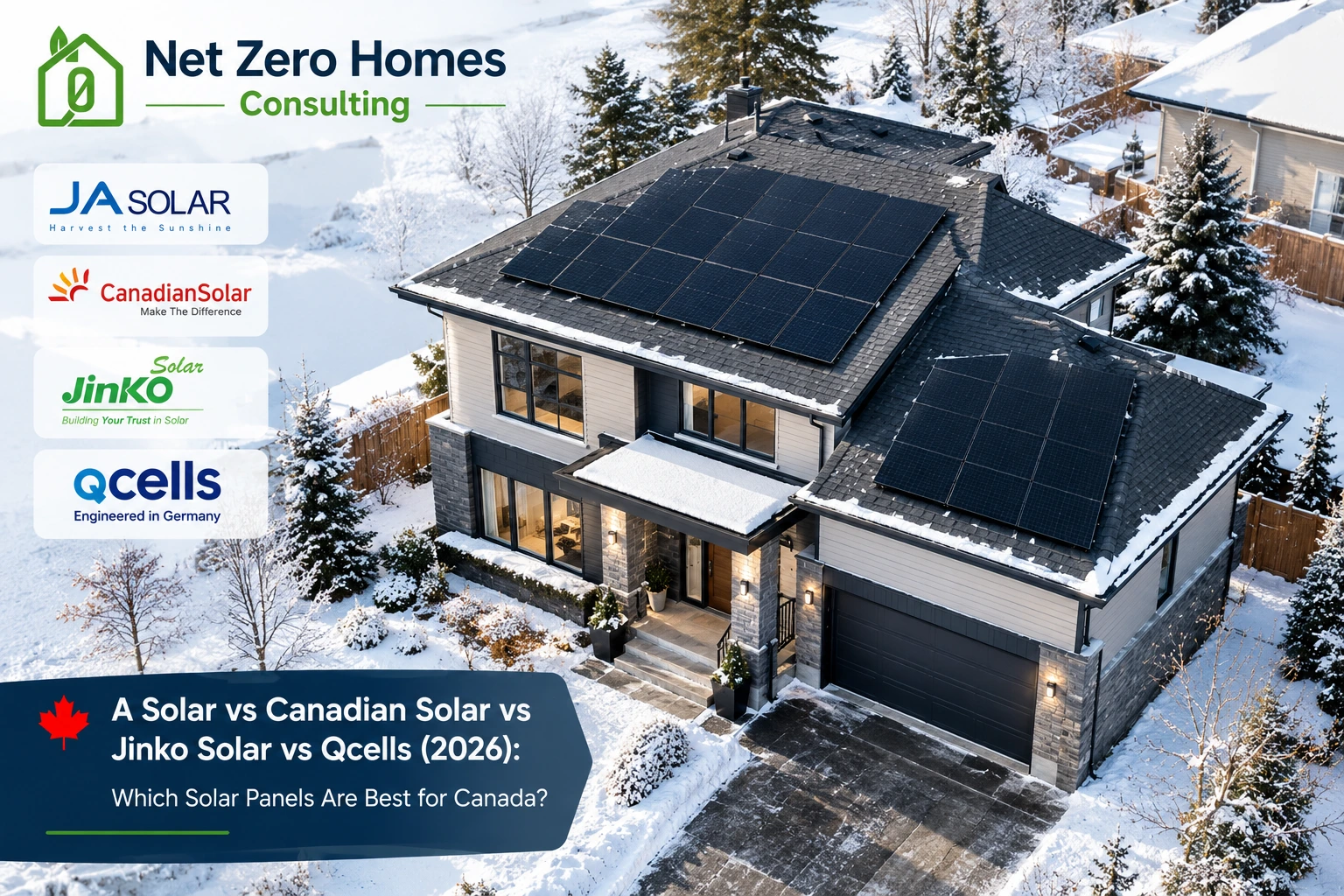
Which Solar Panel Brand Is Best for Canada in 2026?
Here is the honest answer: there is no single “best” solar panel brand for every Canadian home.
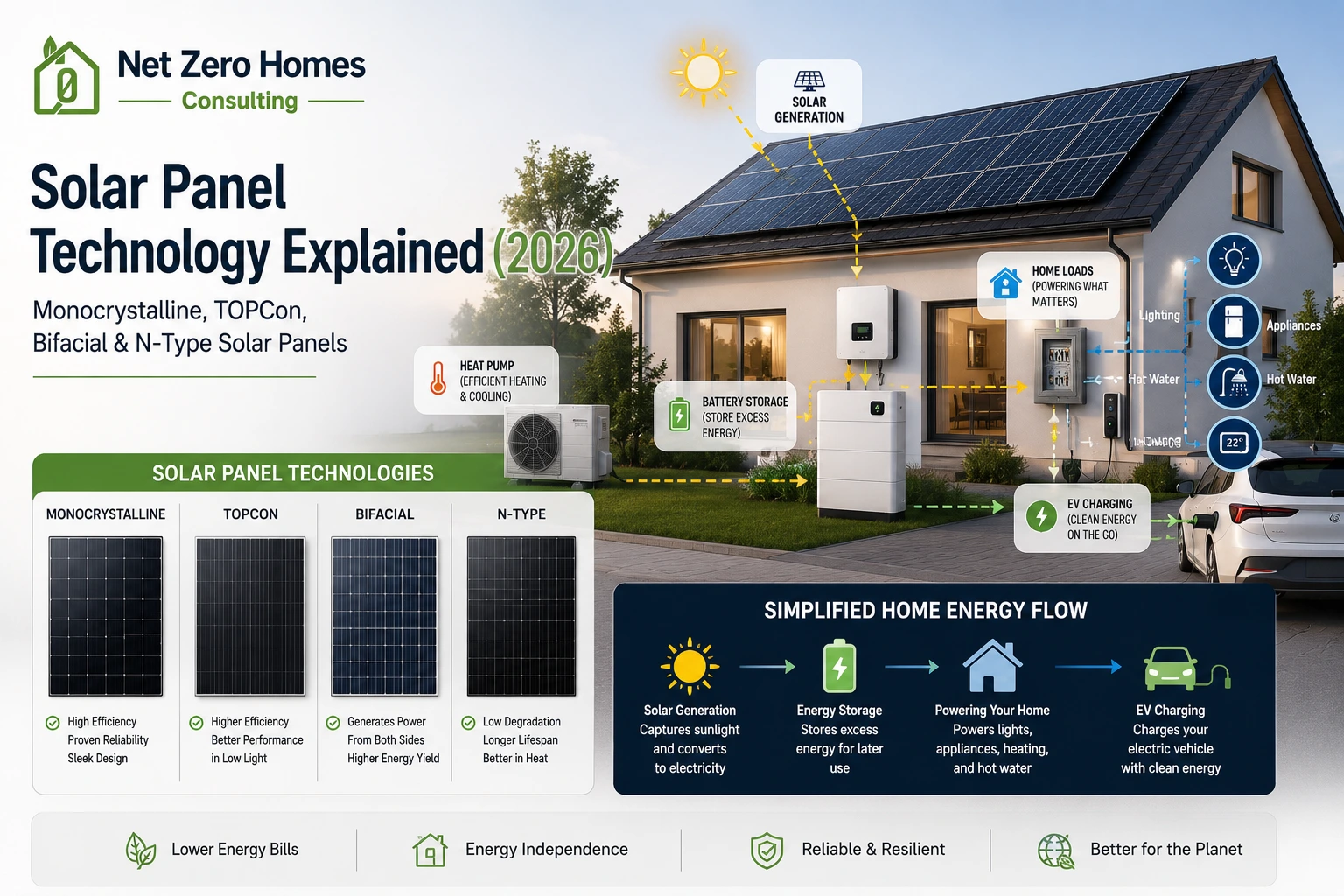
The four brands we are comparing JA Solar, Canadian Solar, Jinko Solar, and Qcells are all global Tier-1 manufacturers. In 2026, their leading residential products are more similar than different. All have transitioned to N-type TOPCon technology, which is the industry’s current gold standard for efficiency, degradation and cold-weather performance .
If you want a short answer: for most Canadian homes, any current N-type TOPCon module from these Tier-1 brands will perform well, provided it is matched to your roof, designed properly and installed by a qualified contractor .
The real question is not “which brand?” but “which specific product and complete system makes the most sense for my house, roof, climate, and electrification plans?”
That is what we will help you answer in this article.
JA Solar: Technology, Efficiency and Canadian Climate Performance
Who Is JA Solar?
JA Solar is a Chinese headquartered manufacturer consistently ranked among the top three global solar panel producers. In Wood Mackenzie’s 2026 Global Solar PV Module Manufacturer Ranking, JA Solar placed third, ahead of Canadian Solar and well ahead of Qcells . The company is recognized as a Tier 1 supplier by S&P Global Commodity Insights .
Current 2026 Residential Products
JA Solar’s leading residential product family is the DeepBlue series, which uses N-type TOPCon cell technology. Depending on the specific model, residential modules are available in power outputs from approximately 430 W to 485 W, with module efficiencies reaching up to about 22.4% to 24.1% .
Canadian Climate Performance
The DeepBlue series offers typical temperature coefficients around 0.29%/°C, which means the panels lose about 0.29% of their rated power for each degree Celsius above the standard test temperature of 25°C. Canadian winters actually improve solar panel output because cold temperatures lower electrical resistance. JA Solar’s TOPCon modules operate effectively in the -40°C temperatures common across Canadian winters.
Snow-load ratings are typically industry-standard at 5,400 Pa, meaning the panels can support a significant snow load before risk of damage.
Availability and Warranty
JA Solar products are widely available through Canadian solar distributors. Product warranties range from 12 to 25 years depending on the specific model, with 30-year linear performance warranties common on the N-type lines .
What JA Solar Does Best
Strong value proposition: competitive performance at attractive pricing
Solid TOPCon technology with wide distribution
Good low-light performance for cloudy days
Backed by one of the world’s largest manufacturers
Limitations
Product warranty length may be shorter on entry-level models verify before purchase
Less Canadian brand recognition than Canadian Solar
Canadian Solar: Technology, Efficiency and Canadian Climate Performance
Who Is Canadian Solar?
Canadian Solar is a unique player in this comparison. Though headquartered in Canada (Guelph, Ontario), the company manufactures primarily overseas. It ranked fourth in Wood Mackenzie’s 2026 global ranking, just behind JA Solar . The brand carries significant weight in the Canadian market due to its Canadian headquarters and strong local presence.
Current 2026 Residential Products
Canadian Solar’s current residential flagship is the TOPHiKu6 series, featuring N-type TOPCon cells with half-cut cell design. Models range from about 435 W to 465 W with efficiencies up to approximately 22.8% . Higher-power TOPHiKu7 models in larger formats can reach up to 500 W or more, depending on panel size .
The product has a specified operating temperature range of -40°C to +85°C, which comfortably covers all Canadian climate conditions.
Canadian Climate Performance
Canadian Solar’s TOPHiKu6 offers a temperature coefficient around -0.30%/°C, putting it in line with competing TOPCon products. First-year degradation is typically ≤1%, with annual degradation around 0.35% to 0.40% meaning about 84.8% of original power at year 30 .
The panels carry a 12-year product warranty (standard) and a 30-year performance warranty. Snow-load ratings reach 5,400 Pa, matching industry-leading standards .
Availability and Canadian Advantage
Because Canadian Solar is headquartered in Canada, the company has stronger local service infrastructure and easier warranty claim processes. Some installers report that Canadian Solar’s Canadian presence translates to more responsive support . This is a meaningful advantage when you need a warranty claim years from now.
What Canadian Solar Does Best
Strong Canadian brand recognition and local support
Excellent balance of performance and value
30-year performance warranty
Wide availability across all Canadian provinces
Canadian headquarters (Guelph, Ontario) with some Canadian manufacturing
Limitations
12-year product warranty is shorter than some competitors (verify if upgraded warranty is available)
P-type HiKu6 models are being phased out; insist on TOPHiKu6 N-type.
Jinko Solar: Technology, Efficiency and Canadian Climate Performance
Who Is Jinko Solar?
Jinko Solar is the world’s largest solar panel manufacturer by shipment volume . In Wood Mackenzie’s 2026 ranking, Jinko placed second globally . The company ships more solar modules worldwide than any other manufacturer, giving it unmatched economies of scale and supply chain reliability.
Current 2026 Residential Products
Jinko’s flagship residential product is the Tiger Neo series, built on N-type TOPCon technology with the company’s proprietary HOT 2.0 cell architecture. Residential modules typically range from about 430 W to 485 W, with module efficiencies reaching up to approximately 22.5% to 24.8% depending on the specific model .
The Tiger Neo series features a clean all-black aesthetic with multi-busbar design, making it popular for front-facing roofs where appearance matters .
Canadian Climate Performance
The Tiger Neo series offers temperature coefficients in the -0.26%/°C to -0.30%/°C range, putting it at the top tier of cold-weather performance. Like other N-type TOPCon modules, it maintains high efficiency at low temperatures and operates in -40°C conditions.
Annual degradation is approximately 0.35% to 0.40%, with first-year degradation of 1% or less. Jinko offers 30-year linear performance warranties on applicable N-type modules, guaranteeing approximately 87.4% of rated power in year 30 .
Snow-load ratings are industry-standard 5,400 Pa .
Availability and Warranty
Jinko panels are widely available through Canadian distributors. Historically, the company’s Canadian warranty enforcement network has been slightly weaker than Canadian Solar’s, but it has improved rapidly in 2026 .
Product warranties vary: the standard 12-year warranty is common, but 25-year product warranties are available on some registered systems. Crucially: ensure your quote specifies the extended product warranty rather than the shorter default .
What Jinko Solar Does Best
World’s #1 manufacturer by volume proven reliability and supply chain
Excellent aesthetic quality with all black design
Strong low-light performance for cloudy Canadian conditions
Competitive pricing, often the lowest per watt among these brands
Limitations
Standard product warranty is only 12 years extend it at time of purchase
Canadian support network historically weaker than Canadian Solar (improving)
Higher-efficiency models may cost more
Qcells: Technology, Efficiency and Canadian Climate Performance
Who Is Qcells?
Qcells is a South Korean-headquartered manufacturer with significant North American presence and U.S. manufacturing operations. In Wood Mackenzie’s 2026 ranking, Qcells placed tenth globally . The company benefits from strong brand recognition in residential channels and has a reputation for quality engineering (German influenced technology background).
Current 2026 Residential Products
Qcells’ residential flagship is the Q.TRON series, built on N-type TOPCon technology. Residential models range from about 420 W to 480 W, with module efficiencies reaching up to approximately 22% to 22.5% .
Higher-wattage variants are available, but Qcells residential SKUs typically top out lower than the maximum outputs offered by some competitors (480 W vs 500-590 W+ on some competitor lines) .
Canadian Climate Performance
Q.TRON panels offer temperature coefficients around -0.28%/°C to -0.30%/°C. Annual degradation is approximately 0.40%, and the panels are known for excellent year-25 power retention around 90.6% of original rating .
Product warranty is typically 25 years, matching Qcells’ performance warranty of 25 years .
North American Manufacturing Advantage
Qcells has invested heavily in U.S. manufacturing, building ingot, wafer, cell, and module production capacity. This provides greater supply chain predictability and compliance advantages for North American markets . However, this does not automatically mean a higher-quality panel it means a stronger North American supply chain.
What Qcells Does Best
Strong North American brand presence and U.S. manufacturing
25-year product warranty longer than standard offerings from others
Excellent brand recognition in residential channels
High quality and engineering reputation
Good low-light performance
Limitations
Residential SKUs top out at lower wattage (≈480 W) vs competitors
Often carries a small price premium ($0.02–$0.04/W)
Limited bifacial options compared to competitors
JA Solar vs Canadian Solar vs Jinko vs Qcells: Side-by-Side Comparison
2026 Residential Product Comparison Table
| Category | JA Solar (DeepBlue) | Canadian Solar (TOPHiKu6) | Jinko Solar (Tiger Neo) | Qcells (Q.TRON) |
|---|---|---|---|---|
| Current residential series | DeepBlue series | TOPHiKu6 / TOPHiKu7 | Tiger Neo series | Q.TRON series |
| Cell technology | N-type TOPCon | N-type TOPCon | N-type TOPCon | N-type TOPCon |
| N-type/TOPCon | Yes | Yes | Yes | Yes |
| Maximum power | ~430–485 W | ~440–500 W | ~430–485 W | ~420–480 W |
| Maximum efficiency | Up to ~22.4–24.1% | Up to ~22.8% | Up to ~22.5–24.8% | Up to ~22–22.5% |
| Temperature coefficient | ~–0.29%/°C | ~–0.26% to –0.30%/°C | ~–0.26% to –0.30%/°C | ~–0.28% to –0.30%/°C |
| First-year degradation | ≤1% | ≤1% | ≤1% | ≤1% |
| Annual degradation | ~0.35–0.40% | ~0.35–0.40% | ~0.35–0.40% | ~0.40% |
| Product warranty | 12–25 yrs (varies by model) | 12–25 yrs (standard 12 yrs) | 12–25 yrs (standard 12 yrs) | 25 years |
| Performance warranty | 30 years linear | 30 years linear | 30 years linear | 25 years |
| Bifacial | Yes | Yes | Yes | Limited/model-dependent |
| Glass-glass | Yes | Yes | Yes | Varies |
| Snow-load rating | 5,400 Pa typical | 5,400 Pa typical | 5,400 Pa typical | Industry standard |
| Wind-load rating | 2,400 Pa typical | 2,400 Pa typical | 2,400 Pa typical | Industry standard |
| Operating temperature | -40°C to +85°C | -40°C to +85°C | -40°C to +85°C | Industry standard |
| Canadian availability | Widely available | Strong Canadian presence | Widely available | Strong NA presence |
| North American manufacturing | No | Limited | No | Yes (U.S.) |
| Best use case | Value + solid TOPCon | Canadian support + value | Volume leader + aesthetics | Brand recognition + warranty |
Note: Exact values vary by specific model and series. Always verify the precise product quoted by your installer .
Which Solar Panels Perform Best in Canadian Winters?
Canadian winters are unlike any other market’s conditions. Let us separate myth from reality.
Cold Temperatures Are Actually Good
Solar panels are tested at 25°C. As panel temperature rises above 25°C, output decreases. In cold Canadian winters, panel operating temperatures are often well below 25°C, which means higher electrical output per hour of sunlight compared to a hot summer day .
What matters is the temperature coefficient. A panel with a -0.26%/°C coefficient loses less power as temperature rises than a panel with -0.30%/°C. In Canadian winters, all four brands perform well, with Jinko’s -0.26%/°C (on some models) slightly leading the category.
Snow Accumulation and Shedding
Snow is the real winter challenge. Snow covered panels produce no electricity. All four brands offer 5,400 Pa snow-load ratings, which is the industry standard .
Here is the key insight for snow: system design matters more than brand.
A steeper roof pitch, panels tilted at higher angles, dark frames that absorb heat, and smooth glass surfaces all help snow slide off faster. Some installers recommend glass-glass (bifacial) panels for snowy climates because the rear glass can capture reflected light from snow on the ground.
What about manual snow removal? Generally not recommended. You risk scratching the glass or damaging the frame. Most of the time, snow melts and slides off within a few sunny days.
Winter Reliability Comparison
All four brands’ TOPCon modules operate at -40°C, cover all Canadian climate zones, offer 5,400 Pa snow-load ratings, and have solid encapsulation and glass construction.
The difference is in temperature coefficient and low-light performance. Jinko’s Tiger Neo leads slightly on temperature coefficient, while Canadian Solar’s TOPHiKu6 and JA Solar’s DeepBlue perform very similarly. Qcells’ Q.TRON also performs well but may lag on output at the lowest winter sun angles due to slightly lower wattage ratings.
The Bottom Line on Winter
All four brands perform well in winter. The marginal differences in temperature coefficient matter but are not decisive. For most Canadian homes, any of these four brands’ N-type TOPCon panels will outperform older technology in cold weather.
Solar Panel Efficiency vs Real-World Energy Production
Panel Efficiency Is Not Annual Production
Panel efficiency measures how much sunlight a panel converts to electricity per square metre of panel surface. A panel with 24% efficiency produces more electricity from the same roof space than a panel with 22% efficiency.
However: higher efficiency does not automatically mean more annual household electricity production.
Actual annual production depends on:
Roof size and shape
Roof orientation and tilt (south-facing is best)
Shading from trees, chimneys, and neighbouring buildings
Snow accumulation in winter
Operating temperature
Inverter efficiency
System losses from wiring and electrical design
Local weather patterns and solar irradiance
A 22% efficient panel on a perfectly south-facing, unshaded roof will produce more than a 24% efficient panel that is partially shaded.
How to Compare Panels Correctly
Ask your installer for estimated annual kWh production for the specific system design, not just the panel wattage. Use PVWatts or similar tools to model your specific roof with different panels. Focus on lifetime energy production, not peak efficiency.
Best Solar Panels for Ontario
Climate Context
Ontario faces cold winters, significant snow, freeze-thaw cycles, and humid summers. Electricity rates are moderate-to-high, making solar economics favourable. Net metering in Ontario allows you to export excess production to the grid.
What Matters in Ontario
Snow load: all four brands are adequate
Temperature coefficient: slightly favours Jinko
Degradation: lower annual degradation improves long-term production
Warranty: Ontario’s humid summers mean product warranty length matters more than in drier climates
Availability: all four brands are widely available in Ontario
Ontario Recommendation
Jinko Tiger Neo’s leading temperature coefficient and strong degradation warrant strong consideration. Canadian Solar TOPHiKu6’s local support network is a major advantage if you need warranty service. JA Solar DeepBlue offers value without compromise.
Best Solar Panels for Alberta
Climate Context
Alberta has Canada’s highest solar resource more sunny days than most provinces. Winters are very cold, with occasional chinook winds that can clear snow. Summer heat is a factor. Hail is a real risk in Alberta.
What Matters in Alberta
Solar resource: you will get more production per installed watt than in cloudier provinces
Cold temperatures: benefit all panels but favour superior temperature coefficients
Hail resistance: all four brands offer standard hail ratings; verify with your specific model
Snow: less persistent than in Ontario but still significant
Alberta Recommendation
Jinko Tiger Neo’s superior temperature coefficient can translate to meaningful annual gains in Alberta’s extreme temperatures. Canadian Solar and JA Solar offer very similar performance. Qcells’ Q.TRON may be less suitable for small roofs due to lower maximum wattage per panel .
Best Solar Panels for Quebec
Climate Context
Quebec has heavy snow, very cold temperatures, and relatively low electricity prices (thanks to hydro power). Solar economics are less compelling due to low electricity rates, but solar can still be part of a Net Zero strategy.
What Matters in Quebec
Heavy snow load: all brands are adequate at 5,400 Pa
Extreme cold: all operate at -40°C
Low-light performance: Quebec’s cloud cover means low-light performance matters
Cost: competitive pricing is essential because payback is longer
Quebec Recommendation
Canadian Solar’s strong Canadian presence makes it a natural choice. The company’s Guelph headquarters offers responsive support. Jinko Tiger Neo’s strong low-light performance is valuable for Quebec’s cloudier conditions. JA Solar offers excellent value.
Best Solar Panels for Snowy Canadian Climates
What Matters in Snow
Snow-load rating: 5,400 Pa is standard across all four brands
Glass-glass (bifacial): can capture reflected light from snow
Smooth glass: helps snow slide off
Dark frames: absorb heat to accelerate snow melt
Panel tilt: steeper tilts shed snow more readily
Which Is Best for Snow?
All four brands are capable. Bifacial glass-glass options from JA Solar, Canadian Solar, and Jinko can capture reflected light from snow on the rear side. This is a genuine advantage in snowy climates.
Canadian Solar’s TOPHiKu series is available in glass-glass bifacial versions, as are Jinko’s Tiger Neo and JA Solar’s DeepBlue.
The Key Insight
Snow performance is 70% system design and 30% panel choice. A well-designed system with a steep enough roof pitch and proper racking will outperform a poorly designed system even with the best snow-rated panels.
Best Solar Panels for Small Roofs
The Small Roof Scenario
Imagine a Toronto homeowner with a limited south-facing roof section. Dormers, vents, and setbacks reduce usable space. Every square metre counts.
What Becomes Most Important
Panel efficiency: higher efficiency = more watts per square metre
Panel wattage per panel: higher-wattage panels = fewer panels needed for the same system size
Physical dimensions: smaller panels may fit better around obstacles
Small Roof Recommendation
Compare the watts per square metre of the specific panels you are considering. A 500W panel and a 440W panel of the same physical size produce 13% more power from the same roof space . Higher-efficiency panels command a price premium but can be justified when roof space is limited.
Jinko Tiger Neo and JA Solar DeepBlue both offer high-efficiency options up to approximately 24%. Canadian Solar TOPHiKu7 in higher wattages (500W+) provides excellent roof-space efficiency.
Best Solar Panels for Solar + Heat Pumps
Why This Matters
A heat pump can double your electricity consumption in winter. A solar system sized only for your current consumption will not cover winter heat-pump demand.
The Correct Sizing Process
Current consumption + future heat-pump consumption = required solar system size.
Do not size solar based only on your current utility bill.
Heat Pump Recommendation
Any of these four brands in N-type TOPCon will work well. The key is system sizing you need more panels than you think.
Because heat pumps run heavily in winter when solar production is lowest, you have two options:
Oversize your solar system to maximize winter production
Accept that you will draw more grid power in winter and rely on net metering credits from summer overproduction
Which Panel?
A high-efficiency panel like Jinko Tiger Neo (if roof space is tight) or an efficient and well-priced panel like Canadian Solar TOPHiKu6 (if roof space is adequate) will serve a heat-pump home well. The difference in panel selection is small compared to the importance of total system size.
Best Solar Panels for Solar + EV Charging
EV Electricity Demand
An average EV adds approximately 3,000–5,000 kWh to annual household consumption. That is equivalent to adding 8–12 more panels to your system (depending on panel wattage and local solar resource).
EV Charging Recommendation
Plan for your future EV when sizing your system. If you are buying an EV next year, design your system for that load today.
Which Panel?
Again, panel choice matters less than system size. For an EV home, prioritise:
Annual kWh production: estimate this for your roof and panel choice
System capacity: size for EV + current consumption + future heat pump
Roof space: if you have a small roof, prioritise efficiency
Best Solar Panels for Solar + Battery Storage
Understanding kW vs kWh
Many homeowners confuse power (kW) and energy (kWh). Your solar panels generate energy (kWh). Your battery stores energy (kWh). Your home consumes energy (kWh). The inverter converts DC to AC at a certain power (kW).
kW = power: the rate of electricity flow
kWh = energy: the total electricity over time
Battery Recommendation
All four brands produce compatible modules. The battery brand matters more Enphase, Tesla, or other. Some panel form factors may work better with certain racking systems that also accommodate batteries.
Which Panel?
Jinko, JA Solar, Canadian Solar, and Qcells all work well with battery systems. The best panel is the one that provides the best cost per lifetime kWh for your specific roof, because battery storage economics depend on maximising self-consumption.
Solar Panel Cost in Canada
Panel-Only Pricing (2026 Estimates)
Based on current Canadian market data:
| Brand | Model | Estimated Panel-Only Price (CAD) |
|---|---|---|
| Jinko Solar | Tiger Neo 440W | ~$329 |
| Canadian Solar | TOPHiKu6 435W | ~$0.85–1.05/W |
| JA Solar | DeepBlue series | Similar to Canadian Solar |
| Qcells | Q.TRON 430W | ~$409 |
Wholesale prices across these Tier-1 brands are very tight—typically within $0.04–$0.07/W of each other .
Installed System Costs
Installed residential solar costs in Canada vary by province, system size, roof complexity, and equipment. Typical 2026 ranges fall between $2.50–$4.00+ CAD per watt before incentives .
For a 7 kW system:
Typical installed cost: $17,500–$28,000 CAD before incentives
Panel cost is only 20–30% of this total
Never compare panel prices alone. Compare total installed system cost.
Solar Panel Warranty Comparison
Key Warranty Terms to Compare
| Brand | Product Warranty | Performance Warranty | Year 30 Output Guarantee |
|---|---|---|---|
| JA Solar | 12–25 years (varies) | 30 years linear | ~87.4% (some models) |
| Canadian Solar | 12–25 years (standard 12) | 30 years linear | ~84.8% |
| Jinko Solar | 12–25 years (standard 12) | 30 years linear | ~87.4% |
| Qcells | 25 years | 25 years | ~90.6% (year 25) |
What Warranty Language Really Means
Product warranty: covers defects in materials and workmanship. If a panel cracks or fails, the manufacturer may repair or replace it (but not necessarily labour or shipping).
Performance warranty: guarantees the panel will produce at least X% of rated power in year Y. Does not cover reduced production from snow, soiling, shading, or inverter issues.
Important: A 30-year performance warranty does not mean your panel will produce exactly 87.4% in year 30 under every real-world condition. It means the manufacturer guarantees a minimum. Real-world production may be higher or lower.
Why Solar Panel Installation Quality Matters
The Hard Truth
A premium panel installed poorly can produce a worse outcome than a very good panel installed correctly.
Installation quality affects everything:
Roof penetration waterproofing
Electrical safety
System production (poorly oriented or shaded arrays lose production)
Longevity (improper flashing leads to leaks)
Warranty support (some installers disappear)
What to Evaluate in an Installer
Experience and references
System design process (do they use shading analysis tools?)
Roof assessment (do they check roof age and condition?)
Electrical design (do they check panel capacity?)
Inverter selection (microinverters vs string inverters each has tradeoffs)
Racking and flashing quality
Permit handling and compliance
Warranty support after installation
Common Solar Panel Buying Mistakes
Mistake 1: Choosing Only by Price
The cheapest installed system is rarely the best. Low-quality installers cut corners on racking, flashing, wiring, and design.
Mistake 2: Choosing Only by Brand
All four brands in this comparison are solid. The installer matters more.
Mistake 3: Ignoring Future Electrification
If you plan to add a heat pump or EV, design your system larger now. Adding more panels later is expensive and may not match your inverter.
Mistake 4: Not Understanding Your Roof’s Limitations
Not every roof is suitable. South-facing, unshaded, and structurally sound roofs are best. Some roofs need reinforcement or replacement before solar installation.
Mistake 5: Trusting Marketing Claims
Manufacturer efficiency claims are laboratory numbers. Real-world production depends on installation conditions.
Which Solar Panel Is Best for a Net Zero Home?
The Correct Sequence
A Net Zero home is not designed by choosing solar panels first.
ASSESS → REDUCE → ELECTRIFY → GENERATE → STORE → OPTIMIZE
ASSESS: Understand your home’s energy use, insulation, heating, roof, and electrical panel.
REDUCE: Improve insulation, air sealing, and windows before adding solar. Reducing consumption is cheaper than generating more electricity.
ELECTRIFY: Add heat pumps, induction cooktops, heat-pump water heaters, and EV charging.
GENERATE: Design the solar system based on your new, electrified consumption.
STORE: Add battery storage if appropriate for your needs.
OPTIMIZE: Use smart thermostats, energy management systems, and load controls.
Which Panel for Net Zero?
Any of the four N-type TOPCon panels works for a Net Zero home. The best choice depends on:
Roof space: high-efficiency panels (Jinko or JA Solar) if space is tight
Budget: value-oriented panels (Canadian Solar or JA Solar) if roof space is abundant
Warranty: Qcells or extended-warranty Jinko/Canadian Solar if long-term peace of mind matters
Frequently Asked Questions
What is the best solar panel brand in Canada?
There is no single best brand. In 2026, Tier-1 N-type TOPCon panels from JA Solar, Canadian Solar, Jinko Solar, and Qcells all offer excellent performance. The best choice depends on your roof, climate, budget, and future electrification plans.
Is JA Solar good for Canada?
Yes. JA Solar’s DeepBlue N-type TOPCon panels perform well in Canadian winters, with strong temperature coefficients, 5,400 Pa snow-load ratings, and -40°C operating temperatures. They offer solid value and are widely available in Canada .
Is Canadian Solar good in winter?
Yes. Canadian Solar’s TOPHiKu6 N-type TOPCon panels are designed to operate at -40°C and handle snow loads up to 5,400 Pa. Their Canadian headquarters (Guelph, Ontario) provides strong local support.
Is Jinko Solar good for Canadian homes?
Yes. Jinko Tiger Neo panels are world-leading in volume and technology. They have excellent temperature coefficients (-0.26 to -0.30%/°C), strong low-light performance, and 30-year performance warranties .
Are Qcells panels good in cold climates?
Yes. Qcells Q.TRON panels operate in -40°C conditions and carry a 25-year product warranty. They perform very well in cold weather, though their lower maximum wattage (≈480W) may be a limitation for small roofs .
Which solar panel is best for snow?
All four brands offer 5,400 Pa snow-load ratings. Bifacial glass-glass versions from JA Solar, Canadian Solar, and Jinko can capture reflected light from snow. System design steeper tilt, smooth glass, dark frames matters more than brand.
Do solar panels work in Canadian winters?
Yes. Cold temperatures actually improve solar panel efficiency. Snow can temporarily block production, but panels typically shed snow within days. Canadian winters do not stop solar production they reduce it, but don’t eliminate it.
Are TOPCon panels better for Canada?
Yes. N-type TOPCon panels offer superior temperature coefficients, lower degradation, and better low-light performance than older P-type PERC technology. In 2026, TOPCon dominates the market, with over 80% of shipments from top manufacturers .
Are N-type solar panels worth it?
Yes. N-type panels degrade more slowly than P-type, have better temperature coefficients, and produce more over their lifetime. The price premium has mostly disappeared N-type is now the standard .
Which solar panel has the highest efficiency?
Among these brands, Jinko Tiger Neo and JA Solar DeepBlue can reach approximately 24% efficiency on some models. Canadian Solar TOPHiKu6 reaches up to about 22.8%. Efficiency is not the whole story annual production matters more.
Which solar panel lasts the longest?
All four brands offer 25–30 year performance warranties. Qcells offers a 25-year product warranty, while others offer 12–25 years depending on model. Longevity also depends on installation quality and climate conditions.
Which solar panel has the best warranty?
Qcells offers a 25-year product warranty and 25-year performance warranty. Jinko, JA Solar, and Canadian Solar offer 30-year performance warranties but standard product warranties may be shorter (12 years) unless upgraded .
What is the best solar panel for Ontario?
Canadian Solar TOPHiKu6 (strong local support), Jinko Tiger Neo (best temperature coefficient), or JA Solar DeepBlue (solid value) are all excellent. The right choice depends on your specific roof and priorities.
What is the best solar panel for Alberta?
Jinko Tiger Neo’s superior temperature coefficient provides a marginal advantage in Alberta’s extreme temperature swings. Canadian Solar TOPHiKu6 and JA Solar DeepBlue offer very similar performance at competitive pricing .
What is the best solar panel for a small roof?
Highest-wattage, highest-efficiency panels. Jinko Tiger Neo or JA Solar DeepBlue high-efficiency variants. Compare watts per square metre, not just panel wattage.
Should I choose a higher-wattage solar panel?
Higher wattage is valuable when roof space is limited. If you have abundant roof space, choose based on cost per watt and long-term performance rather than peak wattage alone.
Is Canadian Solar better than Jinko?
Both are excellent Tier-1 brands. Canadian Solar has stronger Canadian presence and warranty support. Jinko has superior global volume, often better pricing, and a slight temperature coefficient edge. Choose based on your installer and specific quote.
Is Qcells better than Canadian Solar?
Qcells has a longer standard product warranty (25 years) and strong brand recognition. Canadian Solar offers 30-year performance warranties and stronger Canadian support. Both are excellent. The decision depends on your specific priorities.
Is JA Solar better than Jinko?
Both are top-three global manufacturers. JA Solar offers excellent value. Jinko leads slightly in technology and temperature coefficient on some models. Both will serve a Canadian home well.
Should I buy solar panels before installing a heat pump?
Design for your future consumption. If you plan to install a heat pump in 1–2 years, size your solar system for that increased load today. Adding panels later is more expensive and may not work with your inverter.
Should I add a battery to my solar system?
Batteries make sense if you have high time-of-use electricity pricing, want backup power, need to maximize self-consumption, or require energy independence. They add significant cost and extend payback periods.
How many solar panels does a Canadian home need?
Typical Canadian homes with electric heating need 15–25 panels (5–10 kW). Without electric heating (gas furnace): 8–15 panels (3–6 kW). Always size for future heat pumps and EV charging.
Before You Choose Your Solar Panel, Understand What Your Home Actually Needs
Here is the bottom line: a solar panel comparison between JA Solar, Canadian Solar, Jinko Solar, and Qcells in 2026 reveals four strong competitors. Their N-type TOPCon residential products are high-quality, reliable, and capable of performing well in Canadian winters.
The differences between them are smaller than the difference a good installer makes.
Before you sign any solar contract:
Assess your roof, electricity consumption, and future electrification plans
Reduce your energy use with insulation and air sealing
Electrify with heat pumps and EV charging
Only then design your solar system
Compare quotes from multiple installers, not just panel prices
Ask about specific model numbers, warranties, and production estimates
Net Zero Homes Consulting helps homeowners evaluate the entire home-energy system not just choose a solar panel. We are vendor-neutral, homeowner-focused, and committed to helping you make the right long-term decision for your home, climate, and