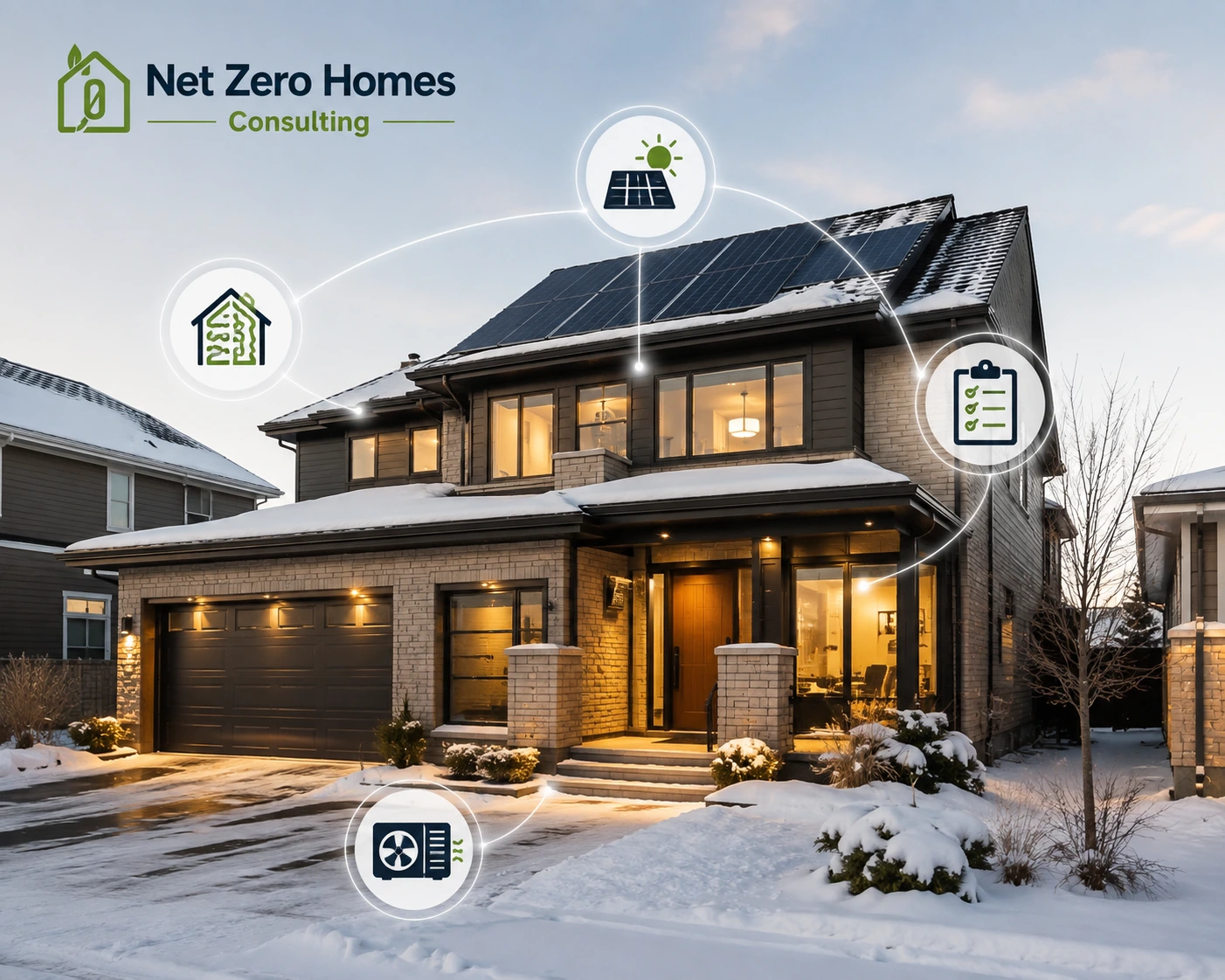
Ontario homeowners often face rising energy bills, drafty rooms and pressure to “go green” by jumping straight into solar panels, a heat pump or new windows. The financial risk is real. A poorly sequenced project can waste thousands of dollars, leave comfort problems unsolved and miss out on available incentives. Many start by calling contractors first. That approach usually produces product recommendations and quotes before anyone has mapped what the home actually needs.
Net Zero Homes takes a different route. The consulting-first path begins with assessment, priorities and a clear plan. Only then do contractors enter the picture. This article walks through that process so you can make informed decisions for your Ontario home.
Short answer: Before calling contractors, Ontario homeowners should understand what their home actually needs, which upgrades should come first, and what a reasonable project cost looks like. A whole-home energy plan starts with assessment of the building envelope, prioritizes air sealing and insulation, then moves to HVAC, solar, and electrification. This sequencing reduces waste and improves results.
What Is a Net Zero Home?
A net zero home produces as much energy as it consumes over a year. High-performance insulation, airtight construction, efficient heating and cooling and on-site renewable generation (usually rooftop solar) work together as a system.
In Ontario’s climate this matters. Heating dominates energy use in most existing homes. Net zero or net-zero-ready performance can cut that demand dramatically compared with standard code-built houses. Benefits include lower monthly bills, better comfort, higher resale appeal and protection against future energy price increases.
Net zero does not require perfection on day one. Many homeowners pursue staged upgrades that move the home toward net-zero readiness. The key is treating the house as one connected system rather than a collection of separate products.
What Is Net Zero Home Consulting?
Net zero home consulting is independent guidance that helps homeowners decide which upgrades make sense, in which order and at what budget. Consultants focus on the whole home: building envelope, mechanical systems, electrical capacity, comfort and long-term energy use.
This differs from a sales visit. A consultant is not tied to one manufacturer or one trade. The goal is a practical roadmap that matches the home’s actual condition and the homeowner’s priorities.
The process follows a clear sequence: Assess → Prioritize → Plan → Compare → Upgrade. That order prevents the common mistake of installing expensive equipment before the house is ready for it.
Why Homeowners Should Consult Net Zero Homes Before Calling Contractors
The contractor-first path looks like this: Homeowner → Contractor → Product recommendation → Quote. It works well when you already know exactly what you need. Most homeowners do not.
The consulting-first path works differently: Homeowner → Home assessment → Priorities → Budget → Upgrade plan → Contractor comparison → Quote → Decision.
Contractors are skilled at installing specific systems. An independent consultant’s role is to help you determine which systems you actually need and how they fit into the bigger picture. Net Zero Homes brings experience from more than 10,000 home energy consultations across Ontario. Advisors understand HVAC, heat pumps, furnaces, solar, insulation, air sealing, windows and doors, electrification and overall home comfort.
Advice is vendor-neutral. No single manufacturer’s equipment has to be recommended. Consultations are virtual, so there is no high-pressure in-home sales appointment. There are no “today only” prices or forced decisions. Homeowners gain access to highly rated contractors and competitive bids when the time is right. Negotiation support is available where appropriate. The focus stays on the right project, not the biggest project. The company is insured. Incentive programs change, so current eligibility should always be verified before decisions are finalized.
Project sequencing often matters more than any single upgrade. Insulation and air sealing before a heat pump or solar array usually produces better performance and lower overall cost.
How the ASSESS Step Works
Assessment starts with understanding how the home uses energy and where it loses it. Tools include utility bill review, satellite and roof analysis, heat-load calculations and discussion of comfort issues.
In Ontario many older homes have insufficient attic insulation, leaky air barriers, and ducts that were never balanced for modern equipment. An EnerGuide-style evaluation or equivalent review identifies these gaps. Electrical service capacity is checked early because heat pumps, EV chargers, and future electrification can require panel upgrades.
The output is a clear picture of current performance and realistic improvement potential. This step prevents oversized equipment and unnecessary spending.
PRIORITIZE: What Upgrades Should You Do First?
Most Ontario homes benefit from addressing the building envelope before mechanical systems or generation.
Typical priority order:
- Air sealing and weatherstripping
- Attic, wall, and basement insulation
- Window and door improvements where cost-effective
- Heating and cooling upgrades (heat pump or hybrid systems)
- Ventilation (HRV or ERV)
- Solar PV and battery storage
- EV charging and further electrification
Why this order? A leaky, poorly insulated house forces any heating system to work harder. Solar panels sized for high consumption will be larger (and more expensive) than necessary. Fixing the envelope first shrinks the heating load, improves comfort, and can allow smaller, less costly equipment later.
Windows are rarely the highest-return first step unless they are failing or the home is undergoing other exterior work. Solar is powerful once demand is reduced. Battery storage and EV charging fit later in the sequence for most homeowners.
PLAN: Building a Whole-Home Energy Strategy
A whole-home energy plan links every upgrade. It considers:
- Building envelope performance
- HVAC and heat pump sizing
- Electrical capacity
- Comfort and indoor air quality
- Future-proofing for electrification
- Realistic budget and timeline
- Available Ontario incentives
The plan is not a sales document. It is a roadmap that shows which measures deliver the best results for the money and when each should occur. Staged projects are common. Some homeowners complete insulation and air sealing one year, then a heat pump the next, and solar later.
Incentives such as those under Ontario’s Home Renovation Savings Program can support many of these steps. Program details, amounts, and eligibility change, so always confirm current rules before starting work.
COMPARE: Why Contractor Quotes Should Come After Planning
Once priorities and a plan exist, comparing contractor quotes becomes useful. You can evaluate apples-to-apples proposals because the scope is clear. Sizing assumptions, equipment choices, and installation quality can be assessed against the plan rather than against a salesperson’s pitch.
Without a plan, quotes often differ wildly in scope and assumptions. One contractor may recommend a large heat pump; another may push solar first. Neither may address the underlying air leakage that drives high energy use.
A consulting first approach gives you a baseline against which quotes can be judged. It also supports negotiation when pricing or scope needs adjustment.
UPGRADE: Moving From Plan to Action
With a plan and competitive quotes in hand, homeowners can proceed with confidence. Work is sequenced so each step supports the next. Milestones and oversight help keep projects on track.
Hypothetical Ontario example (not an actual Net Zero Homes client result): A 1970s two-storey home in the Greater Toronto Area has high heating bills, cold bedrooms, and a 100-amp panel. Assessment shows attic insulation at R-20, significant air leakage, and an aging gas furnace. The plan prioritizes attic insulation and air sealing first, followed by a cold-climate heat pump sized for the reduced load, then a panel upgrade and modest solar array. Estimated staged investment falls well below a full simultaneous deep retrofit while still moving the home substantially toward lower bills and greater comfort.
This kind of sequencing is typical. Actual results always depend on the specific house, climate zone and homeowner goals.
How Much Does a Net Zero Home Retrofit Cost?
Costs vary widely. A full deep retrofit aiming for net-zero performance on an existing single-family home in Canada often falls in the $100,000–$200,000 range before incentives. This can include envelope upgrades, windows, heat pump systems, ventilation and solar.
Staged approaches cost less up front. Individual measures have lower ranges:
- Attic insulation and air sealing: several thousand dollars
- Heat pump installation: commonly $10,000–$25,000+ depending on type and complexity
- Solar PV: often $20,000–$40,000 for a typical residential system
Ontario’s Home Renovation Savings Program has offered support for heat pumps, insulation, solar and storage, windows and other measures. Maximums and rules change; verify current amounts and requirements. Electrical upgrades, permits and unexpected findings (rot, asbestos, or ductwork issues) can add cost. A solid plan reduces the chance of expensive mid-project changes.
Comfort, Energy Consumption, and Future-Proofing
Better insulation and air sealing reduce drafts and temperature swings. Properly sized heat pumps deliver quieter, more even heating and cooling. Balanced ventilation improves indoor air quality.
Lower energy consumption protects against rate increases. Electrical capacity planning prepares the home for EV charging and further electrification. These steps also support long-term resale value as buyers increasingly look for efficient, comfortable homes.
Practical Tips for Ontario Homeowners
- Review at least 12 months of utility bills before any consultation.
- Ask about blower-door testing or equivalent air-leakage measurement.
- Confirm whether a pre-upgrade energy assessment is required for the incentives you hope to claim.
- Treat solar and heat pumps as later steps after envelope improvements unless the home is already high-performing.
- Keep records of all assessments, plans, and invoices for rebate applications and future reference.
Frequently Asked Questions
What is the difference between net zero and net-zero ready?
A net zero home produces as much energy as it uses annually. A net-zero-ready home is highly efficient and prepared for renewable generation but may not yet have the solar system installed.
Do I need solar panels to start a net zero journey?
No. Reducing demand through insulation, air sealing and efficient equipment comes first for most existing Ontario homes.
Should I install a heat pump before insulating?
Usually no. Improving the envelope first allows a smaller, more efficient heat pump and better comfort.
How long does a typical home energy consultation take?
Virtual consultations are focused and efficient. Preparation with utility data and photos speeds the process.
Are rebates available for home energy upgrades in Ontario?
Yes, programs such as the Home Renovation Savings Program have supported many measures. Always verify current eligibility, amounts and requirements because programs change.
What is a whole-home energy plan?
It is a prioritized roadmap that links envelope, mechanical, electrical, and generation upgrades so each step supports the next.
Can older Ontario homes reach net zero?
Many can move substantially toward net-zero performance through staged deep retrofits. Full achievement depends on the house, roof space and budget.
Why is air sealing important?
Air leakage wastes heating and cooling energy and creates drafts. Sealing improves comfort and reduces the load on any HVAC system.
Do I need an energy assessment before every upgrade?
Some incentive paths require a pre- and post-upgrade assessment. Single-measure paths may not. Check the specific program rules.
How does electrical capacity affect upgrades?
Heat pumps, EV chargers, and electric water heating can require panel or service upgrades. Assessing capacity early avoids delays.
Is virtual consulting as effective as an in-home visit?
For planning and prioritization, virtual consulting combined with data analysis and photos works well for many Ontario homeowners.
What happens after the consultation?
You receive a clear plan and can then request competitive quotes from qualified contractors matched to that plan.
Can I stage the work over several years?
Yes. Many homeowners complete envelope work first, then mechanical systems, then solar as budgets allow.
Does Net Zero Homes sell equipment?
No. Advice is vendor-neutral. The focus is planning and connecting homeowners with suitable contractors when ready.
How do I know if my home is a good candidate for a heat pump?
Assessment of insulation levels, air leakage, ductwork (if present) and climate zone determines suitability and sizing.