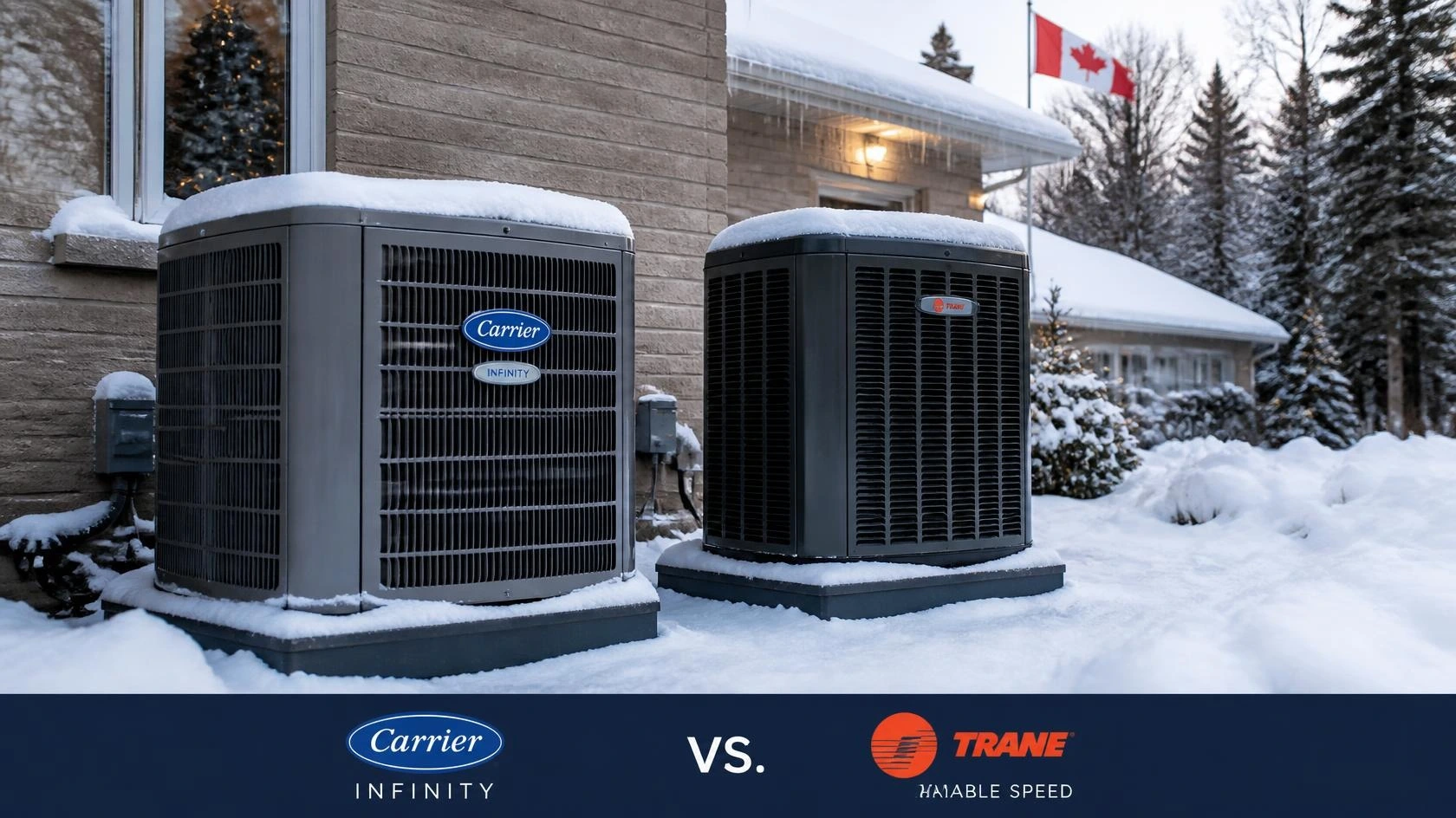
Ontario winters demand more from a heat pump than mild climate marketing claims. Design temperatures in much of the province sit around –20°C to –25°C, with occasional dips lower. Homeowners comparing Carrier and Trane want clear answers on real cold-climate capacity retention, efficiency (HSPF2, COP), operating costs, rebate eligibility, and long-term reliability not brochure hype.
This guide delivers a vendor neutral, evidence based comparison focused on Ontario conditions, Canadian climate zones, NRCan and ENERGY STAR Cold Climate requirements, current rebate programs, realistic installed costs and how either system fits a whole home Net Zero strategy.
Quick Answer :
Both Carrier and Trane offer strong cold climate heat pumps suitable for most Ontario homes. Carrier’s Infinity series with Greenspeed Intelligence (notably the Ultimate Cold Climate models) typically leads in lowest operating temperature (down to approximately 30°C / –23°F) and high HSPF2 (up to 10.5–12.5 in top configurations), maintaining high capacity at 0°F.
Trane’s premium variable-speed and newer low profile cold climate models (such as XV20i / Premier 20 and 19 Multi-Speed CCHP) deliver excellent durability via Spine Fin coils, solid HSPF2 (often 9–10.5) and reliable performance to –25°C range with strong real-world reliability. Proper Manual J sizing, installation quality, and insulation matter more than brand alone.
Both can qualify for Ontario rebates when listed on NRCan cold climate product lists.
Why Heat Pump Choice Matters in Ontario Winters ?
Older heat pumps lost significant capacity below –10°C or –15°C and relied heavily on expensive electric resistance backup. Modern cold-climate air source heat pumps (ccASHPs) from both Carrier and Trane use variable speed inverter compressors, enhanced vapour injection or similar technology, improved heat exchangers and smart defrost controls. They routinely deliver 70–100% of rated heating capacity at –15°C and continue operating usefully at lower temperatures.
Ontario’s climate zones (roughly 5–7 depending on location) and electricity/gas price dynamics make efficiency and capacity retention critical. A well-chosen, properly sized system can cut heating costs versus electric baseboards or older furnaces while providing cooling, reducing carbon emissions on Ontario’s relatively clean grid, and supporting home electrification goals.
NRCan guidance and ENERGY STAR Cold Climate criteria set clear benchmarks: COP ≥ 1.75 at 5°F (–15°C), ≥70% capacity retention at that temperature (versus 47°F rating), and minimum HSPF2/SEER2 thresholds. Always verify specific model AHRI numbers against current NRCan qualified product lists for rebate eligibility.
Carrier Heat Pumps: Overview, Key Models & Cold-Climate Strengths
Carrier (United Technologies / Carrier Global) has deep roots in refrigeration and air conditioning. Its residential Infinity series with Greenspeed Intelligence stands out for cold climates.
Key strengths relevant to Ontario:
- Variable speed compressors that modulate in fine increments (often 1% steps) for precise comfort and high part load efficiency.
- Strong low ambient performance on dedicated cold climate models (e.g., Infinity Variable Speed Ultimate Cold Climate / 27VNA1 family): operation down to –23°F (approx. –30°C), 100% heating capacity at 0°F in many configurations, HSPF2 up to 10.5–12.5, SEER2 up to 21+.
- Excellent dehumidification and quiet operation (often mid-50s dB).
- Transition to lower-GWP refrigerants (R-454B / Puron Advance in newer units).
- Dual-fuel (hybrid) capability with gas furnaces for seamless backup on the coldest days.
Carrier models frequently appear on ENERGY STAR Cold Climate and NEEP lists. Real world feedback in Canadian markets highlights consistent comfort and high efficiency when paired with matching Infinity controls and properly designed ductwork or ductless systems. Drawbacks can include higher upfront cost on premium Infinity units and the importance of dealer expertise for Greenspeed setup.
Trane Heat Pumps: Overview, Key Models & Cold-Climate Strengths
Trane (Trane Technologies) emphasizes durability and robust construction. Its Climatuff compressors and all aluminum Spine Fin coils are frequently cited for longevity in harsh conditions.
Key strengths relevant to Ontario:
- Premium variable speed models such as the XV20i / Premier 20 TruComfort: SEER2 up to ~20–22, HSPF2 often in the 9–10.5 range, strong modulation, and quiet operation.
- Newer low profile cold climate multi-speed units (16/17/19 Multi Speed CCHP): designed for side discharge or space-constrained installations, with HSPF2 around 9–10, capacity retention to –13°F (approx. –25°C) in many ratings, and 100% capacity at milder cold points.
- Excellent weather resistance (WeatherGuard top, DuraTuff basepan, rustproof features).
- ComfortLink II / Trane Link communicating systems for optimized performance and diagnostics.
- Strong reputation for reliability and fewer service calls in Canadian winters among many contractors.
Trane participates in cold-climate development efforts and offers models that meet ENERGY STAR Cold Climate thresholds when properly matched. Some independent comparisons note Trane’s coil design helps maintain performance during defrost cycles. Potential drawbacks include slightly less aggressive lowest-temperature ratings on certain flagship units versus Carrier’s top cold-climate models, and proprietary communicating controls that work best within the Trane ecosystem.
Head-to-Head Comparison Tables
Efficiency & Cold-Weather Performance (Typical Top Models – Verify Specific AHRI for Exact Numbers)
| Metric | Carrier Infinity Cold Climate / Greenspeed | Trane XV20i / Premier 20 or 19 CCHP | Notes for Ontario |
|---|---|---|---|
| SEER2 (up to) | 21–23 | 20–22 | Cooling efficiency |
| HSPF2 (up to) | 10.5–12.5 | 9–10.5 | Critical for heating bills |
| Min. operating temp | ~–23°F / –30°C | ~–13°F to –25°C range | Capacity drops at extremes |
| Capacity at 0°F / –18°C | Often 100% | Strong retention | Varies by model |
| COP at 5°F / –15°C | Meets/exceeds ENERGY STAR (≥1.75) | Meets ENERGY STAR | Higher = better |
| Compressor | Variable-speed Greenspeed | Variable-speed Climatuff | Both excellent modulation |
| Coil technology | High-efficiency | Spine Fin (all-aluminum) | Durability edge for Trane |
Cost, Warranty, Noise & Features (Installed Ranges Approximate for Ontario 2026 – Highly Variable)
| Factor | Carrier | Trane |
|---|---|---|
| Equipment + Install (3-ton premium) | $10,000–$16,000+ before rebates | $9,000–$15,000+ before rebates |
| Typical warranty | 10-year parts (registration often required) | 10–12 year parts/compressor (registered) |
| Noise (outdoor) | As low as ~53–55 dB | As low as ~54–55 dB |
| Smart / Communicating | Infinity System Control | ComfortLink II / Trane Link |
| Dual-fuel ready | Excellent | Excellent |
| Maintenance | Standard filter + annual professional | Similar |
Actual installed prices depend on home size, ductwork condition, electrical upgrades, location (GTA vs rural), and contractor. Always obtain multiple quotes with Manual J load calculations.
Cold-Climate Performance Deep Dive
Capacity retention and COP at design temperatures matter most.
At –15°C, quality ccASHPs from both brands typically hold 70–100% of rated capacity. Below that, output declines and COP falls (still often >1.5–2.0 until very low temperatures). Defrost cycles are managed more intelligently on modern units, reducing energy waste and temperature swings.
Carrier’s top cold climate models are frequently highlighted for maintaining full capacity deeper into the cold. Trane models emphasize consistent output and coil performance that resists frost buildup effectively. In both cases, backup heat (electric resistance or dual-fuel gas furnace) is recommended for the coldest nights or when capacity is intentionally undersized for efficiency.
Ontario examples:
In the Greater Toronto Area or southwestern Ontario, design temperatures are milder than northern or Ottawa-region extremes. Properly selected models from either brand handle typical winters with minimal backup runtime when the home is well insulated and sealed.
Efficiency Ratings Explained
- SEER2: Seasonal cooling efficiency (higher = better). Minimums have risen; ENERGY STAR requires 15.2+.
- HSPF2: Seasonal heating efficiency (Region IV or V). For Ontario, aim for 8.5–10+ on cold-climate units. Higher HSPF2 directly lowers winter electricity costs.
- COP: Instantaneous efficiency (heat output / electricity input). Look for ≥1.75–2.0+ at –15°C for strong cold performance.
- Manual J: Professional load calculation is non-negotiable. Oversizing causes short-cycling and poor humidity control; undersizing leaves you cold.
Both brands offer models that meet or exceed ENERGY STAR Cold Climate criteria when correctly matched with indoor units.
Cost, Installation, Operating Costs & ROI in Ontario
Typical Costs (2026 ranges, before rebates): Premium cold-climate ducted systems often land $8,000–$16,000+ installed for average homes. Ductless multi-zone can be competitive for additions or homes without ducts. Electrical panel upgrades or duct modifications add cost.
Operating Costs: With Ontario electricity rates (roughly $0.10–0.15+/kWh depending on time-of-use and location) and HSPF2 9–11, annual heating costs for a typical home can be competitive with or lower than high-efficiency gas, especially versus electric resistance. Cooling is essentially free compared with a separate AC. Savings of $500–$1,500+ per year versus older systems are common, varying by home efficiency and usage.
Maintenance: Annual professional service ($150–300), filter changes, outdoor coil cleaning. Lifespan 15–20+ years with good care.
ROI & Payback: After rebates, payback is often 5 to 12 years depending on displaced fuel, electricity rates, and home improvements. Over 15 to 20 years the combination of lower operating costs, dual heating/cooling, and potential carbon pricing or future incentives improves returns. Dual fuel hybrids can optimize further by using gas only on the coldest days.
Always model your specific home with actual utility rates and a proper energy audit.
Warranties, Noise, Reliability & Smart Features
Both brands offer strong 10-year limited parts warranties (often extended on compressor with registration). Labour coverage depends on the installer. Carrier and Trane both have extensive dealer networks in Ontario.
Noise levels on premium variable speed units are low enough for urban or suburban placement. Smart thermostats and communicating systems improve efficiency and allow remote monitoring. Both integrate with popular smart-home ecosystems to varying degrees; check specific model compatibility.
Reliability depends heavily on installation quality, refrigerant charge, airflow, and maintenance more than brand mythology. Choose experienced, certified installers familiar with cold-climate heat pumps and Manual J/S/D procedures.
Rebate Eligibility & Provincial Programs
Ontario’s primary program is the Home Renovation Savings Program (Save on Energy / Enbridge partnership). Cold-climate air-source heat pumps listed on NRCan’s qualified product list can receive:
- Up to $1,250 per ton (max $7,500) for homes heated by electricity, oil, propane, or wood.
- $500 per ton (max $2,000) for Enbridge natural gas customers.
Ground-source systems have higher incentives. No full energy audit is required for a standalone heat pump in many cases, but rules change confirm current details on the official program site. Federal supports (e.g., residual Oil to Heat Pump Affordability elements or Greener Homes Loan interest-free financing up to $40,000) may stack for eligible households. Municipal or utility add-ons sometimes exist.
Critical: The specific outdoor + indoor combination must appear on the current NRCan cold-climate list with matching AHRI reference. ENERGY STAR Cold Climate designation helps but is not always identical to program lists. Have your contractor confirm eligibility in writing before purchase.
Common Homeowner Mistakes
- Choosing solely on lowest price or brand loyalty without cold-climate ratings.
- Skipping professional Manual J load calculation and relying on rule-of-thumb sizing.
- Ignoring home envelope (insulation, air sealing, windows) a heat pump cannot overcome a leaky, poorly insulated house efficiently.
- Hiring installers without cold-climate heat pump experience or proper certification.
- Overlooking electrical capacity or duct design issues.
- Missing rebate windows or failing to use NRCan-listed equipment.
- Neglecting annual maintenance or proper defrost/ drainage setup.
- Expecting 100% capacity at –30°C without backup planning.
Net Zero Homes Integration
A high performance Carrier or Trane cold-climate heat pump is a cornerstone of electrification and Net Zero Ready / Net Zero homes in Canada. Pair it with:
- Deep energy retrofits (attic, wall, basement insulation; air sealing to ≤1.5–3 ACH50 where practical).
- Triple-pane windows and high-performance doors.
- Solar PV + net metering (Ontario rules apply) and optional battery storage for resilience and time-of-use optimization.
- Smart thermostats and home energy management.
- EV charger readiness.
- Heat-pump water heaters and induction cooking for full electrification.
An energy audit (EnerGuide) provides the baseline and prioritized measures. The heat pump reduces operational carbon dramatically on Ontario’s grid while the envelope work maximizes its efficiency and comfort. Net Zero Homes advisors help sequence upgrades, model savings, and navigate incentives without pushing specific equipment brands.
FAQ
1. Which is better for Ontario winters Carrier or Trane? Both perform well. Carrier often edges lowest-temperature capacity and peak HSPF2 on flagship cold-climate models. Trane emphasizes durability and consistent real world reliability. Match the specific model to your design temperature and get competing quotes with load calculations.
2. Do these heat pumps work at -25°C or colder? Top models operate and deliver useful heat at those temperatures, though capacity and COP decline. Backup heat is prudent for extreme cold snaps or undersized systems.
3. What HSPF2 should I look for? Aim for 8.5+ (preferably 9 to 11+) on cold-climate models for good Ontario performance. Higher is better for operating cost.
4. Can a heat pump fully replace my gas furnace? In many southern and central Ontario homes with good envelopes, yes for most of the season. Dual-fuel hybrids or electric backup handle the extremes and provide redundancy.
5. How much do Carrier and Trane heat pumps cost installed in Ontario? Premium systems commonly $9,000–$16,000+ before rebates. Exact figures require a site assessment.
6. What rebates are available in 2026? Home Renovation Savings Program: up to $7,500 (non-gas) or $2,000 (gas) for qualifying cold climate ASHPs. Confirm current rates and NRCan list eligibility. Additional federal or local supports may apply.
7. Are they noisy? Premium variable-speed models from both brands are quiet (low-to-mid 50s dB outdoors at typical speeds).
8. How long do they last? 15–20+ years with proper installation and maintenance.
9. Do I need special ductwork? Existing ducts may work if sized and sealed properly; many homes need modifications for optimal airflow and efficiency.
10. Should I get a dual-fuel system? Often smart in Ontario heat pump for the majority of the season, gas for extreme cold maximizing efficiency and comfort.
11. How important is the installer? Extremely. Experience with cold-climate heat pumps, Manual J, refrigerant handling, and electrical work determines real-world results more than the brand name.
12. Can I integrate with solar and batteries? Yes. Heat pumps pair excellently with solar PV and storage for further bill reduction and resilience.
13. What about maintenance? Annual professional service, regular filter changes, and keeping the outdoor unit clear of snow/debris.
14. Are newer low-GWP refrigerants used? Both brands are transitioning to R-454B and similar lower GWP options in current generations.
15. Where can I get unbiased advice? Vendor neutral home energy advisors, certified energy auditors, and resources from NRCan, ENERGY STAR Canada, and independent consultants help compare options without sales pressure.
Conclusion
For Ontario homeowners, both Carrier and Trane produce capable cold climate heat pumps that perform reliably in winter when properly selected and installed. Carrier frequently leads on the most aggressive low-temperature capacity and peak efficiency numbers. Trane stands out for robust construction and proven durability. The “better” choice depends on your specific home load, design temperature, budget, existing infrastructure, and the quality of the installation team.
Prioritize Manual J sizing, NRCan-listed cold-climate models for rebates, envelope improvements, and a trusted installer. This combination delivers comfort, lower bills, reduced emissions, and progress toward Net Zero goals.
Ready to compare options for your home? Net Zero Homes provides vendor neutral guidance on heat pumps, rebates, energy audits, and whole-home electrification planning. Book a virtual consultation to review your situation, potential savings, and next steps tailored to Ontario conditions.