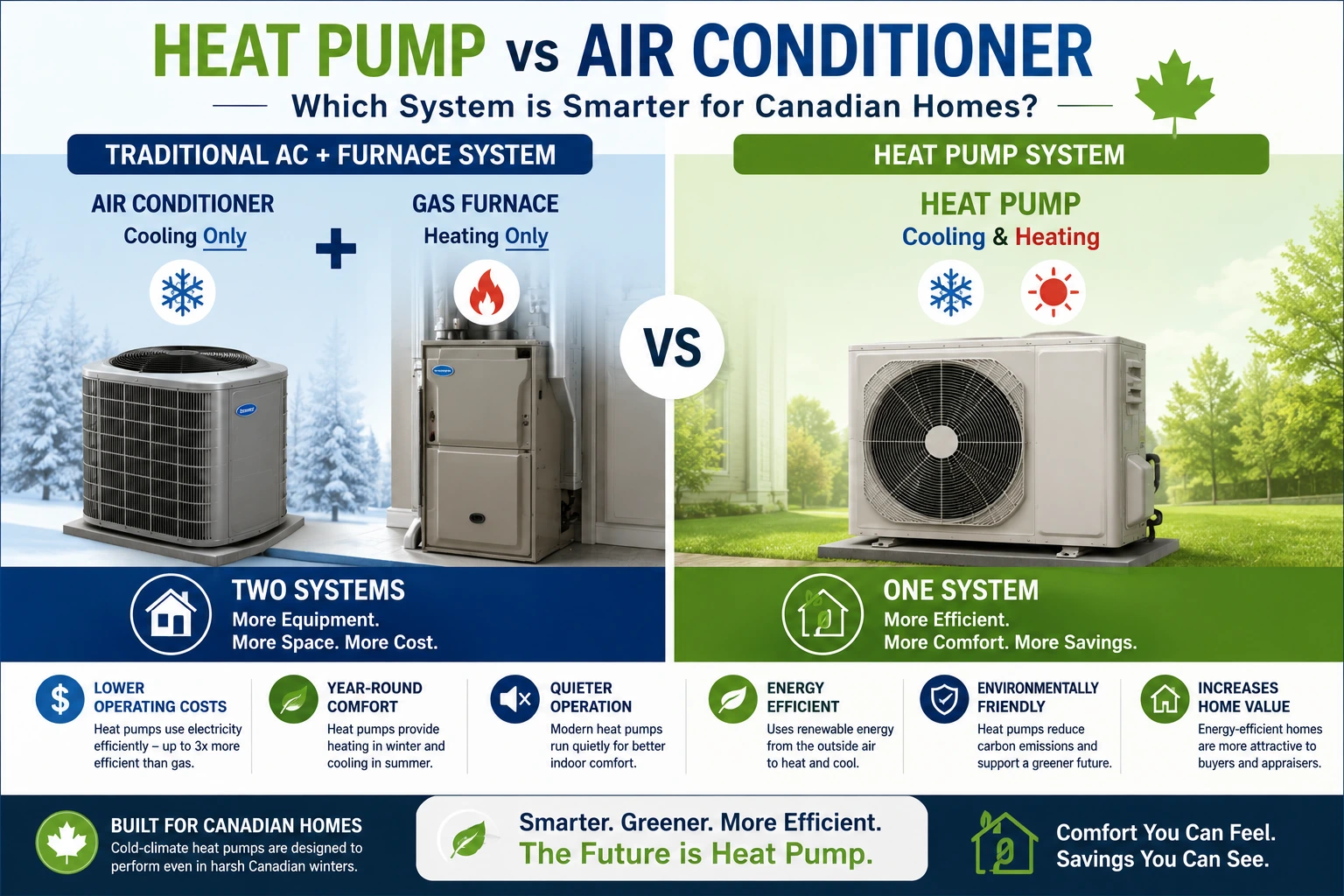
Short answer: A heat pump is the smarter choice than a traditional air conditioner for Canadian homes because it provides both heating and cooling in one system. While a standard AC only cools, a cold-climate heat pump can efficiently heat your home even at -30°C, saving you hundreds on energy bills each year. With federal and provincial rebates now available, the upfront cost often matches a new AC installation but modern heat pumps offer efficiency ratings that older models could only dream of, making them a key step toward any net zero home.
You might be facing a dilemma that’s becoming all too common in Canadian homes that your air conditioner just gave out and you’re staring at a repair bill that makes you wince Or maybe your HVAC system is pushing 15 years and you know it’s time to start planning for a replacement.
Here’s a thought that might surprise you: what if you could replace that old air conditioner with a system that cools your home just as well in July, heats it efficiently in January and could save you money year-round? That’s the promise of a heat pump.
For decades, Canadian homeowners have accepted the standard setup: a furnace for winter and an air conditioner for summer. But HVAC technology has changed dramatically and the debate of heat pump vs air conditioner is no longer a close call. In 2026, with energy costs rising and Canada pushing toward a net-zero future a heat pump is the smarter choice for most homes.
The core difference between a heat pump and an air conditioner lies in one crucial feature: a heat pump can reverse its operation. It pulls heat from inside your home to cool you in summer just like an AC but when winter comes, it reverses the flow, extracting heat from the outside air and bringing it inside.
Because of this, heat pumps can handle both jobs with one system. This guide will walk you through 15 reasons why a cold-climate heat pump beats an air conditioner for Canadian homeowners covering everything from efficiency and cost to performance and peace of mind.
1. What Is a Heat Pump? (And Why It’s Not Just an AC)
Let’s start with a simple explanation. An air conditioner is a one trick pony: it’s designed to move heat from inside your home to the outside. The compressor, condenser, and evaporator coil work together to pull warm indoor air over a cold coil, removing the heat and sending cool air back through your vents. The heat it removes gets dumped outdoors.
A heat pump does this too, and it does it just as effectively as a standard air conditioner but it adds a second trick: a reversing valve. When the weather turns cold, that valve flips the system into heating mode. Now, the heat pump does the opposite: it extracts heat from the outdoor air, yes, even at -20°C, there’s still heat energy in the air and transfers it inside your home.
The principle is the same as a refrigerator, but on a house-sized scale. The system uses refrigerant to absorb and release heat as it changes from liquid to gas and back again. This is why many experts call heat pumps “two-way air conditioners.”
Air Conditioner vs. Heat Pump: The Basic Difference
| Feature | Air Conditioner | Heat Pump |
|---|---|---|
| Summer Cooling | Yes | Yes |
| Winter Heating | No | Yes |
| Technology | One-way heat transfer | Reversible heat transfer |
| Energy Source | Electricity (for cooling only) | Electricity (for both heating and cooling) |
2. Why This Matters for Canadian Homeowners in 2026
If you live in Canada, you know our climate demands a lot from our homes. We get scorching summers, bone chilling winters, and everything in between. This constant strain on our HVAC systems is why you’re likely reading this article your current setup might be struggling, aging, or costing a fortune to run.
There are three big reasons this decision matters more now than ever:
Climate Challenges
Canada’s weather extremes have always been tough on HVAC equipment. Traditional air conditioners only address half the problem. A heat pump addresses the full year. More importantly, today’s cold climate heat pump technology has come so far that it can handle Canadian winters without struggling. Systems from manufacturers like Moovair can now deliver 100% heating capacity at -15°C and continue operating down to -30°C . That’s game changing for a country where winter used to disqualify heat pumps.
Energy Costs and Volatility
Heating and cooling account for about 21% of Canada’s total energy use . Whether you’re burning natural gas or using electricity, these costs are only going up. Homeowners who installed heat pumps report significant savings. One Ontario homeowner who switched from oil heating to a heat pump went from paying roughly $1,000 a month for oil in winter to paying only $50-100 more on their hydro bill . Another real world example: a fully electrified home in Komoka, Ontario, using a heat pump and solar panels, reduced electricity bills by 45% and carbon emissions by 55%.
Government Electrification Trends
Governments at every level are pushing electrification. Programs like the Oil to Heat Pump Affordability (OHPA) program offer up to $25,000 for eligible homeowners switching from oil to heat pumps . The federal government has also revived the Canada Greener Homes Affordability Program, providing no-cost retrofits for low and median income households in several provinces . Over 60% of heat pump owners surveyed used a rebate, and half said they wouldn’t have made the switch without financial support .
When you realize your home is part of a bigger movement toward energy independence and carbon reduction, choosing a heat pump over a simple air conditioner feels like a step toward a smarter future.
3. The Technical Explanation: How Cold-Climate Heat Pumps Work
This is where many homeowners get confused and where you can become the most informed person in the room.
How Does a Heat Pump Provide Heat in Winter?
Even at -20°C, the air outside contains thermal energy. The heat pump’s outdoor coil acts as an evaporator, absorbing heat from that cold air and vaporizing the refrigerant inside. The compressor then squeezes that vapor, raising its temperature dramatically. The hot gas flows to the indoor coil (the condenser), which releases heat into your home’s air or water system.
Refrigerants: The Game-Changer
The type of refrigerant is crucial for cold-weather performance. Many modern heat pumps now use R32 refrigerant instead of older refrigerants like R410A. R32 has a lower Global Warming Potential (GWP), making it more environmentally friendly. More importantly for Canadian homeowners, studies show that R32-based heat pumps with vapor injection technology can increase heating capacity by 7.5% to 25% and COP by up to 17% at -20°C . This means more heat, less electricity.
Efficiency Ratings: SEER2, HSPF2, and COP
To compare a heat pump vs air conditioner, you need to understand these three ratings:
SEER2 (Seasonal Energy Efficiency Ratio): This measures cooling efficiency. Higher numbers mean better cooling. Minimum Canadian standards require SEER2 ratings of 14.3 for split-system heat pumps . Some high-end models now achieve up to 27.4 SEER2 .
HSPF2 (Heating Seasonal Performance Factor): This measures heating efficiency over a whole season. A minimum of 6.0 HSPF2 (Region V) is required . Higher is better, and top units now reach 9.8 HSPF2 .
COP (Coefficient of Performance): This is the most useful number for cold weather. A COP of 3 means for every 1 unit of electricity you put in, you get 3 units of heat out. A gas furnace, by contrast, has a COP around 0.95. That’s why heat pumps are 300% efficient or more .
The beauty of inverter technology is that the compressor doesn’t just turn on and off it modulates its speed. This maintains a stable temperature, reduces energy waste, and prevents the on/off cycling that wears out traditional AC compressors.
4. Cost Breakdown: Heat Pump vs Air Conditioner
One of the biggest concerns for Canadian homeowners is the upfront cost. Here’s the reality: on a pure price-per-unit basis, a heat pump usually costs more than a comparable air conditioner. But when you account for installation, rebates, and long-term savings, the gap shrinks dramatically and sometimes reverses.
Equipment and Installation Costs
A homeowner in Winnipeg recently faced this dilemma directly: a 6-year-old Lennox air conditioner compressor died, and they were quoted $5,500 CAD to replace the compressor. When they looked at replacing the whole system, they found that after rebates, a new heat pump cost almost the same as a new air conditioner. Their takeaway: why replace a failed AC with another AC when you can get a system that both cools and heats for nearly the same price?
Typical costs for a Canadian 2,000 sq ft home:
Standard Air Conditioner + Installation: $4,000 – $8,000
Cold Climate Heat Pump + Installation: $8,000 – $16,000
Electrical Panel Upgrades (if needed): $1,500 – $3,500
Rebates and Incentives
Here’s where the math changes. Depending on your province and income level, you could access:
Oil to Heat Pump Affordability Program (OHPA): Up to $25,000 for income eligible households switching from oil heating .
Yukon Rebate: 50% of project costs up to $10,500 for heat pump installation, including electrical upgrades .
Canada Greener Homes Affordability Program: No-cost heat pump retrofits for low and median-income households in four provinces .
Various provincial and utility rebates that can reduce your net cost by thousands.
Operating Costs
This is where heat pumps win. Consider the oil-to-heat pump example from Natural Resources Canada: a homeowner previously paid $1,000/month for oil during winter. After switching to a heat pump, their hydro bill went up by $50-100 per month, but they eliminated the $1,000 oil bill. That’s a massive net saving .
For a natural gas home, the savings are smaller but still significant. A heat pump handles most of the “shoulder season” (spring and fall) and even a chunk of winter before the furnace needs to kick in . This reduces your natural gas consumption substantially.
Payback Period
Based on a study of air-source heat pumps across Canada, typical payback periods range from 5 to 12 years, depending on the province, climate, and energy prices . Given that a heat pump’s average lifespan is 15-20 years, you’re looking at many years of pure savings after the payback.
5. Real-Life Example: An Ontario Homeowner’s Journey
To make this real, let’s walk through a typical Ontario scenario.
The Home: A 2,000 sq ft detached house in the Toronto suburbs. Built in 1995. Currently has a 15-year-old gas furnace and a 12-year-old central air conditioner. The AC struggles to keep the house cool during hot summers, and the furnace is starting to make worrying noises.
The Decision: Replace both with a new gas furnace + central AC, or install a cold-climate heat pump while keeping the furnace as backup (hybrid setup).
The Cost Comparison:
| Component | Furnace + AC Option | Heat Pump + Existing Furnace |
|---|---|---|
| Equipment & Installation | $7,500 | $12,000 |
| Available Rebates | $0 | -$5,000 |
| Net Upfront Cost | $7,500 | $7,000 |
| Annual Energy Cost | $1,800 (gas + electricity) | $1,400 (electricity) |
| Annual Savings vs Baseline | N/A | $400 |
The Result: The homeowner ends up with a newer, more efficient system that cost slightly less upfront after rebates. They save about $400/year on energy bills. They also gain a year-round comfort improvement: the heat pump’s inverter technology maintains a steady temperature without the blasts of hot or cold air typical of traditional systems. Their carbon footprint drops significantly, and if they ever want to add solar panels, their home is already electrified.
6. Pros and Cons: A Balanced Comparison
| Pros | Air Conditioner | Heat Pump |
|---|---|---|
| Cooling Performance | Excellent in all weather | Excellent in all weather |
| Heating Performance | None | Excellent down to -30°C with modern cold-climate models |
| Upfront Cost | Lower (but rebates often equalize) | Higher |
| Operating Cost | Higher (you still need a furnace) | Lower year-round |
| Environmental Impact | High (uses fossil fuels for heat) | Much lower (electric, renewable-ready) |
| Lifespan | 12-15 years | 15-20 years |
| Single System | No (requires separate furnace) | Yes (handles both heating and cooling) |
| Maintenance | One system (cooling only) | Two seasons (heating and cooling) |
| Backup Needed in Extreme Cold | N/A | Yes, below -30°C (but can use existing furnace) |
| Quiet Operation | Noisy cycling | Quiet with inverter technology |
| Floor Space | Two units (furnace + AC) | One unit |
7. 15 Reasons a Heat Pump Is the Smarter Choice
Here are the 15 compelling reasons, summarized:
Two-for-One Value: Replaces both furnace and AC with one system.
Year-Round Comfort: Heating and cooling in every season.
Superior Efficiency: 300% efficient vs 95% for gas furnaces.
Lower Energy Bills: Savings of $400–$1,400/year.
Rebates and Incentives: Up to $25,000 available in some programs .
Cold-Climate Capability: Works reliably down to -30°C.
Carbon Reduction: Cut home emissions by up to 55% .
Inverter Technology: Consistent temperature, no hot/cold swings.
Quieter Operation: Whisper-quiet outdoor units.
Longer Lifespan: 15-20 years vs 12-15 for AC.
Simpler Maintenance: One system to care for.
Safety: No combustion, no CO poisoning risk.
Future-Proof: Ready for solar panels and net-zero upgrades.
R32 Refrigerant: Lower environmental impact .
High Satisfaction: 91% of Canadian owners would recommend them to a neighbor
8. Common Homeowner Questions (FAQ)
Are heat pumps worth it in Canada?
Yes. Modern cold-climate heat pumps are designed for Canada’s climate. With high satisfaction ratings (91% of owners would recommend), proven savings, and available rebates, they are a smart investment for most homeowners .
Can a heat pump work below -20°C?
Yes. Many models operate down to -30°C. For extremely cold snaps below that, a backup furnace (hybrid system) kicks in automatically .
Is R32 refrigerant safe?
Yes. R32 is classified as having lower flammability but is widely used worldwide and recognized as a safe, energy-efficient refrigerant with lower global warming potential than older alternatives .
Do heat pumps replace furnaces?
Yes and no. In milder Canadian climates, a heat pump can fully replace a furnace. In most of Canada, they operate in a hybrid system: the heat pump handles heating down to about -15°C, and the furnace provides backup during extreme cold .
How long does a heat pump last?
15-20 years with proper maintenance, compared to about 12-15 years for a typical air conditioner.
What is the difference between a heat pump and an air conditioner?
An air conditioner only provides cooling. A heat pump provides both cooling and heating, making it a year-round, all-in-one solution .
Does a heat pump cost more to run than a gas furnace?
No. Heat pumps are 2-4 times more efficient than gas furnaces, meaning lower operating costs for the heating they provide.
What is SEER2 and why does it matter?
SEER2 measures cooling efficiency. New regulations require minimum SEER2 of 14.3 for split-system heat pumps in Canada . Higher SEER2 equals better cooling performance and lower electricity use.
Is a heat pump better for the environment?
Yes. Heat pumps run on electricity (which can come from renewable sources), while furnaces burn fossil fuels. This reduces your home’s greenhouse gas emissions by 50-55% or more.
Do I need a backup furnace with a heat pump?
In most of Canada, yes. The heat pump works down to -30°C, but for peace of mind and to handle the absolute coldest nights, a backup (gas furnace or electric coils) is recommended .
How do Ontario heat pump rebates work?
Programs like the Oil to Heat Pump Affordability program provide up to $25,000 for eligible low-income homeowners. The Canada Greener Homes Affordability Program also provides support in Ontario.
9. Is a Heat Pump Right for Your Home?
The answer to heat pump vs air conditioner boils down to your goals. If you only care about the cheapest possible upfront cost today, an air conditioner might appear to win. But once you factor in rebates, energy savings, and the value of year-round heating and cooling, a heat pump is the smarter choice by a wide margin.
Consider a heat pump if:
Your existing AC or furnace is over 10 years old.
You want to reduce your monthly energy bills.
You’re interested in home electrification or net-zero renovations.
You want a system that can pair with future solar panels.
You want to lower your home’s carbon footprint.
Net Zero Homes Consulting can help you navigate this decision. We provide custom energy assessments that evaluate your home’s insulation, air sealing, HVAC system, and electricity capacity. We’ll recommend the right heat pump for your climate zone, budget, and home size.
Ready to learn more? Contact us today for a consultation. We’ll walk you through the math, the rebates, and the installation process so you can make a confident decision.