
Imagine an Ontario family replacing their aging gasoline SUV. They drive 18,000–22,000 km a year, heat with natural gas, and have started looking at a cold-climate heat pump. The EV ads look compelling lower “fuel” costs, quieter drives, and no more oil changes but questions pile up fast. Will their 100 amp or 150-amp service handle a Level 2 charger plus the heat pump? Should they add solar panels now or later? Does a home battery make sense, or can the car itself back up the house? What about time-of-use rates, load management, and future second EV plans?
This is the real starting point for most North American homeowners in 2026. Buying an electric vehicle is no longer just a car decision. It is a home energy decision that touches the electrical panel, solar potential, battery storage, heat pumps, and long-term household resilience. When planned together, the combination delivers lower operating costs, better backup power, higher solar self-consumption, and a clearer path to a true Net Zero Home.
This guide walks Canadian and U.S. homeowners through every practical piece of that puzzle charging options, panel capacity, solar sizing, battery comparisons (including why integrated platforms such as Sigenergy appeal to EV-focused households), Vehicle-to-Home realities, 10-year ROI scenarios, and a clear upgrade roadmap. It is written for first-time EV buyers, families, rural properties, cottage owners, dual-EV households, and anyone electrifying the rest of the home at the same time.
Quick Answer:
The smartest EV purchase matches both your driving needs and your home’s energy infrastructure. Most homeowners benefit from a Level 2 charger, a load calculation to confirm panel capacity (or smart load management), and a plan that considers solar and battery storage. Adding solar can cover a large share of annual EV charging energy. A home battery or bidirectional EV (V2H) improves resilience and time-of-use savings. Treat the vehicle, charger, panel, solar, and storage as one connected system rather than separate purchases.
Why EV Ownership Is Really a Home Energy Decision
An electric vehicle shifts energy use from the gas pump to the electrical panel. A typical North American EV driven 15,000–20,000 km per year adds roughly 3,000–4,500 kWh of annual electricity demand. That is significant often 25–40 % of a conventional household’s existing usage but it is also highly controllable.
Unlike a gasoline tank, electricity can be timed. Time-of-use rates, solar production curves, and battery discharge schedules let homeowners charge when power is cheapest or cleanest. The same infrastructure that supports the EV (panel capacity, solar array, storage) also supports heat pumps, induction cooking, and other electrification steps. Buying the car first and discovering panel or service limitations later creates costly rework. Assessing the home first turns the EV into an accelerator for the rest of the Net Zero pathway.
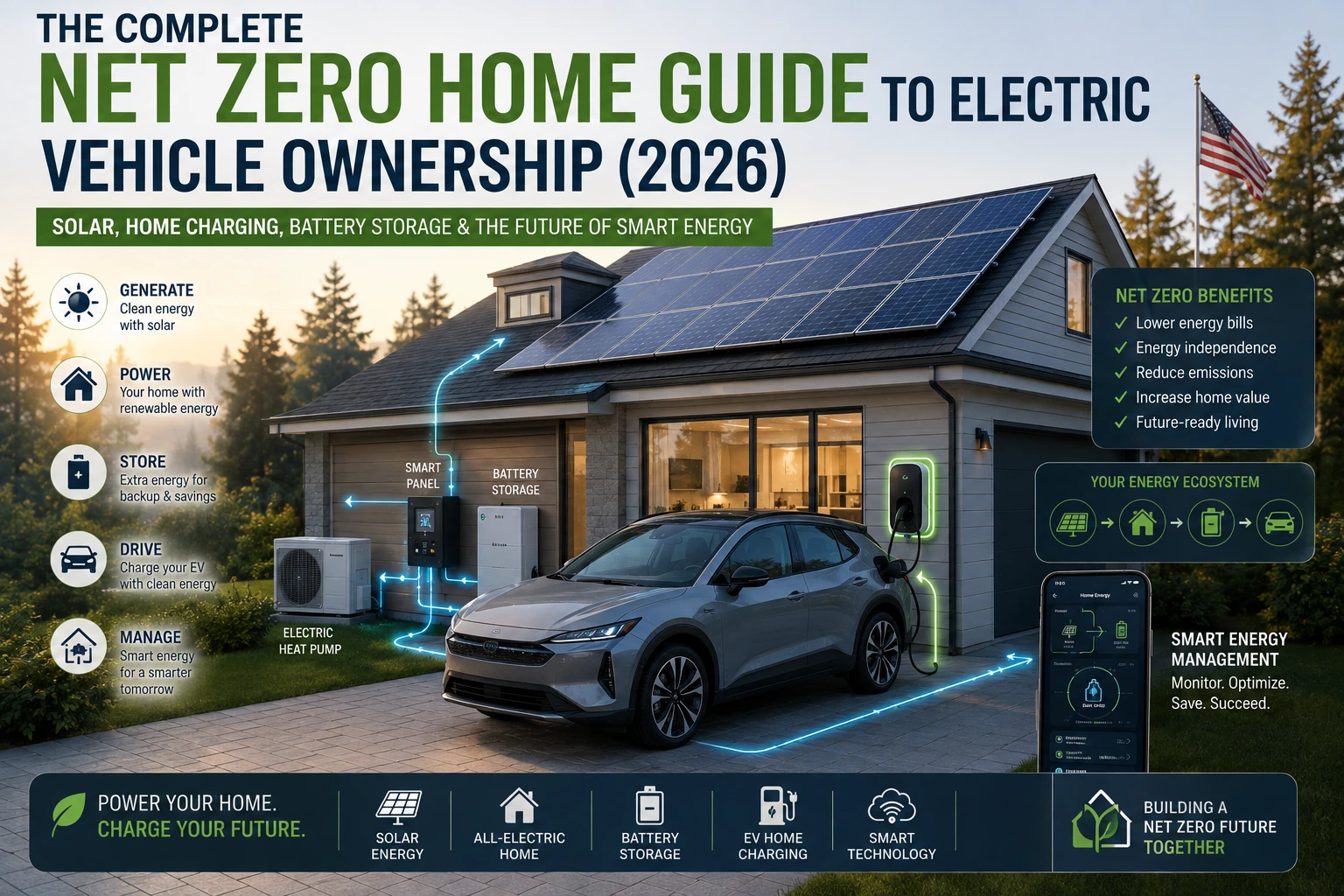
The Net Zero Home EV Ecosystem
Picture the home as an energy hub rather than a simple consumer of utility power:
- Rooftop (or ground-mount) solar generates daytime electricity.
- A hybrid inverter and home battery store excess solar and shift it to evening or outage periods.
- A Level 2 (or bidirectional DC) charger supplies the EV, ideally drawing from solar or off-peak grid power.
- The electric vehicle itself can, in supported configurations, return power to the house (V2H) or grid (V2G).
- A cold-climate heat pump and smart thermostat reduce fossil heating load and respond to price or carbon signals.
- The electrical panel (or smart panel / energy management system) coordinates loads so the service is never overloaded.
- Software ties everything together forecasting solar, optimizing charge/discharge, and prioritizing critical circuits during outages.
When these pieces communicate, the household gains lower bills, higher resilience, and measurable carbon reductions. The EV stops being an extra load and becomes a mobile battery asset within the larger system.
Home Charging: Level 1 vs Level 2 vs DC Fast Charging
Level 1 (120 V) uses a standard household outlet. It typically delivers 1.4–1.9 kW and adds 5–8 km of range per hour. Suitable only for very low daily mileage or as a temporary solution. Overnight recovery is slow for most drivers.
Level 2 (240 V) is the practical home standard. Common power levels are 7.2 kW, 9.6 kW, 11.5 kW, and up to 19.2 kW. A 48-amp (11.5 kW) charger can add 50–70+ km of range per hour on most modern EVs. Installation costs in 2026 typically range from roughly $800–$3,000 for straightforward jobs (equipment + labour + permit) and rise when long wire runs, subpanels, or service upgrades are required.
Public DC Fast Charging (50–350 kW) is for road trips. It is more expensive per kWh and less convenient for daily use. Relying on it as primary charging usually raises costs and reduces convenience.
Recommendations
- Most single-EV households: hardwired or plug-in Level 2 (40–48 amp circuit).
- Dual-EV homes: two Level 2 units with load sharing or a higher-capacity circuit managed by software.
- Rural or cottage properties: confirm voltage drop and consider a slightly higher amperage unit if the service allows.
- Always have a qualified electrician perform a load calculation before installation.
Popular vehicles (Tesla Model 3/Y, Cybertruck, Ford F-150 Lightning and Mustang Mach-E, Hyundai IONIQ 5, Kia EV6/EV9, Chevrolet Equinox EV and Silverado EV, Nissan Ariya, Volkswagen ID.4, Rivian R1T/R1S, BYD models available in Canada, etc.) all charge effectively on Level 2 once the home circuit is in place.
Do You Need a Panel Upgrade Before Buying an EV?
Many older North American homes still have 100 A or 125 A service. Adding a 40–60 A continuous EV charger plus a heat pump can push the calculated load beyond the service rating under Canadian Electrical Code or National Electrical Code rules.
A proper load calculation (not just “open breaker spaces”) is essential. Factors include square footage, heating type, electric ranges, dryers, hot tubs, and the new EV and heat-pump loads. Smart load-management devices or energy-management systems can often keep the existing service by temporarily reducing non-critical loads when the EV or heat pump draws high power. These solutions are frequently cheaper and faster than a full 200 A or 400 A service upgrade.
Future-proofing considerations:
- Planning a second EV, whole-home battery, or larger solar array often justifies moving to 200 A now.
- Large fully electrified homes (heat pump, induction, multiple EVs, battery) may eventually need 400 A service.
- Rural properties with long secondary runs or cottages on seasonal services require extra attention to voltage drop and utility transformer capacity.
Never assume capacity. Have the calculation done before or at the same time as the charger quote.
Why Solar Panels Make EV Ownership Dramatically Better
An EV that travels 18,000 km per year at 0.18–0.22 kWh/km needs roughly 3,200–4,000 kWh annually. A well-sited residential solar array in southern Ontario, the Prairies, or much of the U.S. can produce that much energy (or more) on a modest additional capacity.
Key advantages:
- Daytime solar can directly charge the EV or fill a home battery that later supplies the charger.
- Net metering (where still available and structured favourably) credits excess production.
- Time-of-use optimization becomes more powerful: solar covers daytime loads, battery or off-peak grid covers evening charging.
- Carbon intensity drops because solar displaces grid electricity that may still include fossil generation.
Sizing guidance is location- and rate-structure specific. A solar feasibility study that includes the EV load, heat-pump load, and battery self-consumption goals produces the most accurate result. Seasonal production (lower winter output in Canada) means the system should be sized with winter performance and any net-metering or virtual net-metering rules in mind.
Why Every EV Homeowner Should Consider Battery Storage
A home battery does several high-value jobs for an EV household:
- Outage backup – Critical circuits (or whole-home) stay powered.
- Peak shaving / time-of-use arbitrage – Charge the battery on cheap or solar power and discharge during expensive peak periods.
- Load displacement Reduce the amount of grid power drawn at any moment, helping avoid demand charges or service upgrades.
- Higher solar self-consumption Store midday solar for evening EV charging instead of exporting at low credit rates.
- EV charging optimization Schedule charging from the battery or solar rather than peak-rate grid power.
- Resilience Combined with V2H, the battery plus vehicle can extend backup duration significantly.
In regions with high peak rates, frequent outages, or declining net-metering credits, the economics strengthen further.
Sigenergy vs Tesla Powerwall vs FranklinWH vs Enphase: Which Is Best for EV Owners?
| Feature | Sigenergy (SigenStor platform) | Tesla Powerwall 3 | FranklinWH | Enphase IQ Battery |
|---|---|---|---|---|
| Whole-home backup | Yes, with energy controller | Yes | Yes | Yes (modular) |
| Load displacement / peak shaving | Strong, AI-driven | Excellent | Strong | Good |
| AI energy optimization | Advanced multi-energy management | Strong Tesla app algorithms | Good | Good via Enlighten |
| Solar integration | Native hybrid, high efficiency | Integrated inverter | Hybrid | AC-coupled with microinverters |
| Level 2 / DC EV charging integration | Native 25 kW bidirectional DC module | Compatible; Powershare for supported vehicles | Compatible via external charger | Compatible via external charger |
| V2H readiness | Strong (25 kW DC bidirectional, tested with many models) | Cybertruck Powershare (approx. 11.5 kW) | Via compatible bidirectional chargers | Via compatible bidirectional chargers |
| Scalability | Modular stackable modules, high capacity | Expandable with additional units | Modular | Highly modular |
| Warranty (typical) | Competitive long-term coverage on battery & controller | 10 years (capacity retention) | 15 years or throughput limit | 15 years or cycle limit |
| Best homeowner use case | Homeowners who want one integrated solar + battery + bidirectional EV platform | Tesla vehicle owners or simple high-power backup | AC-coupled retrofits, high capacity needs | Existing Enphase solar owners |
Sigenergy’s architecture is particularly attractive for EV-focused electrification because the bidirectional DC charging module sits inside the same energy platform as the solar inverter and battery. This reduces conversion losses, simplifies control, and supports higher-power V2H (up to 25 kW in current modules) while allowing the home battery and vehicle battery to work together. Other systems remain excellent; the choice depends on existing solar equipment, preferred ecosystem, local installer expertise, and whether native high-power bidirectional charging is a priority. Always verify current regional certifications, utility interconnection rules, and real world installer experience.
Vehicle-to-Home vs Home Battery: Which Should You Buy First?
Vehicle-to-Home (V2H) lets a compatible EV supply power to the house through a bidirectional charger. The vehicle’s large battery becomes temporary home storage.
Current North American status (2026):
- Ford F 150 Lightning offers the most mature consumer V2H experience via the Ford Charge Station Pro and Home Integration System.
- Tesla Cybertruck supports Powershare bidirectional capability with compatible hardware.
- Hyundai/Kia E-GMP vehicles offer Vehicle-to-Load (V2L) widely; full V2H support varies by market, firmware, and charger and is still expanding.
- Nissan has prior Leaf bidirectional experience; newer models continue development.
- GM Ultium platforms have announced bidirectional capability with rollout timing dependent on software and certified equipment.
- Other brands are testing or announcing features; commercial availability and utility approval lag announcements.
A dedicated home battery provides always-available capacity, longer warranty life for daily cycling, and does not require the vehicle to be present and plugged in. Many households adopt a hybrid approach: home battery for daily optimization and short outages, plus V2H for extended backup when the vehicle is home. Cost, available vehicle models, and local interconnection rules determine the practical order. In most cases a properly sized home battery delivers more consistent daily value, while V2H adds valuable extended resilience.
10-Year Net Zero Home ROI Calculator (Illustrative Scenarios)
Assumptions vary widely by electricity rates, driving distance, solar resource, incentives, and equipment costs. The ranges below are directional for a typical Canadian or northern U.S. household driving ~18,000 km/year.
- EV only (vs gasoline SUV): Fuel + maintenance savings often $1,500–$3,000+/year depending on gas prices and electricity rates. Payback on the vehicle premium is highly model- and incentive-dependent.
- EV + Level 2 charger: Adds convenience and ensures most charging happens at the lowest home rate. Installation pays for itself quickly through avoided public charging costs.
- EV + solar: Solar can offset a large fraction of the EV’s annual kWh. Combined fuel + electricity savings accelerate.
- EV + solar + battery: Adds time-of-use arbitrage, higher self-consumption, and backup value. ROI improves in high-peak-rate or outage-prone areas.
- Full pathway (EV + heat pump + solar + battery): Largest long-term operating cost reduction and carbon impact. Upfront investment is highest; 10-year cash-flow and home-value benefits are also highest when incentives and rate structures align.
Exact numbers require a site-specific analysis that includes local rates, available rebates (federal, provincial/state, utility), and realistic production estimates.
Best EV + Home Infrastructure Combinations
- Budget homeowner: Efficient mid-size EV (e.g., Equinox EV, Model 3, ID.4) + Level 2 charger + load management if panel is tight. Solar later.
- Family: Spacious EV (Model Y, IONIQ 5, EV9, Prologue) + dual-capable charging setup + heat-pump planning.
- Rural property: Longer-range or truck EV (Lightning, Silverado EV, Rivian, Cybertruck) + robust Level 2 or bidirectional + consideration of generator or larger battery.
- Frequent traveler: Highest-range models + reliable home Level 2 so public charging is only for long trips.
- Contractor / work vehicle: Lightning or similar with high towing and onboard power (V2L/V2H).
- Cottage owner: Weather-resistant charging, possible solar + battery for off-grid or weak-grid resilience.
- Dual-EV household: Load-sharing chargers or higher-capacity managed circuit + future panel capacity.
- Future Net Zero home: Any efficient EV + integrated solar/battery platform with bidirectional capability + heat pump + smart energy management from the start.
Common Mistakes Homeowners Make When Buying an EV
- Ordering the vehicle before confirming home electrical capacity.
- Assuming any Level 2 charger will fit without a load calculation.
- Ignoring time-of-use rates and charging at peak prices.
- Skipping solar economics once the EV load is known.
- Undersizing or oversizing battery storage relative to actual loads and solar.
- Not planning for a future heat pump or second vehicle.
- Choosing public fast charging as the primary method.
- Overlooking warranty, software support, and local installer experience for batteries and bidirectional systems.
- Failing to check current incentive stacking rules.
- Treating the car, charger, solar, and battery as completely separate projects.
Net Zero Home Roadmap
- Replace the gasoline vehicle with an EV matched to real driving needs.
- Install a properly sized Level 2 charger after a load calculation (or with load management).
- Upgrade or manage the electrical panel/service as needed.
- Add a cold-climate heat pump when the furnace or boiler is due for replacement (or sooner if rates and incentives favour it).
- Install solar sized for home + EV + heat-pump loads.
- Add home battery storage for self-consumption, peak shaving, and backup.
- Enable smart energy management and, where available and desired, bidirectional charging.
- Monitor, optimize, and expand as a second EV or further loads appear.
This sequence minimizes stranded investments and maximizes the value of each step.
FAQ
How does an EV fit into a Net Zero Home? It becomes both a major electricity consumer and, with bidirectional capability, a potential storage asset that works with solar and home batteries.
Do I need a Level 2 charger? Almost always yes for practical daily ownership.
Do I need a panel upgrade? Only if a load calculation shows the existing service cannot safely support the new loads. Smart management often avoids a full upgrade.
Should I install solar with an EV? Yes if the economics and roof/site work; the EV load improves solar utilization.
Should I install home battery storage? Strongly consider it for resilience, time-of-use savings, and higher solar self-consumption.
What is load displacement? Using batteries or controlled loads to reduce the instantaneous power drawn from the grid.
What is Vehicle-to-Home (V2H)? Using the EV battery to power the house through a bidirectional charger.
Can my EV power my house during an outage? Only if the vehicle, charger, and home integration system are all designed and approved for it, and the vehicle is present and sufficiently charged.
How much money can I save with solar + battery + EV? Highly site-specific; many households see substantial reductions in both fuel and electricity costs over 10 years.
Is Sigenergy better for EV owners? Its integrated bidirectional DC module and energy platform make it especially convenient for households prioritizing seamless solar–battery–EV control, but the best system depends on individual circumstances.
How do I future-proof my home for electrification? Perform a whole-home load and solar assessment, leave capacity for additional loads, and choose equipment with open communication protocols where possible.
What is the complete home electrification roadmap? See the step-by-step sequence above.
Final Thoughts
The largest long-term savings and resilience gains come from treating the electric vehicle and the home energy system as one connected project. Choosing the right car is important. Building the right charging, solar, storage, and load-management ecosystem around it is what turns an EV into a cornerstone of a Net Zero Home.
Ready to map your own path? Book a Virtual Net Zero Home Consultation for independent, vendor-neutral guidance on EV ownership planning, home charging assessment, electrical panel evaluation, solar feasibility, battery storage options, heat-pump integration, and a complete whole-home electrification roadmap tailored to your property and goals.