
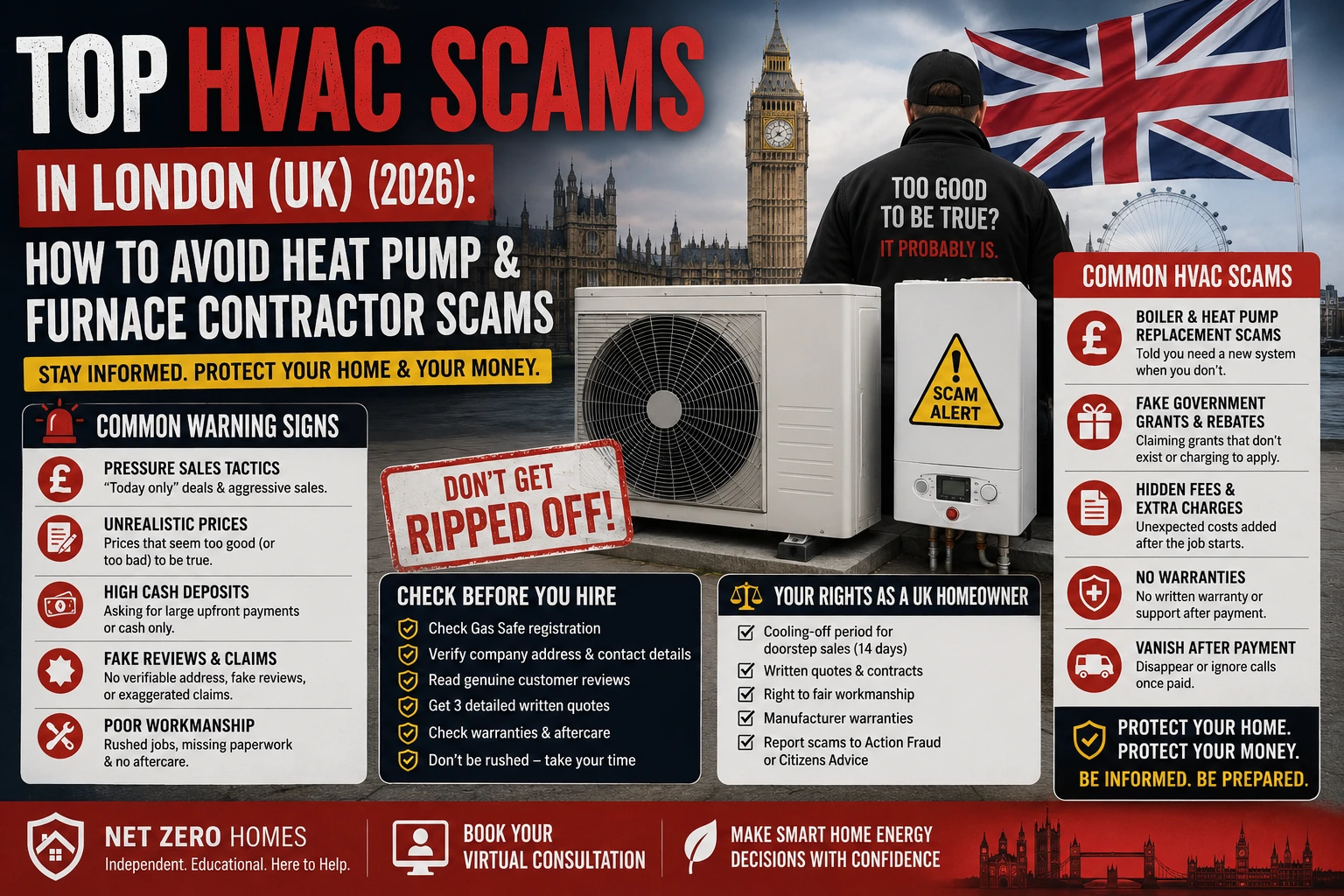
The most common HVAC scams targeting London homeowners in 2026 involve door-to-door or high-pressure sales claiming “free” or heavily subsidised heat pumps under the Boiler Upgrade Scheme, fake MCS certificates, oversized or undersized systems that fail in cold weather, large upfront deposits with disappearing contractors, and misleading claims about energy savings or council grants.
Always verify MCS certification independently, get at least three detailed written quotes, never pay more than a small deposit, and check consumer protection routes through Citizens Advice before signing anything.
A Real London Homeowner Story
Sarah in Islington needed to replace her ageing gas boiler. Three contractors visited. One quoted £18,000 for an air-source heat pump and said the government grant would cover almost everything. Another insisted a new high-efficiency gas boiler was the only sensible choice and dismissed heat pumps as “not ready for London winters.” The third offered a “special council scheme” price if she signed that afternoon and paid a £3,000 deposit.
Quotes differed by thousands of pounds. Claims about running costs contradicted each other. Sarah felt pressured and confused.
This scenario is increasingly common across London and Greater London as the Boiler Upgrade Scheme (BUS), rising energy prices, and net-zero targets drive demand for heat pumps and boiler replacements. Rogue traders and high-pressure sales tactics exploit the complexity. This guide gives London homeowners the clear, practical knowledge needed to protect themselves.
Why HVAC Scams Are Rising in London in 2026
Demand for low-carbon heating is growing. The Boiler Upgrade Scheme offers substantial grants, energy bills remain high under the Ofgem price cap, and many Victorian and inter-war London homes need fabric improvements before heat pumps perform well. This combination creates opportunity for both reputable installers and bad actors.
Reports to Citizens Advice and Trading Standards frequently involve home-improvement work, including heating systems. Door-to-door approaches claiming official schemes have been noted in various London boroughs and nearby areas. High-pressure tactics, exaggerated savings claims, and poor installations that leave homes cold or bills higher than promised are recurring problems.
London Climate and Why System Choice Matters
London has a temperate maritime climate. Average winter temperatures typically range from about 5–9 °C, with occasional colder spells. Summer highs often sit around 20–23 °C, though heatwaves exceeding 30 °C have become more frequent.
Heating degree days dominate. One 2024 dataset for the City of London recorded roughly 1,270 HDD (base 15 °C) and very low cooling degree days. Space heating still drives the majority of domestic energy use. Heat pumps must be correctly sized and the home must be reasonably airtight and insulated; otherwise performance suffers and running costs rise. Scammers often ignore or downplay these realities.
Current Energy Prices and Running-Cost Reality
Under the Ofgem energy price cap for 1 July–30 September 2026, typical Direct Debit rates are approximately 26.11 p/kWh for electricity and 7.33 p/kWh for gas (standing charges around 57 p/day electricity and 29 p/day gas). The typical dual-fuel household bill sits near £1,862 for the period.
A well-designed air-source heat pump can deliver heat at a lower cost per kWh of useful heat than gas in many cases, but only when the system is properly specified, the property is suitable, and the homeowner understands how to run it (lower flow temperatures, good controls). Scammers frequently quote unrealistic savings or ignore the need for fabric upgrades.
The Boiler Upgrade Scheme – What Is Genuine and What Is Fake
The Boiler Upgrade Scheme (England and Wales) currently provides:
- £7,500 towards an air-source or ground-source heat pump
- £2,500 towards an air-to-air heat pump (residential)
- £5,000 towards certain biomass boilers
- An additional uplift (up to £9,000 total in some off-gas cases for a limited period) for eligible oil/LPG properties without mains gas.
Grants are paid to the installer and deducted from the customer’s bill. The installer must be MCS-certified and the installation must meet scheme rules. No legitimate contractor can offer a “free” heat pump solely through the scheme; the homeowner still pays the balance. Claims of exclusive council partnerships or doorstep “guaranteed approval” are almost always false.
Top 10 HVAC Scams Targeting London Homeowners
1. Fake or exaggerated grant claims Contractors claim the work is fully funded or that you “qualify automatically” if you sign today. Reality: you still pay the residual cost and must use an eligible MCS installer.
2. Door-to-door or cold-call “council scheme” sales Salespeople claim to represent the local authority or a national scheme and push immediate decisions. Legitimate schemes do not operate this way.
3. Deposit scams and disappearing contractors Large deposits (sometimes 50 % or more) are taken and the company becomes uncontactable or delivers substandard work.
4. Fake MCS or consumer-code membership Certificates or logos are forged or the company was previously certified but has been suspended. Always check the live MCS database yourself.
5. Undersized or oversized systems Cheap undersized heat pumps fail to heat the home adequately in colder weather. Oversized units cycle inefficiently and cost more.
6. Ignoring fabric first Installers skip insulation, air-sealing or radiator upgrades that are often essential for good heat-pump performance in older London stock.
7. Misleading running-cost and savings claims Promises of “70 % cheaper bills” without modelling the specific property or current tariffs.
8. High-pressure financing or “special finance deals” Pushy credit agreements with high interest or unfavourable terms, sometimes linked to the deposit scam.
9. Counterfeit or grey-market equipment Non-genuine or poorly supported heat pumps and controls that later prove difficult or expensive to service.
10. Poor workmanship and incomplete commissioning Systems left without proper design calculations, inadequate pipework, missing insulation on external runs, or no proper handover and MCS certificate.
Red Flags Checklist
- Pressure to sign or pay a large deposit the same day
- Claims of exclusive “council” or “government” partnerships that cannot be verified
- Refusal to provide a detailed written quote with make, model, capacity and design assumptions
- Inability or unwillingness to show current MCS certification and consumer-code membership (RECC or HIES)
- Quotes that are dramatically lower or higher than market norms without clear justification
- No mention of Building Regulations notification or self-certification
- Guarantees of specific bill savings without a proper assessment
How to Vet Contractors Properly
- Search the official MCS installer database yourself.
- Confirm membership of a consumer code (RECC or HIES).
- Ask for recent local references and, if possible, visit a completed installation.
- Request a full heat-loss calculation and system design summary.
- Obtain at least three comparable written quotations.
- Check Companies House for trading history and any red flags.
- Never rely solely on a company’s own website or sales claims.
Typical Legitimate Costs vs Scam Pricing
Air-source heat pump installations commonly range from roughly £10,000–£16,000 before grant (higher for complex or larger properties). After the £7,500 BUS grant, residual costs frequently fall in the £2,500–£8,500 range depending on property and specification. Ground-source systems cost significantly more.
Quotes far outside these bands without clear technical reasons warrant caution. Extremely low quotes often mean corners will be cut; extremely high quotes may include unnecessary extras or inflated margins.
Building Regulations, MCS and Licensing in England
Heat-pump installations must comply with Building Regulations (notably Part L for energy performance and relevant electrical and water regulations). MCS-certified installers can usually self-certify compliance. Non-MCS work may still be legal for private cash jobs but will not attract the BUS grant and often lacks the same consumer protections. Gas boiler work requires Gas Safe registration. Always confirm the appropriate competencies.
What to Do If You Suspect a Scam or Poor Work
Contact the Citizens Advice consumer helpline on 0808 223 1133. Advisers can provide guidance under the Consumer Rights Act 2015 (services must be carried out with reasonable care and skill) and can pass information to Trading Standards. Keep all paperwork, photos, and communication records. If an MCS installer is involved, use the MCS and consumer-code complaint routes as well.
Connecting Heat Pumps to Wider Home Electrification
A well-executed heat pump is one step on the path to a more efficient, lower-carbon home. Many London properties also benefit from:
- Improved loft and cavity/solid-wall insulation
- Air sealing and draught-proofing
- High-performance windows where appropriate
- Solar PV and battery storage
- Smart controls and EV charging readiness
An independent whole-house view reduces the risk of being sold an isolated product that underperforms.
Practical Homeowner Action Plan
- Improve insulation and air tightness first where practical.
- Obtain an independent energy assessment or use reputable free tools.
- Research MCS installers and request three detailed quotes.
- Verify certifications yourself.
- Understand the residual cost after any grant.
- Review the contract carefully; avoid large upfront payments.
- Ensure proper commissioning and receive the MCS certificate.
- Monitor performance in the first heating season and raise issues promptly.
Frequently Asked Questions
What is the biggest heat pump scam in London right now? Door-to-door or high-pressure claims of “free” or fully funded installations under official schemes, often combined with large deposits.
Do I need an MCS installer for a heat pump? Yes if you want the Boiler Upgrade Scheme grant and the associated consumer protections. MCS is not legally mandatory for every private installation but is strongly recommended.
How much should a heat pump cost in London after the grant? Many residual costs fall between roughly £2,500 and £8,500 for air-source systems, but exact figures depend on property size, fabric condition and specification. Always get property-specific quotes.
Can a heat pump work in an older London terrace? Yes, when the system is correctly designed and the building fabric is improved sufficiently. Performance depends on heat loss, not age alone.
What should I do if a contractor demands a large deposit? Treat it as a major red flag. Legitimate firms usually accept modest deposits and stage payments linked to progress.
How do I check if an installer is genuine MCS? Use the official MCS website search tool with the company name or certificate number.
Are gas boiler replacement scams still common? Yes—overpricing, unnecessary work, and pressure selling remain issues. Always use Gas Safe registered engineers.
What consumer protection exists in the UK for HVAC work? Consumer Rights Act 2015, Trading Standards via Citizens Advice, MCS and consumer-code schemes, and potentially the Financial Ombudsman for credit-related issues.
Should I get multiple quotes? Always. Three detailed, comparable quotes are the minimum sensible approach.
Can I report a rogue trader anonymously? Citizens Advice can take reports and pass intelligence to Trading Standards.
Final Thoughts
London homeowners face real pressure to upgrade heating systems amid high energy costs and climate targets. The majority of MCS installers operate professionally, but the combination of grants, complexity and urgency creates openings for scams. Education, independent verification, and patience remain the strongest protections.
Net Zero Homes exists to help homeowners navigate these decisions with clear, vendor-neutral information—comparing options, reviewing quotes, understanding fabric-first priorities, and planning long-term electrification pathways that include heat pumps, insulation, solar, storage and smart controls.
If you are considering a heat pump, boiler replacement or wider home energy upgrade in London or elsewhere in the UK, book a free virtual consultation with Net Zero Homes.
We can help review quotes independently, explain realistic performance expectations, outline rebate eligibility, and map a practical route toward a more efficient, comfortable and future-ready home without high-pressure sales.
Resources:
https://www.gov.uk/apply-boiler-upgrade-scheme
https://www.recc.org.uk/scheme/consumer-code
Find An Installer