Last winter in Toronto’s east end, a homeowner named Sarah watched the temperature inside her 1970s bungalow drop to 12°C after her aging furnace failed during a polar vortex. With two young kids and overnight lows forecast at –25°C, she called the first company that answered. The technician arrived within hours, shook his head at the cracked heat exchanger, and declared the system “dangerous.” He offered a “same-day special” on a new high-efficiency furnace plus a heat pump “while the government rebates last.” Pressure mounted. Within two hours she signed a financing agreement for nearly $18,000. Only later did she discover the equipment was undersized for her home, the promised rebate did not apply the way it was described, and the warranty required annual service only available through the same company at inflated rates.
Sarah’s story is not unique. Across Toronto, Ottawa, Hamilton, London, Milton, Cambridge and communities throughout Ontario, homeowners facing sudden HVAC failures or the push toward electrification are encountering sophisticated sales tactics that exploit urgency, climate anxiety and complex rebate programs. This guide exists so you do not become the next case.
Written from the perspective of independent home energy advisors and consumer-protection researchers, this resource equips Ontario residents to recognize, avoid and report HVAC contractor scams. It draws on publicly available information from the Better Business Bureau, Canadian Anti-Fraud Centre, Competition Bureau Canada, Consumer Protection Ontario, the Technical Standards and Safety Authority (TSSA), and provincial energy programs. No individual businesses are named or targeted.
Why HVAC Scams Are Increasing in Ontario ?
Ontario’s climate creates perfect conditions for high-pressure sales. Extreme cold snaps and increasingly humid summers drive emergency replacements. Many homes still rely on 15- to 25-year-old furnaces and air conditioners. At the same time, provincial and federal incentives are accelerating heat-pump adoption as part of broader electrification goals.
Equipment prices have risen. Demand for cold-climate air-source and ground-source heat pumps has surged. Utility programs such as the Home Renovation Savings program (delivered by Enbridge Gas and Save on Energy) offer meaningful rebates—up to $7,500 for qualifying cold-climate air-source heat pumps and up to $12,000 for ground-source systems, among other incentives for insulation, air sealing, solar and storage.
Scammers exploit this environment. They exaggerate rebate amounts, invent “limited-time government programs,” claim affiliation with utilities or energy advisors, and use fear of carbon taxes or rising natural-gas prices. Door-to-door sales of furnaces, air conditioners and related HVAC equipment have been banned in Ontario since March 1, 2018, under the Consumer Protection Act, yet aggressive tactics continue through phone calls, online ads, and referrals that appear legitimate.
The combination of aging systems, weather extremes, rising costs and attractive incentives creates both opportunity and risk. Informed homeowners can navigate the market successfully; uninformed ones can lose thousands.
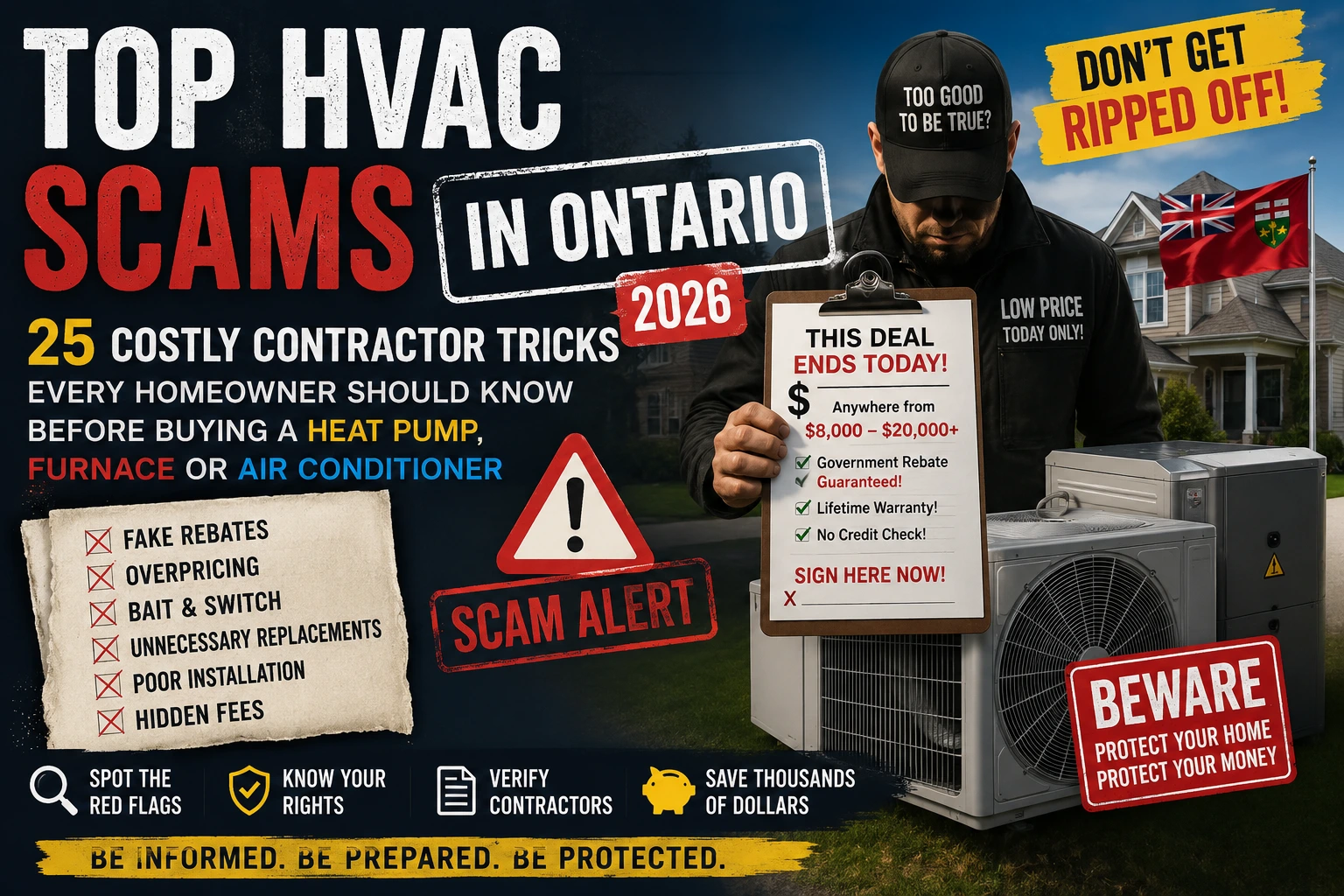
Top 25 HVAC Scams in Ontario
For each scam: how it works, why homeowners fall for it, warning signs, typical financial impact, questions to ask, and how to avoid it.
1. Fake or Inflated Government Rebate Claims How it works: Salespeople claim the federal or provincial government will cover most of the cost, or that the contractor “handles the rebate so you pay nothing.” Why it works: Rebates are real but complex; homeowners want to maximize savings. Warning signs: “Guaranteed $X rebate,” pressure to sign today before the program ends. Impact: $3,000–$10,000+ overpayment or denied claims.
Questions: “Which exact program and what is the application process?” “Can I apply myself?” Avoid: Verify every rebate on official sites (homerenovationsavings.ca, saveonenergy.ca, Natural Resources Canada). Never let a contractor control the application exclusively.
2. Door-to-Door or Unsolicited Home Visits for HVAC Sales How it works: Despite the 2018 ban, some still knock or leave materials then follow up aggressively. Contracts signed this way can be void. Warning signs: Unsolicited knock or “utility representative” claim. Impact: Void contracts still cause stress and removal costs. Questions: “Did I invite you?” Avoid: Never engage. Report to Consumer Protection Ontario. Contracts from unsolicited restricted-product sales are void.
3. “Your Furnace Is Dangerous – Must Replace Today” How it works: Technician invents cracks, carbon monoxide risk or imminent failure during a service call. Warning signs: Immediate condemnation without photos, second opinion refused. Impact: $8,000–$15,000 unnecessary replacement. Questions: “Can I get an independent inspection?” “Show me the defect with photos.” Avoid: Always obtain a second opinion from a TSSA-certified technician not affiliated with the first company.
4. Bait-and-Switch Equipment How it works: Quote features a premium cold-climate heat pump; installed unit is a cheaper model with lower capacity or poorer low-temperature performance. Warning signs: Model numbers change on the final invoice; serial numbers do not match the quote. Impact: $2,000–$6,000 difference plus higher operating costs. Questions: “Confirm exact make, model and AHRI certificate before installation.” Avoid: Require written model numbers and refuse payment until verified.
5. Undersized or Oversized Systems How it works: No proper Manual J load calculation; system is chosen by square footage only. Warning signs: No room-by-room heat-loss calculation provided. Impact: Comfort problems, short-cycling, higher bills, premature failure. Questions: “Did you perform a Manual J calculation? Can I see it?” Avoid: Insist on a documented load calculation.
6. High-Pressure “Today Only” Financing How it works: Special rates or “0% for 60 months” disappear if you do not sign immediately. Warning signs: Financing paperwork filled out before you see the full contract. Impact: High effective interest once promotional period ends; $5,000+ extra. Questions: “What is the deferred interest rate if not paid in full?” “Can I use my own lender?” Avoid: Never sign financing the same day. Compare with your bank or credit union.
7. Excessive Deposits How it works: Demand 50–100% upfront “to order equipment.” Warning signs: Cash or e-transfer requested before any work or permits. Impact: Lost deposit if company disappears. Questions: “What is your standard deposit percentage and when is the balance due?” Avoid: Limit deposits to 10–30%. Use credit cards with purchase protection where possible.
8. Hidden Fees and Change Orders How it works: Base price looks competitive; electrical upgrades, permits, duct modifications and disposal appear later. Warning signs: Vague “allowances” in the quote. Impact: 20–40% cost overrun. Questions: “Is this an all-inclusive fixed price? List every possible extra.” Avoid: Demand a fixed-price contract with clear inclusions.
9. Fake Energy Advisor or Utility Affiliation How it works: Claim to be from Enbridge, Save on Energy, or a municipal program. Warning signs: No official ID or vehicle markings; pressure to sign on the spot. Impact: Misdirected rebates and poor installations. Questions: “What is your independent registration number?” Avoid: Contact the utility or program administrator directly to verify.
10. Warranty Shell Games How it works: Promise 10-year parts and labour; fine print requires annual paid service only by the installing company or voids coverage for any third-party work. Warning signs: Warranty documents not provided before signing. Impact: Out-of-pocket repairs after year two. Questions: “Is labour included? Who can perform service without voiding?” Avoid: Read the manufacturer’s warranty and the contractor’s labour warranty separately.
11. Phantom Permits and Inspections How it works: Claim permits are included or unnecessary; work proceeds without municipal or TSSA oversight. Warning signs: No permit number provided. Impact: Safety risks, insurance issues, forced rework. Questions: “Who pulls the permit and who schedules the inspection?” Avoid: Confirm permit numbers with your municipality before final payment.
12. Misleading Efficiency Claims How it works: Quote SEER2 or HSPF2 numbers that do not match the actual installed equipment or Ontario climate performance. Warning signs: No AHRI certificate or ENERGY STAR documentation. Impact: Higher energy bills than projected. Questions: “Provide the AHRI reference number for this exact model.” Avoid: Cross-check on the AHRI directory and ENERGY STAR Canada site.
13. Ductwork and Airflow Neglect How it works: New equipment installed on old, leaky or undersized ducts without testing. Warning signs: No static-pressure measurement or duct sealing discussed. Impact: Reduced efficiency and comfort. Questions: “Will you perform a duct leakage test and static pressure reading?” Avoid: Require duct assessment as part of any major replacement.
14. Financing Through Third-Party Lenders with High Rates How it works: Contractor steers you to a preferred lender with high deferred-interest rates. Warning signs: Only one financing option offered. Impact: Effective APR of 15–25% if balance remains. Questions: “Can I use any lender I choose?” Avoid: Shop financing independently first.
15. “Free” Thermostat or Filter Upsells That Lock You In How it works: Free smart thermostat requires proprietary subscription or voids warranty if removed. Warning signs: Fine-print subscription language. Impact: Ongoing fees or reduced functionality. Questions: “Is the thermostat fully yours with no ongoing fees?” Avoid: Prefer open-protocol devices.
16. Incomplete or Non-Existent Contracts How it works: Verbal agreements or one-page invoices instead of detailed written contracts. Warning signs: Missing model numbers, timelines, payment schedule, warranty details. Impact: No recourse when problems arise. Questions: “Provide a full written contract meeting Consumer Protection Act requirements.” Avoid: Never proceed without a complete written agreement.
17. Post-Installation Upsells and “Required” Maintenance Plans How it works: After installation, claim the system needs expensive annual service only they can provide. Warning signs: High-pressure maintenance contract push at final payment. Impact: $300–$600/year unnecessary. Questions: “What maintenance does the manufacturer actually require?” Avoid: Follow manufacturer guidelines; use independent service.
18. Misrepresenting Cold-Climate Performance How it works: Claim a standard heat pump will heat efficiently to –30°C when it is not a true cold-climate model. Warning signs: No capacity data at –15°C or –25°C. Impact: Backup heat runs constantly; high bills. Questions: “Provide heating capacity at –15°C and –25°C from the manufacturer’s data sheet.” Avoid: Only accept models listed as cold-climate capable with published low-temperature data.
19. Ignoring Existing Duct or Electrical Limitations How it works: Quote a high-capacity system without checking panel size or duct capacity. Warning signs: No mention of electrical service upgrade. Impact: Additional $3,000–$8,000 in unexpected costs. Questions: “Have you assessed the electrical panel and duct system?” Avoid: Require a full site assessment before accepting a quote.
20. Rebate Assignment Tricks How it works: Contractor takes assignment of the rebate and then fails to process it or pockets the difference. Warning signs: “We’ll handle everything—just sign here.” Impact: Lost rebate funds. Questions: “Will the rebate be paid directly to me?” Avoid: Prefer programs that pay the homeowner; keep copies of all applications.
21. Fake or Expired Certifications How it works: Claim TSSA gas technician certification or other credentials that are invalid or belonging to someone else. Warning signs: Refusal to show certificate numbers. Impact: Unsafe installation, insurance denial. Questions: “Provide your TSSA certificate number so I can verify it.” Avoid: Check the TSSA public registry for fuels contractors and technicians.
22. Pressure to Cancel Existing Warranties or Service Contracts How it works: Claim your current maintenance plan is worthless and must be cancelled to install new equipment. Warning signs: Urgency around cancellation. Impact: Loss of remaining coverage. Questions: “How does this affect my existing warranty?” Avoid: Review existing contracts independently.
23. “We Only Use the Best Brands” While Installing Mid-Tier How it works: Premium branding in the sales pitch; mid-range or rebranded equipment arrives. Warning signs: Brand logos on paperwork do not match installed units. Impact: Lower performance and resale value. Questions: “Confirm the exact brand and series that will be installed.” Avoid: Photograph nameplates on delivery.
24. Incomplete Commissioning How it works: Equipment is started but never properly charged, balanced or documented. Warning signs: No commissioning report or refrigerant charge verification. Impact: Reduced efficiency and lifespan. Questions: “Will I receive a full commissioning report?” Avoid: Withhold final payment until commissioning documentation is provided.
25. Disappearing After Deposit or Partial Payment How it works: Take a large deposit, order nothing, and become unreachable. Warning signs: New company with limited online history, only cell-phone contact. Impact: Full deposit loss. Questions: “How long have you been in business under this name? Provide references from the last 12 months.” Avoid: Research incorporation date, TSSA registration, and online reviews carefully. Prefer established local companies.
BBB Complaint Trends
Public BBB data and complaint patterns across Canada and Ontario frequently highlight recurring themes in the HVAC sector: poor workmanship, billing and pricing disputes, warranty disagreements, communication failures, deposit and refund issues, misleading advertising, and failure to complete work as promised. Many complaints involve high-pressure sales tactics and discrepancies between what was promised and what was delivered. Homeowners are encouraged to check BBB profiles, but ratings alone are not sufficient—look at the nature and resolution of complaints
Comparison Tables
Legitimate vs Suspicious Contractor
| Aspect | Legitimate | Suspicious |
|---|---|---|
| Licensing | Active TSSA fuels contractor registration | Cannot or will not provide numbers |
| Quotes | Detailed, written, fixed-price | Verbal or one-page with vague numbers |
| Pressure | Gives time to decide | “Today only” or “rebate ending” |
| Rebates | Directs you to official program sites | Claims they control or guarantee amounts |
| Deposit | 10–30% | 50%+ or full payment upfront |
| References | Recent local projects with contact info | None or only online reviews |
Good Quote vs Bad Quote
| Element | Good Quote | Bad Quote |
|---|---|---|
| Equipment | Exact make, model, serial range | “High-efficiency heat pump” |
| Load calculation | Manual J provided | Square-footage estimate only |
| Scope | Ductwork, electrical, permits listed | “Installation included” |
| Timeline | Clear start and completion dates | “As soon as possible” |
| Payment schedule | Milestone-based | Large upfront |
| Warranty | Manufacturer + labour details | “Full warranty” with no details |
Proper Heat Pump Proposal vs Scam Proposal
| Item | Proper | Scam |
|---|---|---|
| Climate performance | Capacity tables at –15°C / –25°C | Generic SEER/HSPF only |
| Backup heat | Clearly specified | Ignored or minimized |
| Electrical assessment | Panel and circuit evaluation | Assumed adequate |
| Duct evaluation | Static pressure / leakage discussed | Not mentioned |
| Rebate pathway | Homeowner applies or clear process | “We take care of everything” |
Warranty Comparison
| Type | Strong | Weak |
|---|---|---|
| Parts | 10 years from manufacturer | 5 years or less |
| Labour | 1–2 years from contractor | 90 days or none |
| Transferability | Yes | No |
| Service requirements | Manufacturer schedule | Must use installing company only |
Financing Comparison
| Feature | Preferable | Risky |
|---|---|---|
| Rate | Transparent, competitive | Deferred interest / high APR |
| Lender | Your choice | Contractor-only |
| Prepayment | No penalty | Penalties or restrictions |
| Disclosure | Full cost of credit shown | Buried in fine print |
Rebate Verification Checklist
- Confirm the exact program name and website.
- Verify eligibility (home type, heating fuel, ownership).
- Confirm required documentation (invoices, model numbers, photos).
- Determine who receives the payment.
- Note application deadlines and any energy-assessment requirements.
- Keep copies of everything submitted.
Province-Specific Consumer Rights
Ontario’s Consumer Protection Act provides important protections for HVAC transactions.
- Door-to-door ban: Unsolicited sales of furnaces, air conditioners, air cleaners, air purifiers, water heaters and related HVAC systems at a consumer’s home are prohibited unless the consumer initiated the contact. Contracts resulting from banned activity are void.
- Cooling-off period: When a consumer invites a seller into the home and signs a contract for a restricted product, a 10-day cooling-off period applies from the date a written copy of the agreement is received. Cancellation is without reason or penalty.
- Written contracts: Contracts must meet disclosure requirements, including total cost and cancellation terms. A mandatory cover page outlining consumer rights is required for restricted products.
- Deposits and payments: While no universal deposit limit exists for all contracts, large upfront payments increase risk. Use methods that offer recourse.
- Complaint process: Contact Consumer Protection Ontario for issues involving the Consumer Protection Act. File with the BBB and the Canadian Anti-Fraud Centre for broader patterns. Local police may be appropriate for clear fraud.
- Licensing: Gas-fired equipment work requires TSSA certification. Contractors performing fuels-related work must be registered. Verify via the TSSA public registry.
- Permits and inspections: Most replacements require municipal permits and may involve TSSA oversight for gas work. Confirm both are obtained.
- Warranty protections: Manufacturer warranties remain; contractor labour warranties are contractual. Document everything.
Province-Specific Rebates
The primary current program is the Home Renovation Savings program, a partnership of Enbridge Gas and Save on Energy with Ontario government support. Key offerings (verify current details on the official site as amounts and rules can change) include:
- Cold-climate air-source heat pumps: up to $7,500 (based on size).
- Ground-source heat pumps: up to $12,000 (based on size).
- Insulation (attic, walls, foundation, etc.): various amounts up to several thousand dollars.
- Air sealing: up to $250.
- Heat-pump water heaters: $500.
- Windows and doors: per rough opening.
- Solar and storage: combined incentives available.
- Smart thermostats and certain appliances
Eligibility typically requires ownership of a qualifying residential property connected to the electricity grid or Enbridge Gas service, among other criteria. Some pathways require a home energy assessment; others allow single-upgrade claims. Always confirm on homerenovationsavings.ca or saveonenergy.ca. Additional federal incentives through Natural Resources Canada or Canada Greener Homes may apply in some cases—check current status independently.
Never rely solely on a contractor’s verbal summary of rebate amounts or eligibility.
Homeowner Checklists
Before Requesting Quotes
- Document current system age, model and recent service history.
- Note comfort problems and utility bills.
- Research TSSA requirements and local permit rules.
- Identify target efficiency and fuel type (heat pump vs high-efficiency gas, etc.).
- Prepare a list of must-have features.
Before Signing
- Obtain at least three detailed written quotes.
- Verify TSSA registration and technician credentials.
- Confirm exact equipment model numbers and AHRI data.
- Review the full contract, warranty documents and financing terms.
- Verify rebate eligibility yourself on official sites.
- Check cooling-off rights and cancellation process.
- Sleep on it—never sign under pressure.
During Installation
- Confirm permits are posted.
- Photograph delivered equipment nameplates.
- Observe that work matches the scope.
- Ask for intermediate progress updates.
After Installation
- Receive and review commissioning report.
- Confirm all model and serial numbers.
- Obtain final invoices and warranty registration.
- Apply for or confirm rebate submission.
- Schedule any required municipal or TSSA inspection.
- Test system operation thoroughly.
Warranty Checklist
- Manufacturer parts warranty length and registration.
- Contractor labour warranty length and conditions.
- What voids coverage.
- Transferability if you sell the home.
- Required maintenance schedule.
Documents to Keep
- All quotes, contracts, change orders.
- Equipment manuals and warranty certificates.
- Permit and inspection records.
- Rebate applications and confirmation.
- Photos of nameplates and installation.
- Commissioning data.
Key Questions to Ask Every Contractor
- What is your TSSA registration number?
- Who will perform the work and what are their certifications?
- Will you provide a Manual J load calculation?
- Exact make, model and AHRI number of proposed equipment?
- Is the price fixed and all-inclusive?
- What is the payment schedule?
- Who pulls permits and schedules inspections?
- How are rebates handled and who receives the funds?
- What is included in the labour warranty?
- Can I speak with recent local customers?
Net Zero Homes exists as an independent educational resource for Ontario homeowners navigating electrification, efficiency upgrades and the path toward lower-carbon living. We help you compare equipment options, understand current rebate pathways, plan whole-home energy improvements, evaluate insulation and air-sealing priorities, assess solar and battery storage potential, and develop realistic strategies to reduce both emissions and lifetime energy costs.
We do not install equipment or sell products. Our role is vendor-neutral guidance so you can make informed decisions and avoid the sales pressure that often accompanies major HVAC purchases. Whether you are replacing a failing furnace in Toronto, considering a cold-climate heat pump in Ottawa, or planning a broader renovation in Hamilton or London, independent advice reduces risk and improves outcomes.
FAQ
- How do I verify an HVAC contractor in Ontario? Check TSSA registration for fuels work, request certificate numbers, review recent local references, and examine BBB complaint patterns.
- Can HVAC contractors claim government rebates on my behalf? Some programs allow assignment, but you should always verify eligibility and retain copies of applications. Prefer direct payment to the homeowner when possible.
- Should I get three quotes? Yes. Three detailed written quotes from verified contractors is the minimum standard.
- How do I report an HVAC scam? Contact Consumer Protection Ontario, the Canadian Anti-Fraud Centre (1-888-495-8501), the BBB, and local police if fraud is clear.
- Can I cancel my HVAC contract? Yes, during the 10-day cooling-off period for qualifying home-signed restricted-product contracts. Other cancellation rights may apply under the Consumer Protection Act.
- Who regulates HVAC contractors in Ontario? TSSA for fuels safety and certification; Consumer Protection Ontario for sales practices; municipalities for permits; Skilled Trades Ontario for certain trade certifications.
- Is door-to-door HVAC sales legal in Ontario? No for the restricted list of products (furnaces, ACs, etc.) unless the consumer initiated the transaction.
- What is a reasonable deposit? Typically 10–30%. Larger amounts increase risk.
- Do I need a permit for furnace or heat-pump replacement? In most Ontario municipalities, yes. Confirm with your local building department.
- How do I know if a heat pump is suitable for Ontario winters? Look for published heating capacity at –15°C and –25°C and models designed for cold climates.
- What documents should I receive after installation? Commissioning report, warranty certificates, final invoice with model/serial numbers, permit/inspection records, and rebate paperwork.
- Can a contractor void my manufacturer warranty? Improper installation or unauthorized modifications can. Use certified technicians and follow manufacturer requirements.
- Are maintenance plans mandatory? Rarely. Follow the manufacturer’s recommended schedule; you can usually use independent providers.
- How long should a proper quote process take? Site visit, load calculation and detailed proposal typically require several days to a week or more—not same-day pressure.
- What if the installed equipment differs from the quote? Document immediately, withhold final payment, and demand correction or compensation.
- Do rebates require a home energy assessment? Some pathways do; others allow single-measure claims. Check the current Home Renovation Savings rules.
- Is financing through the contractor a good idea? Compare rates and terms with your own bank or credit union first. Deferred-interest products can be expensive.
- How can I check TSSA certification? Use the public contractor and technician search tools on the TSSA website.
- What should I do if I already signed a questionable contract? Review cooling-off rights immediately, gather all documents, and contact Consumer Protection Ontario for guidance.
- Where can I get independent advice before buying? Resources such as Net Zero Homes offer vendor-neutral guidance on equipment, rebates and whole-home planning. If you are an Ontario homeowner facing a furnace replacement, exploring a heat pump, or simply wanting to understand your options without sales pressure, book a virtual consultation with Net Zero Homes. We provide independent quote reviews, heat-pump performance comparisons, whole-home energy planning, clear rebate guidance, electrification roadmaps, and vendor-neutral recommendations tailored to Toronto, Ottawa, Hamilton, London and communities across the province.Protect your investment, your comfort and your long-term energy costs. Reach out today for unbiased support grounded in building science and consumer protection.