Ontario winters demand more from a heat pump than milder climates. Design temperatures commonly range from about –18°C to –25°C (or lower in northern areas), with high humidity that affects defrost cycles and capacity.
Homeowners searching for the most efficient heating and cooling systems for cold climates, the best cold climate heat pump for Canada, or a heat pump that handles Canadian winters reliably often compare two premium brands: Carrier and Trane.
Both manufacture high-efficiency air-source heat pumps with variable-speed (inverter) compressors suited to cold-climate use. Neither is universally “best.” Performance depends on the specific model, proper Manual J sizing, installation quality, home envelope, and whether the system is all electric or dual-fuel (paired with a gas furnace).
This guide compares their cold-weather capabilities, efficiency metrics (SEER2, HSPF2, COP), real-world Ontario considerations, costs, rebates, warranties, and fit within a Net Zero Homes strategy.
Quick Answer
Both Carrier and Trane offer strong cold-climate air-source heat pumps that can heat effectively in Ontario winters when properly sized and installed. Carrier’s Infinity series with Greenspeed Intelligence often posts higher published HSPF2 and SEER2 numbers and maintains capacity to very low temperatures (down to approximately –30°C / –23°F on select models).
Trane’s cold-climate models (including low-profile multi-speed units) emphasize durability features such as Spine Fin coils and reliable defrost performance. The better choice is usually the one matched to your home’s load, local installer expertise, and total system design rather than brand alone. Always verify current model ratings and Ontario rebate eligibility.
Why Cold-Climate Performance Matters in Ontario
Standard heat pumps lose capacity and efficiency as outdoor temperatures drop. Cold-climate models use variable-speed compressors, enhanced vapour injection or similar technologies, optimized heat exchangers, and intelligent defrost controls to maintain higher capacity and Coefficient of Performance (COP) at low temperatures.
Ontario spans multiple climate zones. Southern areas (e.g., Toronto, Windsor) typically fall in colder zones with design temperatures around –18°C to –20°C. Central and northern regions are colder still. Humidity increases frost buildup, so defrost strategy and coil design matter. NRCan guidance emphasizes selecting units that retain substantial capacity at local design temperatures and pairing them with proper building envelope upgrades.
A well chosen cold climate heat pump can serve as primary heat in many Ontario homes, reduce reliance on fossil fuels, and support home electrification goals. Backup heat (electric resistance or dual-fuel gas) remains common for extreme cold snaps.
Understanding Key Efficiency Metrics
- SEER2: Seasonal Energy Efficiency Ratio 2 — cooling efficiency. Higher is better.
- HSPF2: Heating Seasonal Performance Factor 2 — heating efficiency over a season. Higher is better for cold climates.
- COP: Instantaneous efficiency (heat output divided by electricity input). A COP of 2–3+ at low temperatures is desirable.
- Capacity retention: Percentage of rated heating capacity maintained at –8°C, –15°C, or –20°C (and lower).
- Lowest operating temperature and capacity at that point.
Look for ENERGY STAR Cold Climate certification where available and review manufacturer performance data at multiple temperatures, not just nominal ratings. Canadian testing considerations (including colder climate regions) make capacity at design conditions especially important.
Carrier Heat Pumps for Cold Climates
Carrier’s Infinity line with Greenspeed Intelligence is frequently highlighted for cold-climate capability. Select models feature variable-speed compressors that modulate capacity widely, delivering precise comfort and high part-load efficiency.
Published performance on higher-end cold-climate Infinity models includes:
- Cooling: up to ~21–23 SEER2 (varies by exact model and matched indoor unit)
- Heating: up to ~10.5–12.5 HSPF2 range across the lineup (verify current data)
- Operation down to approximately –23°F (–30°C) on certain units, with strong capacity retention at 0°F and below
- Quiet operation (low-50s dB on some models)
- Advanced controls, humidity management, and integration with Carrier’s Infinity system
Carrier emphasizes adaptive performance and comfort features. Real-world results depend heavily on correct sizing, airflow, refrigerant charge, and outdoor unit placement (clearance for snow and airflow).
Trane Heat Pumps for Cold Climates
Trane offers variable-speed and multi-speed cold-climate models, including low-profile designs suited to tighter outdoor spaces. Features often cited include Spine Fin coils (durable all-aluminum construction that can aid heat transfer and resist corrosion) and robust defrost logic.
Examples from the lineup:
- Higher-end cold-climate units: SEER2 up to ~19–21, HSPF2 in the ~9+ range (model-dependent)
- Capacity maintained at low temperatures with focus on steady output
- Quiet operation on premium models
- Integration with Trane controls and ComfortLink or similar systems
Trane is frequently associated with long-term durability and consistent cold-weather behaviour in independent discussions and installer feedback. As with Carrier, installation quality and proper matching to the indoor unit and home load are decisive.
Head-to-Head Comparison
Exact numbers change with model year, matched components, and testing conditions. Always consult current manufacturer data sheets and a qualified Ontario HVAC professional.
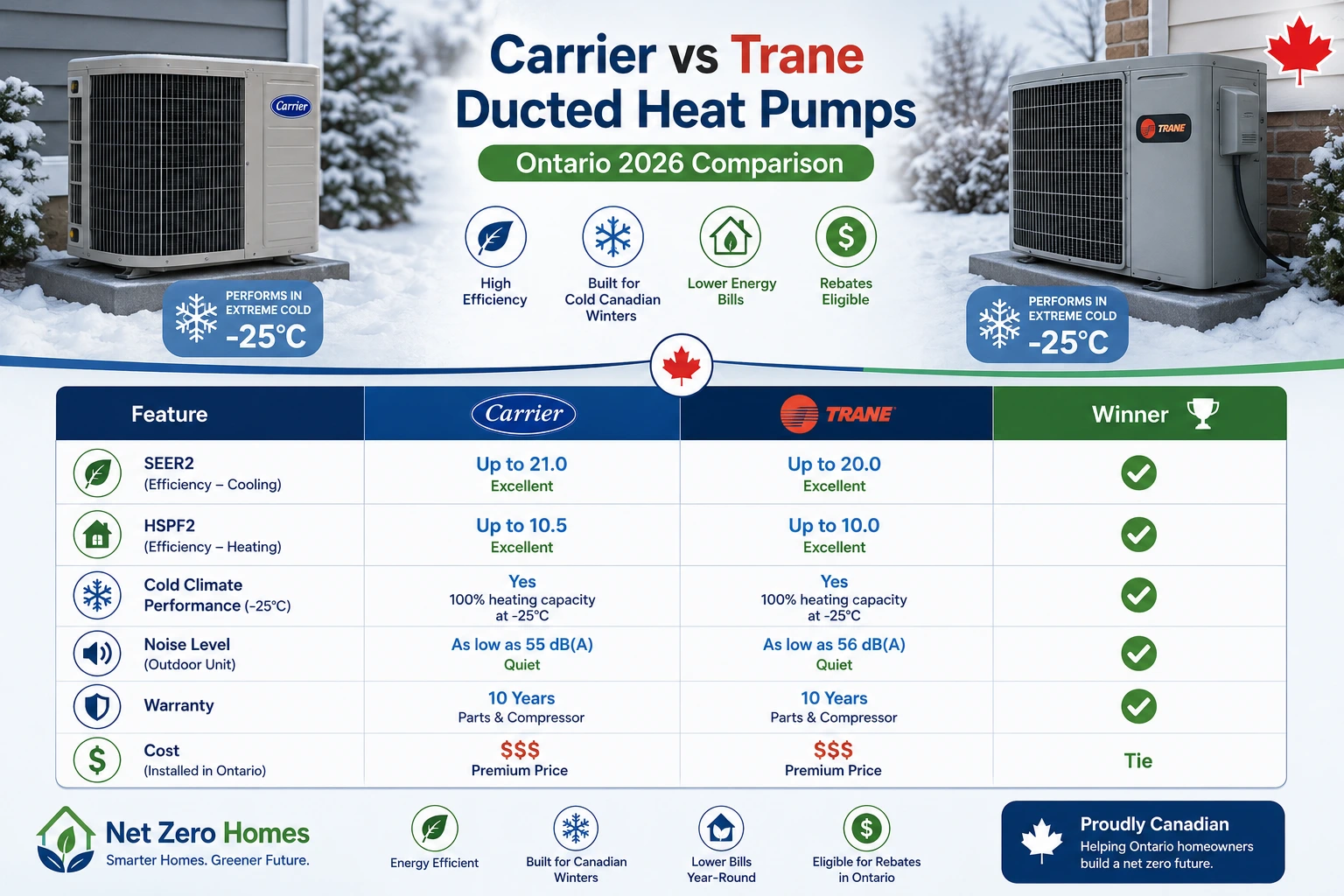
| Factor | Carrier (Infinity / Greenspeed examples) | Trane (Cold-climate / Premier examples) | Notes for Ontario |
|---|---|---|---|
| Cold-weather capacity | Strong; select models to ~–30°C | Strong; designed for freezing conditions | Both suitable when sized correctly |
| Typical high-end HSPF2 | Often higher published range | Competitive (often ~9+) | Verify at local design temp |
| Typical high-end SEER2 | High (20+) | High (up to ~21) | Both excellent for cooling |
| Compressor | Variable-speed inverter | Variable- or multi-speed | Modulation improves comfort & efficiency |
| Coil / durability features | High-quality coils | Spine Fin often highlighted | Local corrosion/snow exposure matters |
| Noise | Very quiet on premium models | Very quiet on premium models | Placement & mounting affect real sound |
| Smart controls | Infinity system | Trane ecosystem | Both support thermostats & monitoring |
| Warranty (typical) | 10-year parts (registration often required) | Similar structure | Labour coverage varies by installer |
| Best suited for | High efficiency & comfort focus | Durability & steady cold performance | Home-specific |
Neither brand dominates every category. Carrier frequently leads published efficiency numbers; Trane often scores well on perceived reliability and coil durability in colder applications.
Real-World Winter Performance Factors in Ontario
- Sizing: Oversizing causes short-cycling and poor humidity control; undersizing leads to reliance on backup heat. Use Manual J load calculations based on local design temperatures and actual home characteristics (not rules of thumb).
- Defrost cycles: Necessary in humid cold weather. Better controls minimize energy use and temperature swings.
- Backup heat: Electric strips or dual-fuel gas furnace. Dual-fuel can optimize operating cost depending on electricity vs natural gas prices.
- Home envelope: Air sealing, insulation, and windows dramatically affect how hard the heat pump works. A heat pump in a leaky home will underperform any brand.
- Snow and placement: Elevate outdoor units, ensure clearances, and protect from drifting snow.
- Electricity rates: Time-of-use and any future dynamic rates influence savings. Ontario’s grid carbon intensity continues to improve, enhancing the emissions benefit of electrification.
Cost, Operating Expenses, and ROI in Ontario
Installed costs for premium Carrier or Trane cold-climate systems typically fall in a broad range of roughly $12,000–$25,000+ CAD depending on capacity (tonnage), single-zone vs multi, ducted vs ductless elements, dual-fuel configuration, electrical upgrades, and labour. Exact quotes vary widely by region and home.
Annual operating costs depend on home size, insulation, thermostat settings, electricity rates, and how much backup heat is used. High-efficiency cold-climate units can deliver substantial savings versus older electric baseboards or inefficient furnaces, and competitive results versus high-efficiency gas in many scenarios—especially when factoring carbon pricing trends and rebates.
Rough payback often falls in the 7–15+ year range after rebates, with longer-term ROI improved by rising energy costs, lower maintenance relative to older systems, and potential home value uplift. Calculate using your actual utility bills and a professional energy audit. Maintenance (annual service) is typically $150–300+.
Installation, Sizing, and Common Mistakes
Proper installation is more important than brand. Common homeowner errors include:
- Choosing the cheapest quote without verifying Manual J sizing or cold-climate capacity data
- Ignoring the building envelope (insulation, air sealing)
- Selecting based solely on SEER2/HSPF2 without checking capacity at –15°C or lower
- Hiring installers without cold-climate heat pump experience or proper licensing
- Skipping electrical panel evaluation
- Overlooking condensate management and outdoor unit elevation
- Failing to register the warranty or follow maintenance schedules
Work with installers familiar with Ontario codes, rebate program requirements, and NRCan sizing guidance.
Maintenance, Lifespan, Noise, and Smart Features
Both brands benefit from annual professional service (coil cleaning, refrigerant checks, electrical inspection, filter changes). Expected lifespan is typically 12–20+ years with good maintenance; compressors and electronics are the main long-term variables.
Premium models from both are among the quieter options available. Smart thermostats, remote monitoring, and zoning improve comfort and efficiency. Compatibility with home energy management systems supports Net Zero goals.
Warranties and Reliability
Both offer competitive parts warranties (commonly 10 years on major components when registered). Labour warranties are installer-dependent. Reliability data is mixed and influenced more by installation and maintenance than brand alone. Independent surveys and long-term owner reports generally place both in the upper tier of North American brands.
Rebate Eligibility and Canadian Programs
Ontario’s Home Renovation Savings program (Enbridge Gas and Save on Energy / IESO partnership) offers significant incentives for eligible cold-climate air-source heat pumps—commonly up to several thousand dollars (figures such as up to $7,500 have been referenced for qualifying systems, with variations by existing fuel type and other factors).
Ground-source systems and oil-to-heat-pump pathways can qualify for higher amounts in specific programs. Additional support may exist through federal initiatives, municipal programs, or income-qualified streams.
Eligibility usually requires ENERGY STAR or equivalent high-performance equipment, qualified installers, and sometimes a home energy assessment. Rules change verify current details on official program sites before purchasing. Net Zero Homes advisors can help navigate options without pushing specific brands.
Environmental Impact and Net Zero Homes Integration
Switching to a high-efficiency cold climate heat pump reduces on-site fossil fuel use and, given Ontario’s increasingly clean electricity grid, lowers overall greenhouse gas emissions compared with oil or inefficient gas systems. Pairing with:
- Air sealing and insulation upgrades
- High-performance windows
- Solar PV and battery storage
- Smart controls and EV charging
- A whole-home energy audit
creates a pathway toward Net Zero or Net Zero Ready performance. Heat pumps form the core of many electrification strategies because they deliver multiple units of heat per unit of electricity.
Which Should Ontario Homeowners Choose?
- Prioritize Carrier if maximum published efficiency ratings, advanced modulation, and the Infinity control ecosystem are top priorities and you have a strong local Carrier dealer.
- Prioritize Trane if durability features, specific coil technology, or a preferred local Trane dealer’s track record matter most.
- In most cases the deciding factors are: accurate load calculation, capacity retention at your design temperature, total installed system quality, warranty support, and after-sales service—not the logo on the outdoor unit.
Get multiple detailed quotes that include performance data at low temperatures, not just SEER2/HSPF2 stickers. Request references for similar Ontario installations.
Frequently Asked Questions
Can a heat pump really heat my Ontario home all winter? Yes, a properly sized cold-climate model can provide the majority or all of the heating in many homes. Extreme cold may still call for backup. Capacity at design temperature is the critical specification.
What is the difference between HSPF and HSPF2? HSPF2 uses updated testing procedures that better reflect real-world conditions. Compare like-for-like (HSPF2 to HSPF2).
Do I need a dual-fuel system? Not always. All-electric works well in many homes, especially with good envelopes and favourable electricity rates. Dual-fuel can optimize cost when gas is inexpensive relative to electricity at peak times.
How important is the installer versus the brand? Installer quality is usually more important. A poorly installed premium unit will underperform a well-installed mid-tier cold-climate system.
Will a heat pump work during a power outage? No—unless paired with battery backup or a generator. Plan accordingly for resilience.
How do rebates work with Carrier or Trane? Both brands have models that can qualify when they meet program efficiency and cold-climate criteria. Confirmation is model- and program-specific.
What about noise in a suburban neighbourhood? Premium variable-speed units from both brands are significantly quieter than older single-stage equipment, especially at part load.
Should I replace my furnace and air conditioner at the same time? Often yes for best integration, efficiency, and rebate stacking, but a heat-pump-only or dual-fuel approach can be staged.
How does this fit a Net Zero goal? A high-efficiency heat pump is foundational. Combine it with envelope upgrades, renewables, and efficient appliances for deepest carbon and cost reductions.
What maintenance is required? Regular filter changes, annual professional service, keeping the outdoor unit clear of debris and snow, and monitoring for unusual noises or performance drops.
Final Recommendations and Next Steps
For Ontario homeowners evaluating the best heat pump for cold climate conditions, both Carrier and Trane provide capable options among the most efficient heating and cooling systems available. Focus on verified low-temperature capacity, professional sizing, quality installation, and available rebates rather than brand loyalty alone.
Net Zero Homes serves as a vendor-neutral educational resource to help you compare equipment, understand provincial and utility incentives, plan electrification steps, and reduce energy bills and carbon emissions. We do not sell equipment; we help you make informed decisions aligned with your home and goals.
Ready to evaluate your options? Book a virtual consultation to review your home’s needs, current system, and pathway to higher efficiency and comfort.