
Introduction: A Homeowner’s Dilemma
Imagine this: it’s a bitterly cold January evening in Ontario, and a winter storm knocks out power across your neighbourhood. Your home goes dark, the heat stops circulating, and the food in your fridge starts to thaw. For many homeowners, this scenario raises an important question: should I invest in a whole home generator or a battery backup system? Each solution promises uninterrupted power, but they operate very differently, come with different costs, and suit different lifestyles.
Understanding the differences between these two systems is essential not just for comfort and safety, but also for long-term energy planning. With energy costs rising and more Canadians pursuing Net Zero homes, choosing the right backup power system can influence your energy bills, resilience, and even your environmental footprint.
Whole Home Generator vs Battery Backup: Understanding the Basics
Whole Home Generators
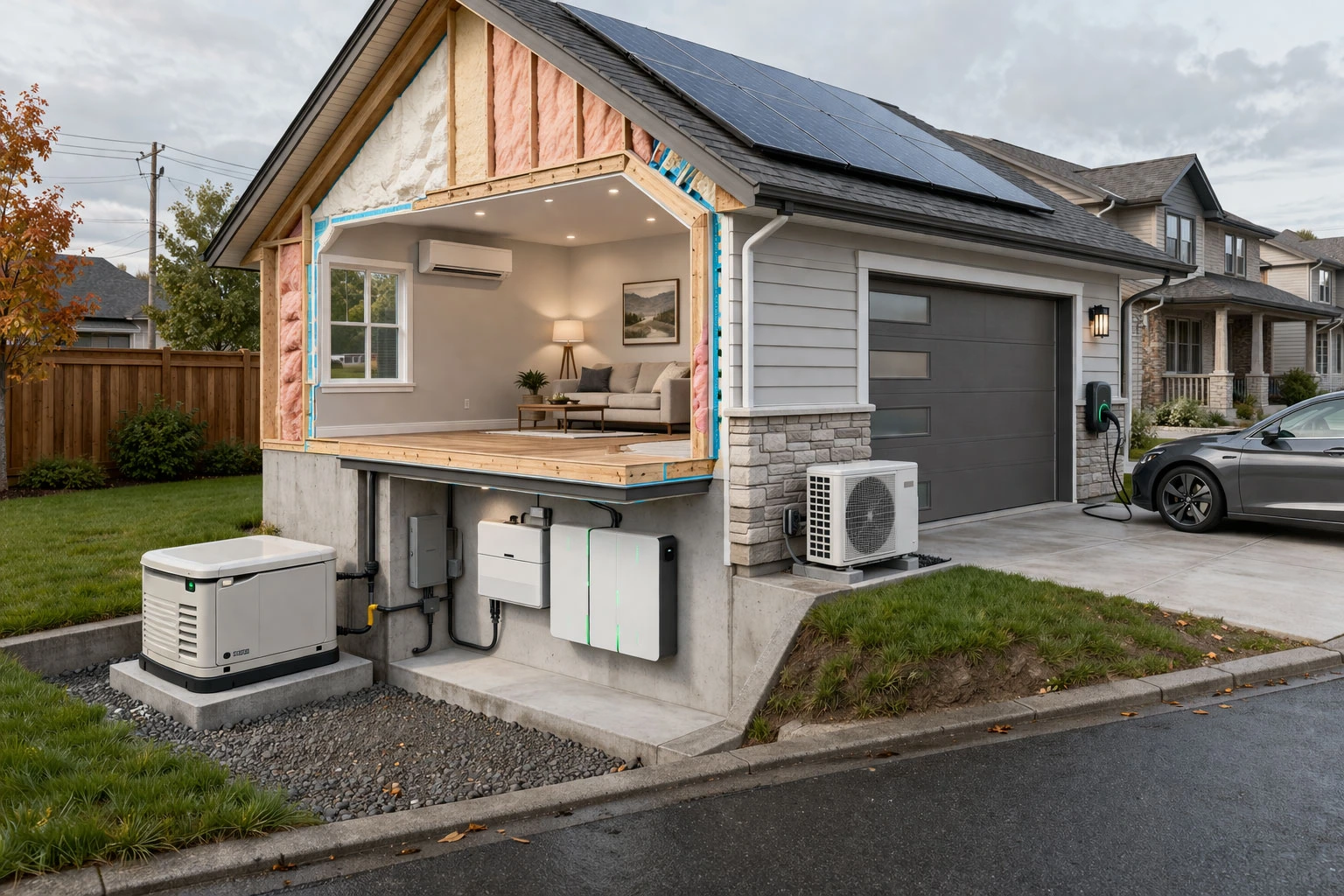
A whole home generator is a standby system that runs on natural gas, propane, or diesel. It automatically kicks in when the power goes out, supplying electricity to your entire home.
Key features:
- Automatic operation: Turns on within seconds of a power outage.
- Fuel source: Commonly natural gas (connected to your home line) or propane.
- Capacity: Can power your entire home, including high-demand appliances like electric furnaces and water heaters.
- Maintenance: Requires annual servicing and occasional fuel management.
Pros:
- Keeps everything running lights, heat, appliances, and HVAC.
- Ideal for long outages.
- Minimal lifestyle disruption.
Cons:
- Higher upfront cost.
- Noise and emissions (depending on fuel type).
- Installation requires professional work and permits.
Battery Backup Systems
Battery backup systems store electricity often paired with solar panels to power essential circuits during an outage. They usually operate silently and provide instant power.
Key features:
- Energy storage: Charges from your home electricity or solar panels.
- Instant switch-over: Provides power immediately during outages.
- Limited capacity: Typically powers essential circuits rather than the entire home.
- Maintenance: Minimal, mostly software updates and occasional checks.
Pros:
- Quiet, low-maintenance, and emission-free.
- Can integrate with solar for off-grid energy.
- Ideal for short outages or selective backup.
Cons:
- Limited energy for prolonged outages.
- Expensive for full-home coverage.
- Requires careful load management.
Cost Considerations: Canadian Context
When deciding between a generator and a battery backup, cost is often the first factor.
Whole home generator costs in Ontario:
- Typical units: CAD 6,000–15,000 for 14–22 kW systems.
- Installation: CAD 3,000–8,000 (including permits, electrical work, and propane/natural gas connection).
- Fuel: Depends on usage; natural gas is often cheaper than propane or diesel.
Battery backup system costs in Canada:
- Popular units (like Tesla Powerwall or LG Chem): CAD 12,000–25,000 installed for one or two batteries.
- Solar integration increases upfront costs but can reduce long-term energy bills.
- Minimal ongoing fuel costs since they rely on stored electricity.
Key takeaway: Generators are more cost-effective for full-home coverage, while battery systems are better for partial backup or solar integration.
Energy Savings and ROI
Battery systems paired with solar panels can reduce monthly electricity bills, potentially delivering a return on investment over 10–15 years. Whole home generators, while critical during outages, do not directly save energy costs unless paired with a smart energy management system.
Consider these examples:
- Battery with solar: Homeowner powers essential circuits during outages and reduces peak electricity costs. Potential ROI improves with Ontario’s net metering programs.
- Generator: Ensures uninterrupted comfort but doesn’t offset utility bills.
Common Mistakes Homeowners Make
Many homeowners jump into purchasing a backup system without considering these pitfalls:
- Overestimating needs: Buying a battery large enough for full-home coverage can be prohibitively expensive; sometimes selective circuit backup is sufficient.
- Ignoring fuel logistics: Propane generators require regular refills, which can be challenging during extended outages.
- Underestimating installation complexity: Generators require permits, concrete pads, and sometimes zoning approval.
- Neglecting future energy plans: Failing to consider future Net Zero or solar upgrades may result in a system that’s incompatible down the road.
Step-by-Step Decision Guidance
Here’s a practical guide for homeowners considering backup power:
- Assess your priorities: Do you need full-home coverage, or just essential circuits (lights, heat, fridge)?
- Evaluate outage frequency: Short, infrequent outages may favour battery backup; frequent long-term outages favour generators.
- Check fuel availability: Natural gas lines vs. propane storage.
- Consider integration with renewables: Battery systems can leverage solar panels, while generators can be combined with smart energy management.
- Calculate costs and ROI: Factor in installation, fuel, maintenance, and potential energy savings.
- Plan for permits and space: Generators need outdoor installation with clearances; batteries need indoor or garage space.
Ontario and Canada Rebate Programs
Homeowners in Ontario and across Canada may access programs that reduce the cost of energy-efficient upgrades, including battery storage and renewable energy integration. While amounts vary by municipality and utility, these incentives often include:
- Rebates for energy storage systems.
- Grants for solar-plus-battery installations.
- Programs that encourage off-grid resiliency as part of energy efficiency upgrades.
Checking with local conservation authorities or utilities is essential to see which incentives apply to your home.
When This Upgrade Makes Sense and When It Does Not
Whole home generator makes sense if:
- You experience frequent or prolonged outages.
- Full-home power is critical (e.g., medical equipment, remote work, elderly family members).
- You prefer a hands-off, automatic solution.
Battery backup makes sense if:
- You want a quiet, emission-free solution.
- Your home already has solar panels or plans to install them.
- You only need to power essential circuits.
- You value energy savings over full-home redundancy.
Avoid unnecessary upgrades if:
- Your power outages are extremely rare.
- You’re only interested in short-term savings without future-proofing energy systems.
- You cannot accommodate the installation space or fuel storage safely.
How Backup Power Fits Into a Net Zero Roadmap
For homeowners pursuing Net Zero or low-carbon goals, backup power is more than convenience it’s resilience.
Generators:
- Must be paired with carbon reduction strategies to align with Net Zero goals.
- Best used sparingly or with low-emission fuel alternatives.
Battery systems:
- Integrate naturally with renewable energy.
- Enable energy storage and load shifting to reduce reliance on fossil fuels.
- Complement heat pumps, EV chargers, and energy-efficient upgrades.
By planning backup power alongside insulation, smart HVAC, and solar, homeowners can maintain comfort while progressing toward Net Zero.
Conclusion
Choosing between a whole home generator and a battery backup system depends on your lifestyle, budget, outage risk, and energy goals. Generators offer full-home security during prolonged outages, while batteries provide silent, sustainable, and selective backup, particularly when paired with solar. By evaluating your priorities, understanding costs, and planning for energy efficiency, you can make a decision that meets both comfort and sustainability objectives.
For a tailored assessment of your home and a roadmap for integrating backup power into a Net Zero strategy, book a consultation with Net Zero Homes Consulting. Our experts will help you choose the right solution, maximize rebates, and future-proof your home’s energy resilience.